Founded in 1937, Quincy Medical Group (QMG) began as a small, physician owned clinic dedicated to serving the rural community of Quincy, Illinois. Nearly 90 years later, that same commitment to quality care by and for the community has fueled its growth into 18 locations across Illinois, Missouri, and Iowa—including the QMG Cancer Institute. Accreditation by the American Society of Clinical Oncology’s Quality Oncology Practice Initiative (ASCO QOPI) and supported by strong academic partnerships, QMG continues to push cancer care forward while honoring its longstanding legacy in the region.
The QMG Cancer Institute offers outpatient oncology/hematology, radiation oncology, and specialized breast cancer care. For treatments beyond these services, QMG partners closely with nearby hospitals, from small, suburban centers to large academic facilities like Siteman Cancer Center at Washington University. This combination of care settings ensures patients have access to providers and cutting-edge treatment options close to home.
Raymond Smith, MD, medical oncologist at QMG, describes the Cancer Institute’s partnership with hospitals as a “2-way street” and a “collaborative relationship.” When QMG has a patient who needs care the group does not offer, such as a bone marrow transplant or gynecologic oncology, it refers them to one of its partner hospitals. If a hospital has a patient who lives near Quincy and whose treatment could be provided by QMG, it sends them to the community oncologist. This allows the patient to receive their care closer to home. “What’s best for patients is best for all of us—our partners, our team, and our community,” said Dr. Smith.

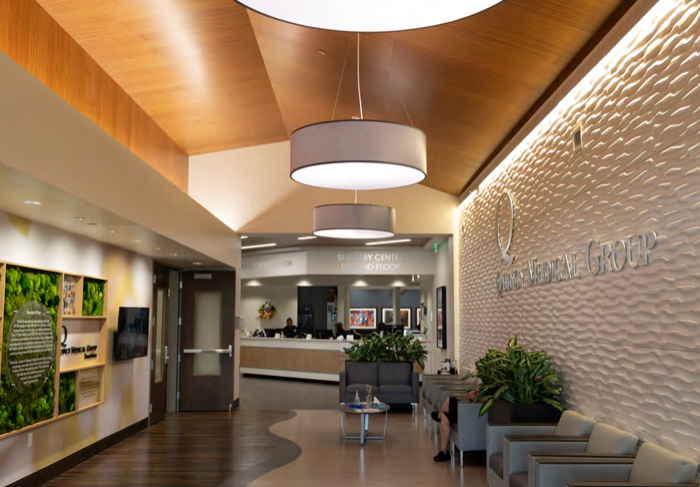
Quincy Medical Group Cancer Institute’s entryway and patient check-in area.
Cultivating a Community-Oriented Culture
Quincy, Illinois, home to approximately 40,000 residents, is a relatively big city for the region. Most of QMG’s patients live in more remote areas that are several hours away from a major hospital. Weather and wildlife—especially deer—pose serious risks for drivers in this area, making access to quality care close to home vital.
The catchment area of QMG’s 18 locations is geographically large, encompassing a population with an average age approximately 17 years older than the national average and a high proportion of farmers. The Cancer Institute primarily sees patients with breast, colon, and lung cancers, closely aligning with national trends, as well as what Dr. Smith estimates to be a higher-than-average rate of skin cancers due to the outdoor lifestyle of farmers.
The Cancer Institute employs a dietitian, a social worker, and financial counselors to support a variety of patient needs, while the QMG Foundation steps in to help fill any gaps. Through year-round fundraising efforts, the Foundation’s Oncology Patient Assistance Fund supports patients in cancer treatment by helping with essential living expenses such as rent, utilities, and transportation. The Foundation also funds The Beyond Shop, which provides wigs, head coverings, breast prosthetics, and comfort items in a salon-like environment—all free of charge for patients. Many individuals who benefit from the QMG Foundation’s resources later go on to become donors themselves, reflecting the community-centered culture at QMG and the gratitude patients and families feel for their care.

QMG Cancer Institute’s infusion room, with one-way windows overlooking the Quincy Town Center fountain court.


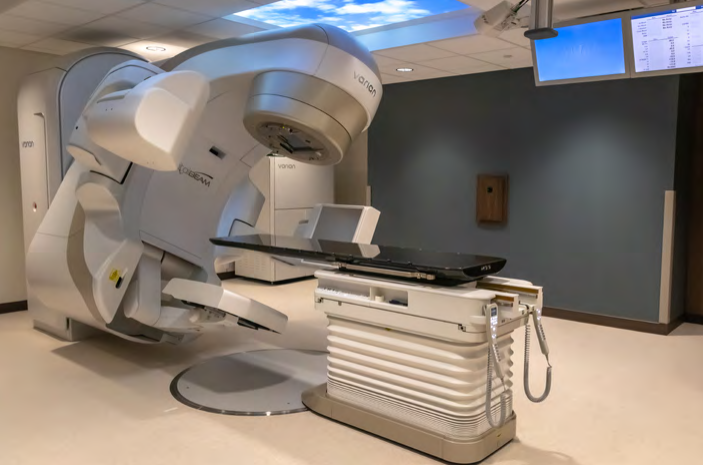
QMG Cancer Institute’s linear accelerator used in the Radiation Oncology department.
QMG Foundation steps in to help fill any gaps. Through year-round fundraising efforts, the Foundation’s Oncology Patient Assistance Fund supports patients in cancer treatment by helping with essential living expenses such as rent, utilities, and transportation.
The Foundation also funds The Beyond Shop, which provides wigs, head coverings, breast prosthetics, and comfort items in a salon-like environment—all free of charge for patients. Many individuals who benefit from the QMG Foundation’s resources later go on to become donors themselves, reflecting the community-centered culture at QMG and the gratitude patients and families feel for their care.
A Consistent Commitment to Quality, Compassionate Care
QMG is committed to exemplary care from the moment a patient is referred. It aims to schedule patients for their first appointment as quickly as possible so they can have their questions answered and begin accessing support services immediately. Dr. Smith explained that the goal is “to make them and their family as comfortable as possible in what’s often a very difficult circumstance.” The QMG Cancer Institute offers a comprehensive range of services, including labs, scans, radiation, chemotherapy, immunotherapy, and other cancer treatment-related services, all located in 1 building. There are 50 staff members, many of whom live in the area and have been working for QMG for several years. Patients see the same providers and front desk staff year after year, helping to foster trust, comfort, and a sense of community. Providers stay on the patient’s care team through the entire continuum of treatment, including hospice care. “We work with the hospice team so that the patient and families can still use the same numbers and the same contacts and [they] don’t feel like we’re abandoning them when things get really tough at the end,” Dr. Smith explained. He says greatest gratitude often comes from families during this stage of care, who deeply value QMG’s consistency and commitment to compassion.

The QMG Foundation’s Beyond Shop, funded by community donations, offers complimentary comfort items for patients.


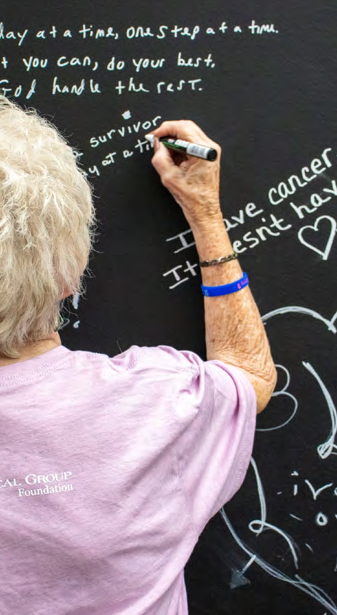
Messages of hope shared by patients, families, and friends line a wall in QMG Cancer Institute’s waiting area.
Embracing Innovation in a Rural Community
QMG stays abreast of the latest cancer therapies to provide the best possible care to its patients. Immunotherapy and other personalized treatments have improved outcomes for their patients in the past several years, with patients living longer and staying on treatments longer due to fewer adverse events. “Our ability to diagnose, treat, and monitor has never been more specific or more precise,” Dr. Smith said, yet QMG continues to strive for even better care.
QMG strongly supports patient participation in clinical trials and collaborates closely with its partner hospitals to facilitate the process. “When there’s a really good trial with a really good treatment that we don’t offer locally, we will do whatever we can to help,” Dr. Smith said. That help includes running labs locally, arranging telehealth visits to cut down on patient travel, and offering transportation assistance, all with a goal of reducing the burden on the patient.
The next step in QMG’s growth is the development of its own hospital. As many emerging cancer treatments require extended observation periods, having the infrastructure for inpatient care is essential. While QMG will continue to collaborate with its partner hospitals—as some services are only available at larger facilities—staff members are eager to expand local treatment options.
While Dr. Smith takes pride in QMG’s ability to offer cutting-edge treatments, he believes the greatest innovation lies in the collaboration between QMG, its patients, and its hospital partners. For the community, that collaboration translates into care that is both high quality and accessible, something patients and families deeply value. Many current and former patients refer their loved ones, bringing new patients to QMG through word of mouth and a strong reputation. It’s that kind of appreciation that makes physicians like Dr. Smith proud to be part of the team at QMG. “It’s a privilege to go out there and help those folks in their community,” he said.







An at-home option for cervical cancer screening breaks down barriers to care and offers the same level of precision as screening in the clinic.