Women’s health is a rapidly evolving domain that demands increasing attention, not only due to its inherent complexity and breadth but also because of its strategic alignment with one of the most vital service lines in health care: oncology. As cancer becomes more prevalent, particularly among women under age 50, health care systems are recognizing the need to develop integrated, patient-centered programs that address the full continuum of care from prevention to survivorship. This article explores the intersection between women’s health and oncology, identifying the current landscape, unique challenges, emerging trends, and strategic considerations required to build resilient and effective programs.
Epidemiological Trends and the Growing Burden of Disease
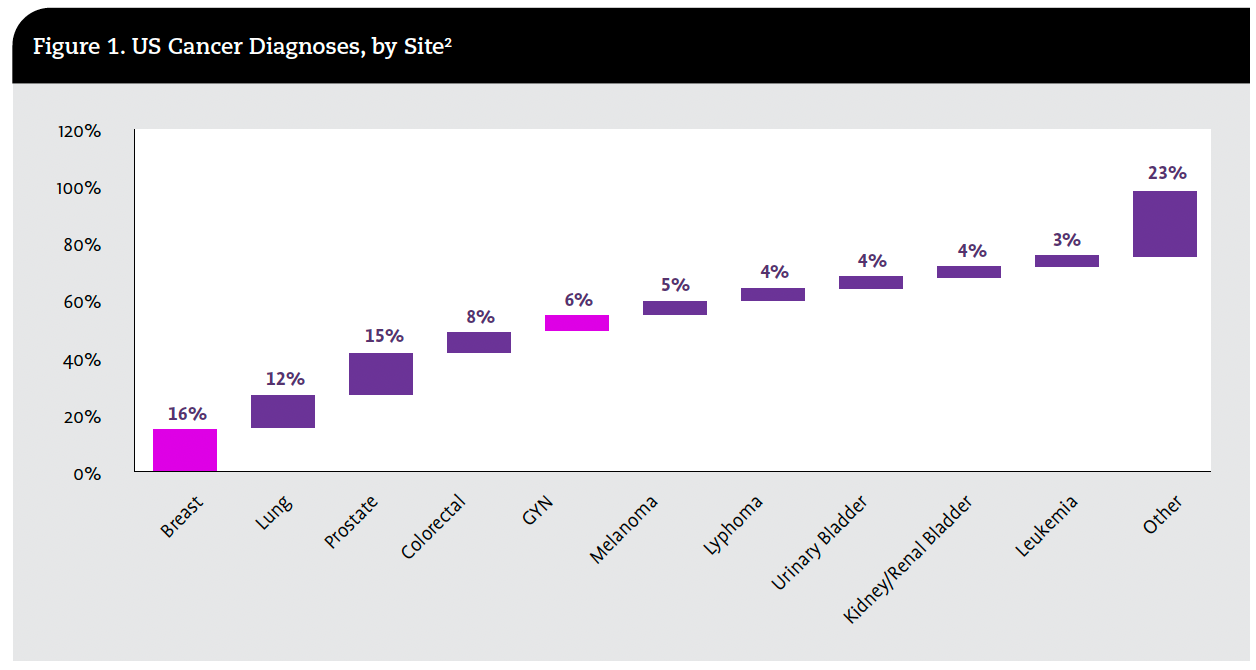
"According to data from the American Cancer Society and the Surveillance, Epidemiology, and End Results (SEER) program, breast and gynecologic cancers combined represent approximately 22% of all cancer diagnoses in the US (Figure 1).1,2 From 2023 to 2024, diagnoses for these cancers increased by over 4%, double the growth rate for all cancers combined."
One in 3 women in the United States will be diagnosed with cancer in her lifetime.3 The accelerating incidence, particularly among young and middle-aged women, is straining existing systems that are often ill-equipped to provide comprehensive, long-term care. While mortality rates have declined due to advances in detection and treatment, the increasing prevalence of cancer diagnoses in women under 50 high-lights a growing crisis that must be addressed through targeted intervention and resource allocation.
Utilization and Financial Impact: A Paradox of Growth and Underuse
Although the number of new cancer cases is increasing, utilization of key cancer treatments is paradoxically declining. This trend is attributed to the evolution of treatment protocols (eg, genomic profiling and risk stratification studies like the TAILORx clinical trial, NCT00310180), that have reduced the need for aggressive therapies in certain subpopulations.
From a financial standpoint, oncology remains one of the most profitable service lines for many health care systems. In some institutions, cancer care contributes over 50% of the total profit margin. However, not all tumor programs are of equal profitability or strategic value. Breast and gynecological cancers offer both clinical significance and financial opportunity, but also require thoughtful programmatic design to maximize returns while delivering high-quality care.
National Perspective: The Changing Landscape of Women’s Health
Women’s health encompasses a broad spectrum of services that span across a woman’s life cycle, including menstrual management, reproductive endocrinology, obstetrics, urogynecology, menopausal care, and beyond. Innovations in this field are accelerating, driven by a demand for personalized, whole-person care models. However, the sector is fraught with reimbursement challenges, especially given Medicaid’s leading role in obstetric coverage, which requires innovators to navigate 50 different state-based platforms. Additionally, many new care models remain limited to commercially insured or self-pay populations, which limits accessibility for a large swath of patients.
The sheer variety of solutions available to meet similar health needs has further complicated the landscape. Many offerings lack the historical performance data necessary to assess long-term viability, applicability, and sustainability. In this fragmented environment, the need for coordinated, longitudinal care is becoming increasingly clear, particularly as women traverse different stages of their health journey—from adolescence through reproductive years and into menopause and beyond.
The Women’s Health Lifecycle: A Continuum of Care
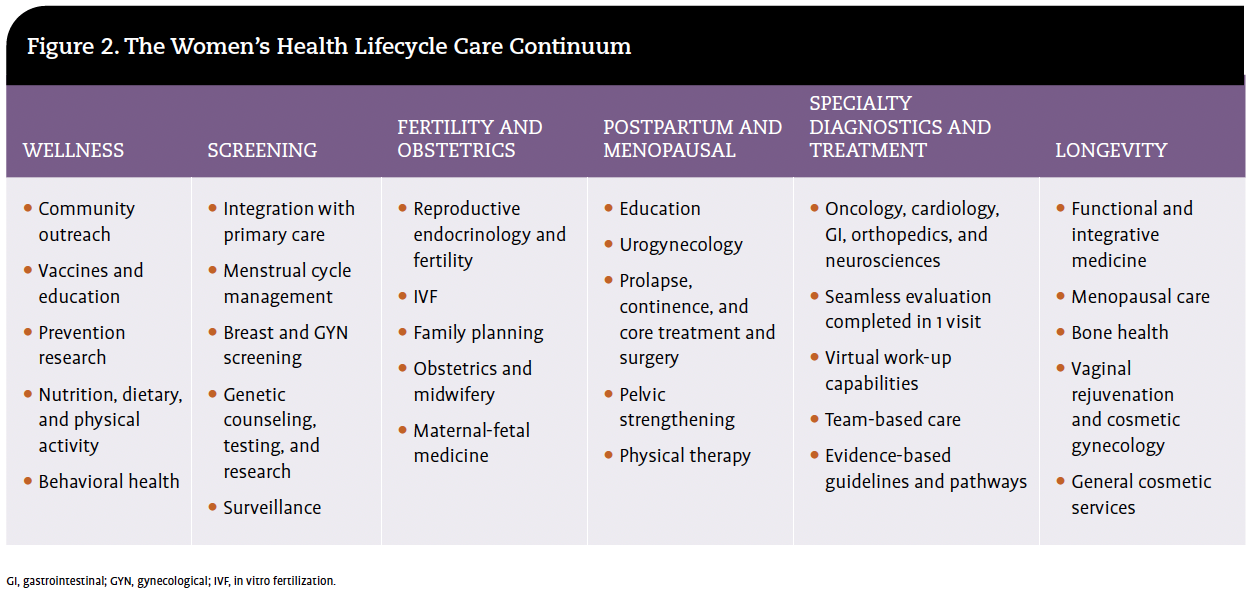
The continuum of women’s health care must address a wide range of services that intersect at key life stages. The women’s health lifecycle begins long before a cancer diagnosis (Figure 2). For many women, the first point of contact with the health care system is during pregnancy. But this “entry point” is just 1 chapter in a much longer story. From adolescence to menopause and beyond, women face a series of interconnected health events—each of which presents an opportunity for early detection, prevention, and education. This lifecycle-based approach reframes women’s health as a strategic front door to oncology. It encourages health care systems to think upstream, by investing in community outreach, wellness, and preventive care, and downstream, by integrating survivorship, mental health, and chronic disease management into long-term care models.
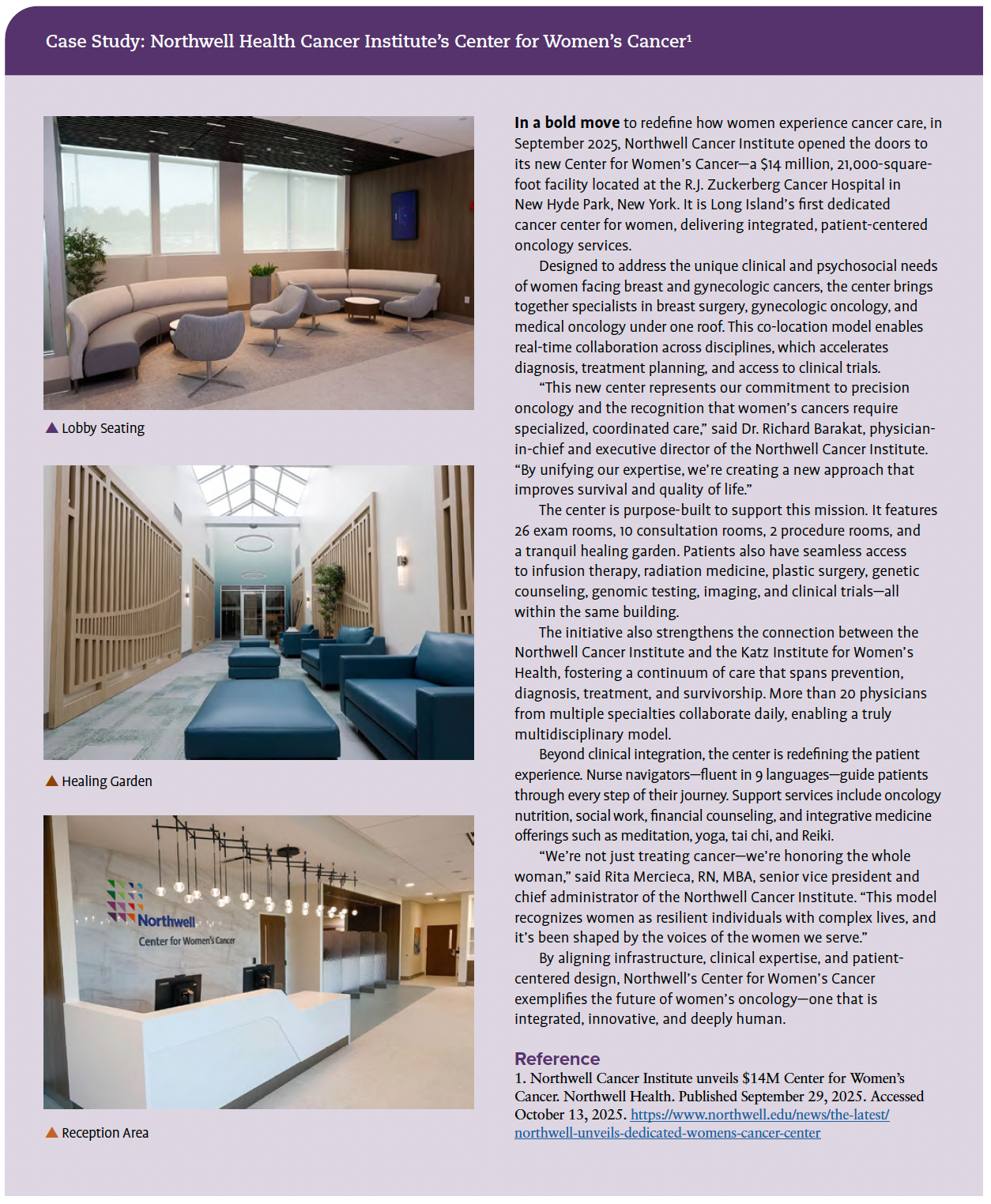
To get started, health care systems should map out these lifecycle touchpoints to identify where women are already engaging with the health system—OB/GYN visits, mammography, fertility care, menopause clinics—and assess how oncology services can be integrated or introduced at each stage. Another key requirement is a shift from episodic care to longitudinal models. A comprehensive model incorporates every point of connection with the health care system, from wellness and screening to specialty diagnostics and longevity. This holistic approach requires seamless integration with primary care, as well as robust infrastructure around care coordination, clinical best practices, social and financial counseling, and patient support services. Read on for a case study of how Northwell Health developed a women’s health hub that includes breast centers, gynecologic oncology, imaging, and survivorship services—under one roof.
Defining Women’s Oncology: A Critical but Underdeveloped Domain
Women’s oncology represents a distinct yet underdefined area within most health care systems. At its core, this service line comprises cancers that predominantly affect women—breast and gynecologic cancers—but the scope can vary significantly across organizations. As the burden of these diseases grows, the imperative for developing dedicated women’s oncology programs becomes increasingly urgent. Several features distinguish women’s oncology from general oncology:
- High disease burden. Breast and gynecological cancers are among the most commonly diagnosed cancers in the United States.
- Rising incidence in younger populations. Alarmingly, cancer rates in women under age 50 are now 82% higher than in men in the same age cohort.4
- Unique quality-of-life considerations. Onco-fertility, sexual health, body image, and mental health require nuanced, integrated care models.5,6
Given these characteristics, health care systems must move beyond traditional silos and develop comprehensive, patient-centered women’s oncology programs tailored to the clinical and psychosocial complexities of this population.
Strategic Alignment: Bridging Women’s Health and Oncology
The intersection of women’s health and oncology is rich with potential for innovation and differentiation. To optimize, programs must answer key questions to assess the opportunity:
- Financial impact. Are financial decisions impacting both oncology and women’s health sufficiently integrated and consensus-based?
- Clinical portfolio. Which clinical services and programs will be jointly managed by the oncology and women’s health services lines (eg, screening and diagnostics)?
- Network development. Are network development and expansion initiatives sufficiently coordinated between oncology and women’s health service lines?
- Service distribution. Are decisions around which services should be offered and where services should be offered sufficiently coordinated between oncology and women’s health services lines?
- Mission impact. Are there opportunities for oncology and women’s health to come together to advance the research mission?
- Operational innovation. Are there opportunities for oncology and women’s health to come together to advance operational innovation, for example, through a high-risk breast cancer program?
- Capital asset optimization. Do opportunities exist to cross-leverage capacity within oncology or women’s health when designing women’s oncology programs?
Strategic Levers for Integration and Impact
A combined approach between women’s health and oncology offers several key advantages—both strategic and operational. Health care systems must activate a set of strategic levers that enhance care delivery, operational efficiency, and long-term differentiation. These levers, when implemented in tandem, can transform fragmented services into a cohesive, patient-centered model. Here’s how:
- Shared infrastructure is foundational. Coordinated staffing, equipment, and support services not only improve operational efficiency but also elevate the patient experience. For example, co-locating services such as breast imaging, gynecologic oncology, and survivorship care within a single women’s health hub allows providers to “walk patients down the hall” to their next appointment. This model reduces fragmentation and improves continuity of care. Health care systems should begin by auditing.
- Cross-service synergies offer another powerful opportunity. Preventive care, screening, and survivorship services can be more effectively integrated when disciplines collaborate. As noted above, OB visits are often a woman’s first interaction with the health care system, making them a prime opportunity to introduce cancer risk assessments and education. To harness this synergy, organizations should develop shared protocols between OB/GYN and oncology for genetic counseling referrals, high-risk breast screening, and early detection strategies.
- Market differentiation is increasingly critical in a competitive health care landscape. Women are often the primary health care decision-makers for their families, and a seamless, lifecycle-based care model resonates deeply with this demographic. Health care systems can build unique value propositions targeting female health care decision-makers. This strategy builds trust and loyalty with female patients, which can have a multiplier effect across service lines and build long-term loyalty. To reap these benefits, health care systems should brand and promote women’s oncology programs as part of a broader whole-person care strategy—emphasizing convenience, personalization, and trust to attract and retain this influential consumer segment.
- Improved outcomes are a natural result of streamlined care pathways and joint clinical oversight. Multidisciplinary collaboration is key, particularly in managing complex cases such as cancer diagnoses during pregnancy. Shared decision-making protocols and integrated care planning are essential to delivering high-quality, consistent care. To support this effort, cancer programs should establish multidisciplinary care teams with shared governance structures that oversee women’s oncology pathways, including OB-oncology crossover cases and survivorship planning.
- Physician engagement is an often-overlooked pillar. Multidisciplinary teams thrive when supported by aligned incentives and shared leadership. Yet, joint strategic planning and budgeting between women’s health and oncology remains rare. To close this gap, health care systems should implement dyad leadership models and joint financial planning processes that align investments, foster collaboration, and ensure sustainability across both service lines.
Building Blocks for Comprehensive Programs
A successful women’s oncology program requires a multidimensional investment strategy built around the following pillars:
- Physician alignment. Many health care systems continue to operate with siloed service lines, where women’s health and oncology make independent decisions about imaging, diagnostics, and care pathways. To break down silos, organizations must invest in recruitment strategies, compensation models, and shared governance that support cross-specialty collaboration. Dyad leadership models—pairing clinical and administrative leaders from both service lines—can foster alignment and accountability across the continuum of care.
- Financial alignment. Joint budgeting and strategic planning between women’s health and oncology is critical. Women’s health services often struggle to justify investments on their own due to unfavorable reimbursement, particularly from Medicaid. However, when paired with oncology’s downstream revenue—such as infusion, surgery, and radiation—the combined business case becomes compelling. Programs that leverage the 340B Drug Pricing Program and align financial incentives across service lines are better positioned to fund supportive services and infrastructure that benefit both domains.
- Technology and infrastructure. Successful organizations are redesigning how they deliver health care services to women. Investment in virtual care platforms, AI-powered diagnostics, and co-located facilities is critical. The rise of virtual lactation consultants, remote midwifery, and digital care navigation tools reflects a broader trend toward tech-enabled, patient-centric care. Health systems must prioritize infrastructure that supports seamless transitions among services—such as breast imaging, gynecologic oncology, and survivorship care—within a single, integrated hub. Investment in virtual care, diagnostic technologies, and dedicated facilities is crucial for enhancing both the provider and patient experience.
- Patient-centered experience. Navigation, counseling, and survivorship planning are vital to holistic care. Navigation is a top priority for organizations. With health care becoming increasingly complex, patients need dedicated guides to help them manage appointments, treatments, and decisions. A benchmark of 1 nurse navigator per 300 new cancer cases is recommended, with additional support from social workers, financial counselors, and genetic counselors. These roles are especially critical in women’s oncology, where quality-of-life issues—such as fertility, body image, and mental health—require nuanced, longitudinal support.
- Research and innovation. Successful organizations ensure ongoing evolution and improvement. Clinical trials, registries, and data analytics not only improve outcomes but also differentiate programs in competitive markets. As cancer incidence rises among younger women, the need for precision medicine, onco-fertility research, and inclusive care models becomes even more urgent. Health care systems must invest in infrastructure and partnerships that support cutting-edge discovery and rapid translation into practice.
Ultimately, these elements must coalesce into a seamless continuum that supports patients from prevention through diagnosis, treatment, and survivorship.
Concluding Thoughts
The convergence of women’s health and oncology represents a critical frontier for health care system transformation. By developing cohesive women’s oncology programs, institutions can address existing service gaps, improve health outcomes, differentiate in crowded markets, and strengthen their financial position. The future of women’s health lies in coordinated, multidisciplinary care models that recognize the unique needs of female patients across the lifespan—and nowhere is this more urgent or promising than in oncology.
Tessa Kerby, MBA, MPH, is a principal, and Matt Cox, MPH, is a partner at Whitecap Health Advisors, LLC.
References
- Cancer stat facts: female breast cancer. NCI: SEER. Accessed October 13, 2025. https://seer.cancer.gov/statfacts/html/breast.html
- Cancer stat facts: cancer of any site. NCI: SEER. Accessed October 13, 2025. https://seer.cancer.gov/statfacts/html/all.html
- Cancer facts & the war on cancer. NCI: SEER. Accessed October 13, 2025. https://training.seer.cancer.gov/disease/war/
- ACS annual report: cancer mortality continues to drop despite rising incidence in women; rates of new diagnoses under 65 higher in women than men. American Cancer Society. Published January 16, 2025. Accessed October 13, 2025. https://pressroom.cancer.org/2025CancerFactsandFigures
- Dreibelbis N, Dorne J. Addressing the unmet need of sexual health in oncology patients. Oncol Issues. 2024;39(3):15-23.
doi:10.3928/25731777-20240710-04 - Multidisciplinary approaches to addressing the needs of patients with gynecologic cancers: a call-to-action summit. Association of Cancer Care Centers. Oncol Issues. 2024;39(1):56-61. https://www.accc-cancer.org/docs/documents/oncology-issues/articles/2024/v39-n1/v39-n1-multidisciplinary-approaches-to-addressing-the-needs-of-patients-with-gynecologic-cancers-a-call-to-action-summit.pdf?