Author(s):
Radon is a naturally occurring gas that enters buildings through porous foundations, crawl spaces, and other openings. The World Health Organization,1 the International Agency for Research on Cancer,2 and the Environmental Protection Agency (EPA)3 have all recognized radon as a known human carcinogen. Exposure to radon is the second-leading cause of lung cancer in the US and the leading cause of lung cancer in nonsmokers, causing more than 21,000 lung cancer deaths per year.3 Over 5400 people in Missouri are diagnosed with lung cancer each year, with the state ranking No. 6 in the nation in lung cancer cases and deaths.4 Thirty-three percent of all tested Missouri homes contain more than the US EPA action level of 4.0 pCi/L, and 49 of 115 counties are rated as high risk due to average radon levels at or above 4.0 pCi/L.5 The Missouri Environmental Public Health Tracking program in the Missouri Department of Health and Senior Services (MODHSS) has published a publicly accessible radon dashboard, reflecting that 1 in 3 Missouri homes has elevated radon levels.6 However, a closer look at the data reveals that 33.7% of homes tested in Missouri showed elevated levels of radon, and it is not surprising that many of the counties with high percentages of elevated test results also experience lung cancer incidence and mortality rates higher than the national averages.6 Fortunately, mitigating high levels of radon gas in homes is a relatively simple and highly effective process.7
Several professional organizations have published best practices for radon testing and mitigation, although most localities and states have not codified or put into policy these best practices.8 There are no federal laws or mandates for radon testing or mitigation, though federal agencies have participated in the issuance of consensus standards.8 There is considerable variation in the implementation of consensus standards across states and localities. Forty states have some form of indoor air quality law pertaining to radon,9 with most states encouraging but not requiring best practices. Maine is the only state to codify a gold standard radon testing and mitigation program to encourage increased rates of testing and mitigation.10 Missouri does not have any state-level policy for radon detection or mitigation.
The knowledge gap between the general public and radiation experts illustrates a clear need to develop and plan strategies that improve communication to a broad range of stakeholders regarding the potential negative health impacts of radon exposure.11
The role of radon in causing cancer appears poorly understood in the general population. A recent systematic review of radon risk perception, awareness, and knowledge compared perceptions of radon risk with other sources of radiation risk (ie, x-rays and nuclear energy) and viewed natural radon gas exposure as low risk.11 A survey of 995 individuals in Illinois, Ohio, Minnesota, and North Carolina examined radon knowledge among homebuyers and found that real estate agents and home inspectors remain the predominant source of information regarding radon, and homebuyers who learned about radon-related health issues were 2 to 4 times more likely to test their home for radon.12 Radon education is a critical first step toward increasing radon awareness and the use of existing radon testing resources. Interventions to increase awareness of radon risk and control strategies include:
The knowledge gap between the general public and radiation experts illustrates a clear need to develop and plan strategies that improve communication to a broad range of stakeholders regarding the potential negative health impacts of radon exposure.11
The purpose of this project was to form a group of cancer prevention experts with the aim of increasing radon testing and mitigation through community outreach, education, and advocacy.
Getting Started
In 2021, the Missouri Lung Cancer Coalition, the American Lung Association in Missouri, and the Missouri Cancer Consortium formed a partnership to establish the Radioactive Radon Reduction Team (Radon Reduction Team), aiming to address radon exposure across Missouri. Other early partners included MODHSS, the Alvin J. Siteman Cancer Center, the Hope Light Foundation, the Heartland Chapter of the Indoor Environments Association (formerly the American Association of Radon Scientists and Technologists), and the St Louis County Library. In 2022, the University of Missouri– Columbia (MU) and the Ellis Fischel Cancer Center joined the coalition’s radon outreach efforts, significantly expanding initiatives through collaborations with the MU Extension offices and the Department of Family and Community Medicine. In 2025, licensed public health agencies became active partners in distributing radon awareness materials, further strengthening the coalition’s statewide impact. These strong partnerships ultimately resulted in the development of the Missouri Radon Risk Reduction model described below.
Radon Education and Awareness Interventions
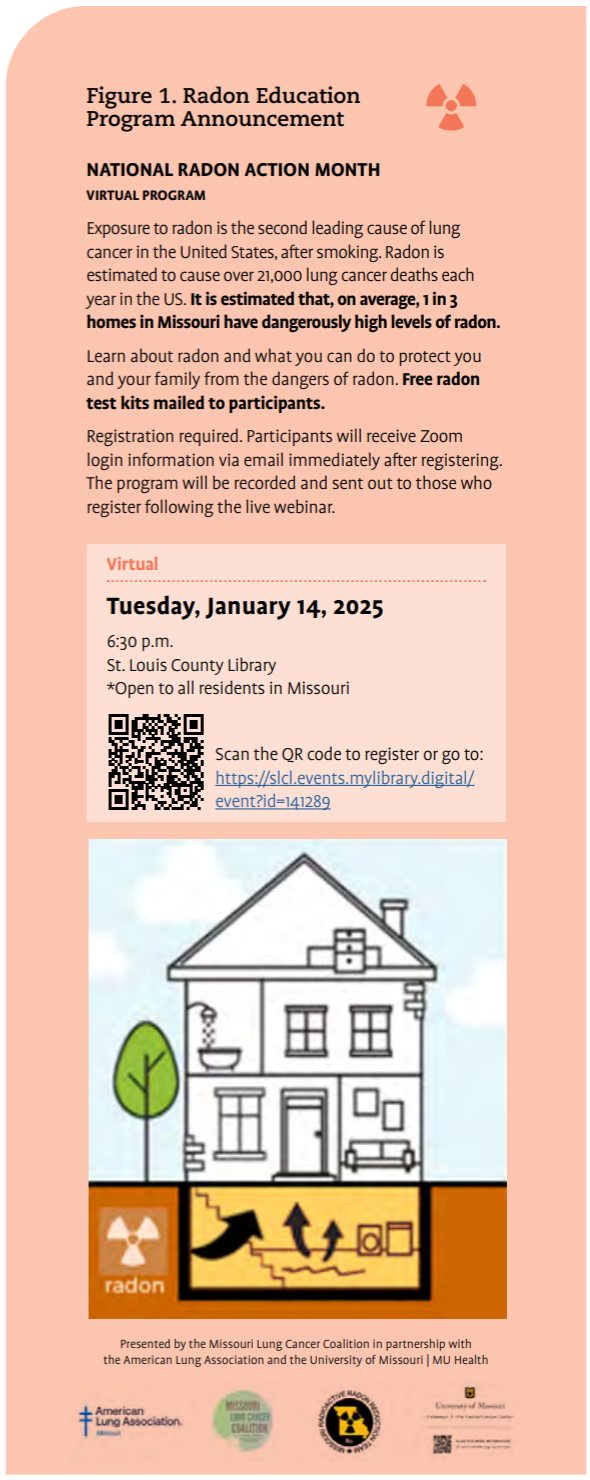
Beginning in January 2021, the Missouri Lung Cancer Coalition and the Radon Reduction Team began hosting National Radon Action Month educational webinars through a partnership with the American Lung Association and the St Louis County Library (Figure 1). Live webinars are hosted every January, featuring radon experts and individuals directly affected by lung cancer and radon. Panelists present an overview of radon, the health risks associated with radon exposure, and the benefits of home testing and mitigation when radon gas is detected. These webinars are open to the public, and local health care professionals who attend receive targeted information to share with their patients.
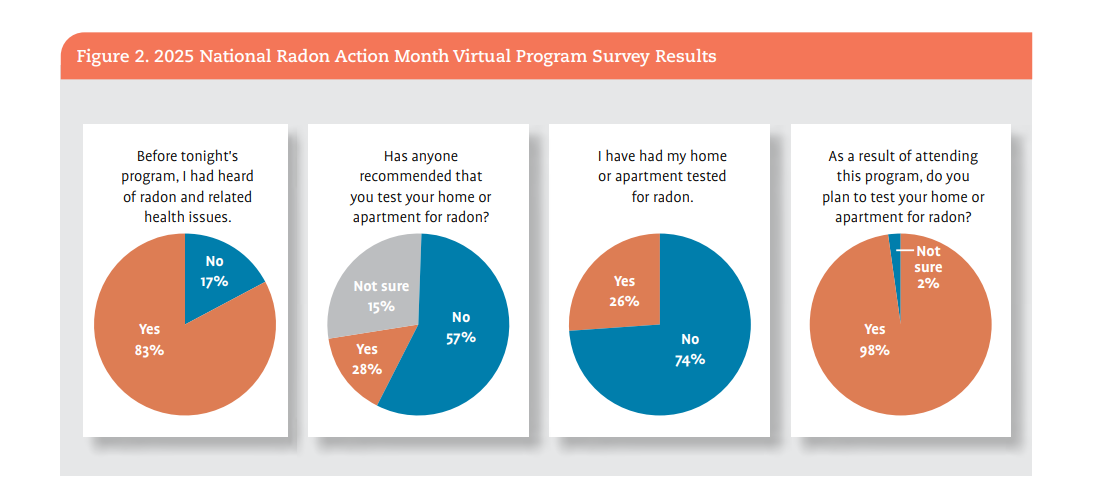
These National Radon Action Month webinars reached a total of 178 live attendees in 2024 and 2025, with numerous additional views of the recorded sessions. A 2025 survey gathered feedback from attendees (Figure 2). Only 26% of respondents reported having previously tested for radon.
After attending the session, 98% of respondents indicated plans to complete radon testing. Notably, the Missouri radon program observed a substantial increase in requests for free radon test kits on its website immediately following the webinars, although it was not possible to directly assess whether webinar attendees made these requests.

In 2022, the Missouri Lung Cancer Coalition identified counties with the highest incidence of lung cancer and contacted partners in each of these locations to include the University of Missouri. Tailored health education materials in the form of bookmarks were created to educate Missouri residents about radon and available resources. These bookmarks were distributed in local libraries. Bookmarks contained information about how to contact the MODHSS radon program and request a free radon test kit.
In 2023 and 2024, bookmark distribution involved mailing bookmarks to MU Extension offices statewide, with community health specialists placing them in local county libraries. In 2025, MODHSS replicated this approach, distributing bookmarks through local public health departments.
Over 70,000 bookmarks have been distributed to date. Of these, 30,000 were sent to libraries in 2022-2023 and 31,500 in 2023-2024. Local public health agencies (n=115) received 5750 bookmarks. Additional distributions included 500 to the Heartland Chapter of the Indoor Environments Association, 400 to the MODHSS Radon Department, 400 to the Lung Cancer Connections’ annual Run Walk Breath Lung Cancer Walk, 300 to the American Lung Association’s local events, 200 to the St Louis County health department, and 200 for Radon Day at the Capitol.
In 2024, the Missouri Lung Cancer Coalition expanded dissemination of factual radon information through social media campaigns promoting bookmarks and testing resources via its website. Platforms included Facebook, Instagram, YouTube, LinkedIn, and the American Lung Association. Key metrics included the following:
In 2025, webinar advertisements led to 76,380 impressions and reached 41,117 accounts, increasing visibility for webinars and further promoting focus on the Missouri Lung Cancer Coalition website.
Throughout these efforts, the Radon Reduction Team worked closely with the MODHSS Bureau of Environmental Epidemiology to increase awareness of statewide radon resources through Radon Awareness Month webinars and bookmarks. Each educational tool included the Missouri radon program phone number and website for detailed information or to request a free radon test kit.
Radon Testing Policy and Advocacy
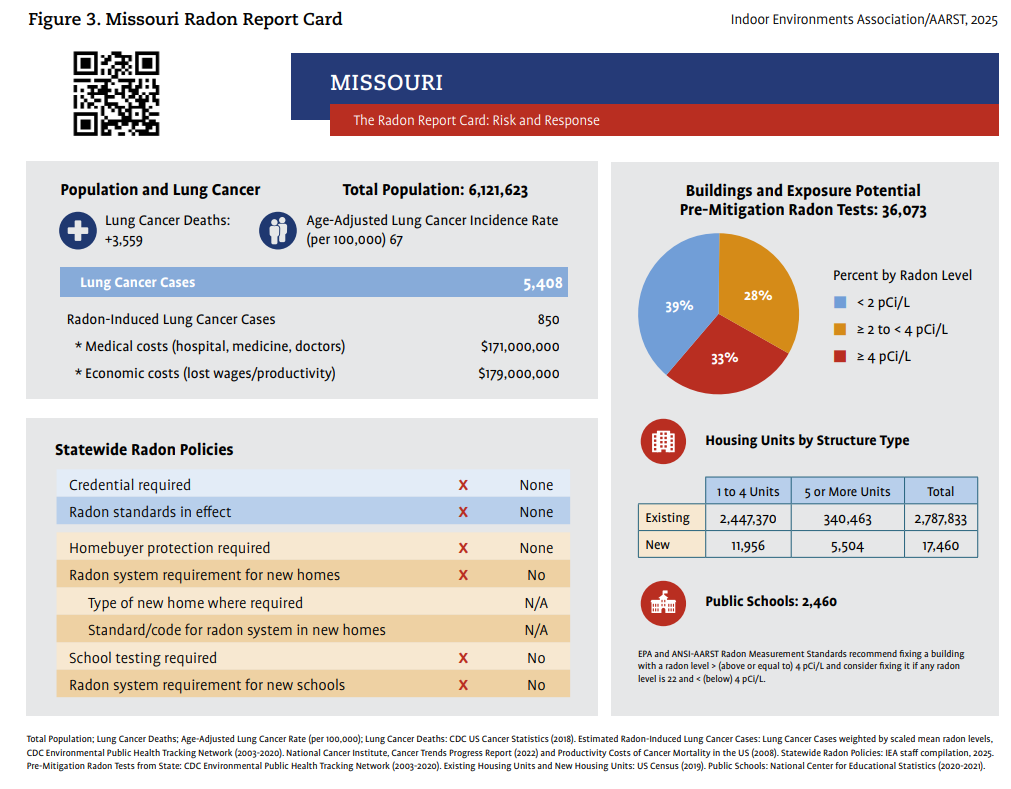
The Missouri Lung Cancer Coalition’s education efforts have increased demand for professional radon services. The Radon Reduction Team used the Missouri Radon Report Card (Figure 3)14 to illustrate identified gaps in Missouri’s statewide radon policies, including a lack of radon testing standards and a lack of credentials for individuals testing and mitigating identified problems. (Missouri has a relatively small number of radon test and mitigation professionals with any form of certification, with only 12 of 114 counties having contractors certified by the National Radon Safety Board.)

In 2024, the Radon Reduction Team helped craft Missouri House Bill 2451 (HB 2451), which requires training, certification, and state licensing for radon professionals providing measurement, inspection, and radon mitigation services in Missouri residences. Members of the Radon Reduction Team organized and attended Radon Day at the Capitol on January 30, 2024, reaching 85 individuals with radon education and advocacy for radon testing. The team met with multiple elected representatives, identifying 2 initial bill sponsors—1 from each party—and submitted a draft bill for introduction. HB 2451 was sent to committee for consideration but did not advance to the second reading or floor debate.
During the 2025 Radon Day at the Capitol, the Radon Reduction Team had 72 engagements and identified legislators for education outreach, including representatives on key committees such as the division of Professional Registration. Prior to the event, the Radon Reduction Team conducted advocate trainings and scheduled 17 meetings with legislators. These meetings included dissemination of the draft bill and the Missouri Radon Report Card (Figure 3). A bill was reintroduced for the 2025 legislative session under Missouri HB 88115 and HB 83616 with bipartisan support, and a committee hearing with the division of Professional Registration was held on April 23, 2025. The bill is currently being revised and will be resubmitted for the next legislative session based on feedback received during the hearing.
Discussion
Raising awareness about radon as a significant risk factor for lung cancer, particularly among nonsmokers, will lead to more radon testing and mitigation efforts and can ultimately decrease deaths from lung cancer. This project highlights the benefits of bringing together cancer prevention experts and organizations to plan and evaluate education events, identify knowledge and policy gaps, and engage in advocacy for policy adoption that complies with evidence-based practices. The Radon Reduction Team, while executing numerous public education interventions, built knowledge and experience to formalize radon health policy change advocacy efforts.

An important lesson learned during The Radon Reduction Team implementation is to develop outcome tracking mechanisms for appropriate evaluation at the beginning of the project. In addition, an unforeseen challenge included not having a physician available during the house bill hearing to answer medically related questions. Future Radon Reduction Team plans include the following:
Conclusion
Coordinated efforts during National Radon Action Month are an effective way to increase awareness of radon and build momentum to support ongoing outreach and education efforts year-round. Furthermore, a partnership that can deliver a range of education interventions to the public can also be used to advocate for policy change. Policy adoption based on evidence-based science is the culmination of translational science endeavors with significant public health benefit.
Through the combined efforts of multiple organizations and individuals, the Missouri Lung Cancer Coalition and the Radon Reduction Team have successfully enacted multiple evidence-based interventions in support of the Missouri Cancer Control Program. Cross-collaboration among health care systems, coalitions, and nonprofit health-focused organizations is key when it comes to increasing radon awareness and access to reliable testing and mitigation resources. The lack of knowledge about the risks of radon is not unique to Missouri; therefore, the collaborative efforts embodied in the Missouri Radon Risk Reduction model can be synthesized and replicated by other states, organizations, coalitions, and initiatives.
Misty Phillips, MSW, MBA, CTTS, is the manager of research activities of Family and Community Medicine at the University of Missouri, a member of the Ellis Fischel Cancer Center Advisory Board, and vice chair of the Missouri Cancer Consortium. Sarah Chavez, PhD, is the assistant director of Community Outreach and Engagement at the Alvin J. Siteman Cancer Center and serves as the chair of the Prevention Subcommittee for the Missouri Cancer Consortium. Bettina Drake, PhD, is a cancer epidemiologist and the Michael F. Neidorff Professor of Surgery in the Division of Public Health Sciences at Washington University School of Medicine. She is also the associate director of Community Outreach and Engagement at Siteman Cancer Center. Rachel Sanford, MSW, LCSW, CTTS, is the health promotions manager for the American Lung Association in Missouri, dedicated to preventing and addressing lung diseases. Alison Thornton, BS, is the executive director at Lung Cancer Connection, whose mission is to raise awareness, increase patient and caregiver support, and advocate for the prevention, early detection, treatment, and research of lung cancer. Kevin D. Everett, PhD, is professor and research director of Family and Community Medicine at the University of Missouri and associate director of Cancer Prevention, Control, and Community Outreach at Ellis Fischel Cancer Center.
References





An at-home option for cervical cancer screening breaks down barriers to care and offers the same level of precision as screening in the clinic.