
ACCC association of cancer care centers
Join/Renew
Login
Join/Renew
Login
Education & Resources
ACCC eXchange LogInCorporate Member Sponsored ResourcesPresentations & AbstractsPresident's ThemeACCC Connect eLearning LogIn
Publications
Oncology IssuesPatient Assistance & Reimbursement GuideTrending Now in Cancer Care
Events
2026 ACCC Leadership SummitAnnual Meeting & Cancer Center Business SummitCapitol Hill DayNational Oncology ConferenceOncology Reimbursement MeetingsOncology State Society Meetings
Policy & Advocacy
2024 Policy Wrap-Up and ACCC 2025 Policy PrioritiesLetters & StatementsAccess, Payment & Reimbursement ReformWhite Bagging & Brown BaggingAdvocacy ResourcesCancer Moonshot
Membership
Join | RenewWho We AreMembership Types & BenefitsCorporate MembersACCC Member Portal FAQMember Directory
Partners
Oncology State SocietiesPartner OrganizationsCME
News
News ReleasesAdvocacy News ReleasesOncology News
About ACCC
Timeline / 50th Anniversary2025 Impact ReportACCC Innovator AwardsACCC FellowsACCC Senior Staff
Breast CancerMetastatic Breast Cancer
Gastrointestinal CancerBiliary Tract CancerColorectal CancerGastric CancerLiver Cancer
Genitourinary CancerBladder CancerProstate CancerRenal Cell Carcinoma
Gynecologic CancerOvarian Cancer
Head & Neck Cancer
Hematologic MalignanciesAcute Lymphocytic Leukemia (ALL)Acute Myeloid Leukemia (AML)Chronic Lymphocytic Leukemia (CLL)Mantle Cell Lymphoma (MCL)Multiple Myeloma (MM)Myelodysplastic Syndromes (MDS)
Lung CancerNon-Small Cell Lung Cancer (NSCLC)Small Cell Lung Cancer (SCLC)
Sarcoma
Skin CancerMelanomaNon-Melanoma Skin Cancers (NMSC)
Clinical Practice & TreatmentCancer DiagnosticsCare CoordinationEHR Integration for Biomarker TestingQuality Improvement Collaboration: Integration of Precision Medicine in Community OncologyTreatment
Financial NavigationFAN Boot CampFinancial Advocacy Network (FAN) Resource LibraryPatient Assistance & Reimbursement GuidePrior Authorization
Health Equity & Access3, 2, 1, Go! Practical Solutions for Addressing Cancer Care DisparitiesAppalachian Community Cancer AllianceOncology Advanced PractitionersPersonalizing Care for Patients of All BackgroundsSocial Drivers of Health
Patient-Centered CareAddressing Care Disparities for VeteransAdolescent and Young Adult (AYA)Care Action Plans for People with CancerDermatologic ToxicitiesEmpowering CaregiversGeriatric OncologyHealth LiteracyNutritionOncology PharmacyPatient NavigationPsychosocial Care in OncologyShared Decision-MakingSupportive CareSurvivorship Care
Practice Management & OperationsCancer Program FundamentalsLeadership Sustainment and Engagement VideosOncology Practice Transformation and Integration CenterOncology Team Resiliency
ResearchACCC Community Oncology Research Institute (ACORI)
Technology & InnovationTelehealth & Digital Medicine
ACCCBuzz Blog
CANCER BUZZ Podcast
Oncology Issues
Join/Renew
Login
Breast CancerMetastatic Breast Cancer
Gastrointestinal CancerBiliary Tract CancerColorectal CancerGastric CancerLiver Cancer
Genitourinary CancerBladder CancerProstate CancerRenal Cell Carcinoma
Gynecologic CancerOvarian Cancer
Head & Neck Cancer
Hematologic MalignanciesAcute Lymphocytic Leukemia (ALL)Acute Myeloid Leukemia (AML)Chronic Lymphocytic Leukemia (CLL)Mantle Cell Lymphoma (MCL)Multiple Myeloma (MM)Myelodysplastic Syndromes (MDS)
Lung CancerNon-Small Cell Lung Cancer (NSCLC)Small Cell Lung Cancer (SCLC)
Sarcoma
Skin CancerMelanomaNon-Melanoma Skin Cancers (NMSC)
Clinical Practice & TreatmentCancer DiagnosticsCare CoordinationEHR Integration for Biomarker TestingQuality Improvement Collaboration: Integration of Precision Medicine in Community OncologyTreatment
Financial NavigationFAN Boot CampFinancial Advocacy Network (FAN) Resource LibraryPatient Assistance & Reimbursement GuidePrior Authorization
Health Equity & Access3, 2, 1, Go! Practical Solutions for Addressing Cancer Care DisparitiesAppalachian Community Cancer AllianceOncology Advanced PractitionersPersonalizing Care for Patients of All BackgroundsSocial Drivers of Health
Patient-Centered CareAddressing Care Disparities for VeteransAdolescent and Young Adult (AYA)Care Action Plans for People with CancerDermatologic ToxicitiesEmpowering CaregiversGeriatric OncologyHealth LiteracyNutritionOncology PharmacyPatient NavigationPsychosocial Care in OncologyShared Decision-MakingSupportive CareSurvivorship Care
Practice Management & OperationsCancer Program FundamentalsLeadership Sustainment and Engagement VideosOncology Practice Transformation and Integration CenterOncology Team Resiliency
ResearchACCC Community Oncology Research Institute (ACORI)
Technology & InnovationTelehealth & Digital Medicine
ACCCBuzz Blog
CANCER BUZZ Podcast
Oncology Issues
    • Education & Resources
    • Publications
    • Events
    • Policy & Advocacy
    • Membership
    • Partners
    • News
    • About ACCC
ACCC association of cancer care centers
1801 Research Boulevard, Suite 400, Rockville, MD 20850
Tel: 301.984.9496 Fax: 301.770.1949 Email Us
Contact UsVolunteers
Advertise
Career Center
Terms and Conditions
Privacy Policy
ACCC Rebranding
Copyright © 2026 Association of Cancer Care Centers. All Rights Reserved.
Web Header
Advertisement
Home / Education And Resources / Patient Centered Care / AYA Resources

ADOLESCENT AND YOUNG ADULT (AYA) SERVICES

National Comprehensive Cancer Network (NCCN) Guidelines define an adolescent and young adult (AYA) oncology patient as an individual between 15 and 39 years of age at the time of initial diagnosis. These guidelines state that AYAs develop different cancers than other age groups; this patient population also has unique needs around treatment and survivorship.

According to NCCN more than 700,000 AYAs are diagnosed with cancer annually in the U.S., accounting for 5 out of 100 new cancer diagnoses and 2 out of 100 cancer deaths.

The American Cancer Society calls attention to issues that can uniquely affect young adults with cancer including:

  • Delays in diagnosis
  • Communication challenges with providers unaccustomed to treating patients in this age range
  • Financial issues, including lack of or limited insurance coverage
  • Social and emotional concerns specific to adolescents and young adults

Several recent studies report a continued increase in diagnosis of colorectal cancer in individuals younger than age 50 in the U.S., and that younger adults are being diagnosed with more advanced disease.1-3

A recent observational study by Sung and colleagues found increased risk of obesity-linked cancer in the younger adult population. Researchers found that individuals born around 1985 had a 2 to 5 times increased risk for kidney, gallbladder, pancreatic, and endometrial cancers—almost double the risk for colorectal cancer and about 1.5 times the risk for multiple myeloma--compared to those born around 1950.4

Explore resources from ACCC to help cancer care providers better serve the unique needs of AYA patients with cancer:

From the ACCCBuzz Blog

Childhood Cancer: A Journey Beyond Treatment

Childhood Cancer: A Journey Beyond Treatment

Sep 20th 2024

Childhood cancer, although rare, remains the leading cause of death by disease in children under the age of 15 years. Despite its rarity, the impact of the disease in young people is long-lasting, with challenges extending well beyond the completion of treatment.
ACCC Recognizes July as Sarcoma and Bone Cancer Awareness Month

ACCC Recognizes July as Sarcoma and Bone Cancer Awareness Month

Jul 16th 2024

ACCC recognizes July as Sarcoma and Bone Cancer Awareness Month.

Stethoscope on One Hundred Dollar Bill with Arrows_ACCCBuzz_Square

Cancer's Economic Impact Among Adolescents and Young Adults

Apr 4th 2023

The rising costs of anti-cancer treatment in the United States have placed adolescents and young adults with cancer at an increased risk for financial toxicity.

2022-amccbs-blog-240x160

Recap: ACCC’s 48th Annual Meeting and Cancer Center Business Summit, Part 1

Mar 9th 2022

ACCC convened its members, sponsors, and industry partners in person (for the first time since the dawn of the COVID-19 pandemic) and online for the 48th Annual Meeting and Cancer Center Business Summit in Washington, D.C., enabling more people to participate in ways in which they were most comfortable.

Lilibeth Torno Headshot

The Role of Community Partners in Serving AYA Patients

Apr 1st 2021

Poor access to care among AYA patients is not only evident in low clinical trial enrollment. The struggle to access much-needed care continues when treatment concludes. Most AYA cancer survivors must learn to navigate follow-up medical care on their own.

Jenna Benn Shersher at BWC Chicago 2020 (1)

Twisting Out Cancer

May 18th 2020
More Adolescent and Young Adult (AYA) Services Blog Posts

From Oncology Issues

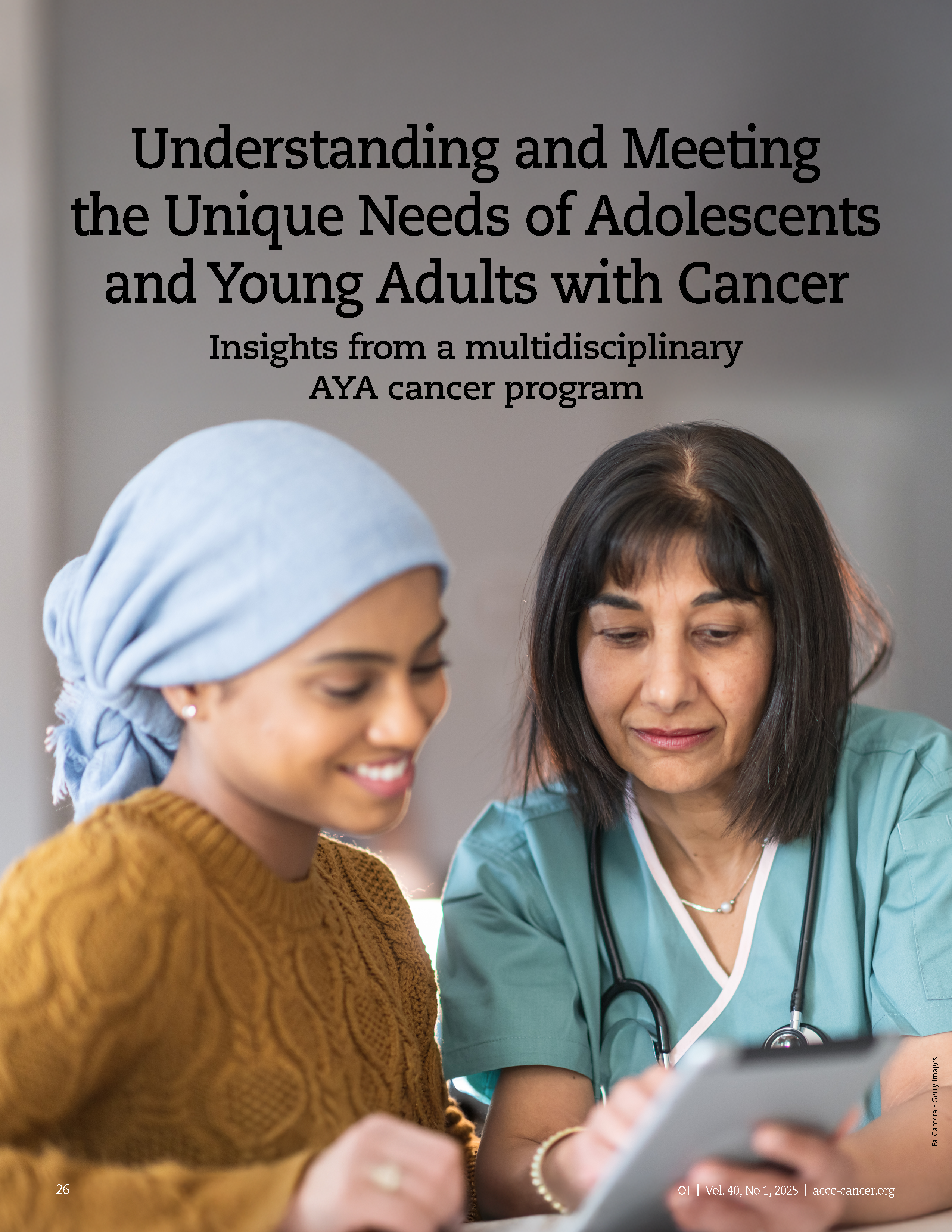
Understanding and Meeting the Unique Needs of Adolescents and Young Adults with Cancer

Understanding and Meeting the Unique Needs of Adolescents and Young Adults with Cancer

References

1. Virostko J, Capasso A, Jankeelov TE, Goodgame B. Recent trends in the age at diagnosis of colorectal cancer in the US National Cancer Data Base, 2004-2015. Cancer. 2019;125(21):3828-3835.

2. Siegel RL, Miller KD, Fedewa SA, et al. Colorectal cancer statistics, 2017. CA Cancer J Clin. 2017;67:177-193.

3. American Cancer Society: Key statistics for colorectal cancer. Available at cancer.org/colon-rectal-cancer/about/key-statistics.html.

4. Sung H, Siegel RL, Rosenberg PS, Ahmedin J. Emerging cancer trends among young adults in the USA: analysis of a population-based cancer registry. Lancet Pub Health. 2019;4(3):PE137-E147.