ACCC association of cancer care centers
Join/Renew
Login
Join/Renew
Login
Education & Resources
ACCC eXchange LogInSponsored Education from ACCC Corporate PartnersACCC eLearning LogInPresentations & Abstracts
Publications
Oncology IssuesPatient Assistance & Reimbursement GuideTrending Now in Cancer CareBusiness Case Studies for Hiring New Staff
Events
2026 ACCC Leadership SummitAnnual Meeting & Cancer Center Business SummitCapitol Hill DayNational Oncology ConferenceOncology Reimbursement MeetingsOncology State Society Meetings
Policy & Advocacy
ACCC 2026 Policy PrioritiesLetters & StatementsAccess, Payment & Reimbursement ReformWhite Bagging & Brown BaggingAdvocacy ResourcesCancer Moonshot
Membership
Join | RenewWho We AreMembership Types & BenefitsCorporate MembersACCC Member Portal FAQMember Directory
Partners
Oncology State SocietiesPartner OrganizationsCME
News
News ReleasesAdvocacy News ReleasesOncology News
About ACCC
Timeline / 50th Anniversary2025 Impact ReportPresident's ThemeACCC Innovator AwardsACCC FellowsBoard of TrusteesACCC Senior Staff
Breast CancerMetastatic Breast Cancer
Gastrointestinal CancerBiliary Tract CancerColorectal CancerGastric CancerLiver Cancer
Genitourinary CancerBladder CancerProstate CancerRenal Cell Carcinoma
Gynecologic Cancer
Head & Neck Cancer
Hematologic MalignanciesAcute Lymphocytic Leukemia (ALL)Acute Myeloid Leukemia (AML)Chronic Lymphocytic Leukemia (CLL)Mantle Cell Lymphoma (MCL)Multiple Myeloma (MM)Myelodysplastic Syndromes (MDS)
Lung CancerNon-Small Cell Lung Cancer (NSCLC)Small Cell Lung Cancer (SCLC)
Sarcoma
Skin CancerMelanomaNon-Melanoma Skin Cancers (NMSC)
Clinical Practice & TreatmentCancer DiagnosticsCare CoordinationEHR Integration for Biomarker TestingQuality Improvement Collaboration: Integration of Precision Medicine in Community OncologyTreatment
Financial NavigationFAN Boot CampFinancial Advocacy Network (FAN) Resource LibraryPatient Assistance & Reimbursement GuidePrior Authorization
Health Equity & Access3, 2, 1, Go! Practical Solutions for Addressing Cancer Care DisparitiesAppalachian Community Cancer AllianceOncology Advanced PractitionersPersonalizing Care for Patients of All BackgroundsSocial Drivers of Health
Patient-Centered CareAddressing Care Disparities for VeteransAdolescent and Young Adult (AYA)Care Action Plans for People with CancerDermatologic ToxicitiesEmpowering CaregiversGeriatric OncologyHealth LiteracyNutritionOncology PharmacyPatient NavigationPsychosocial Care in OncologyShared Decision-MakingSupportive CareSurvivorship Care
Practice Management & OperationsCancer Program FundamentalsLeadership Sustainment and Engagement VideosOncology Practice Transformation and Integration CenterOncology Team Resiliency
ResearchACCC Community Oncology Research Institute (ACORI)
Technology & InnovationTelehealth & Digital Medicine
ACCCBuzz Blog
CANCER BUZZ Podcast
Oncology Issues
Join/Renew
Login
Breast CancerMetastatic Breast Cancer
Gastrointestinal CancerBiliary Tract CancerColorectal CancerGastric CancerLiver Cancer
Genitourinary CancerBladder CancerProstate CancerRenal Cell Carcinoma
Gynecologic Cancer
Head & Neck Cancer
Hematologic MalignanciesAcute Lymphocytic Leukemia (ALL)Acute Myeloid Leukemia (AML)Chronic Lymphocytic Leukemia (CLL)Mantle Cell Lymphoma (MCL)Multiple Myeloma (MM)Myelodysplastic Syndromes (MDS)
Lung CancerNon-Small Cell Lung Cancer (NSCLC)Small Cell Lung Cancer (SCLC)
Sarcoma
Skin CancerMelanomaNon-Melanoma Skin Cancers (NMSC)
Clinical Practice & TreatmentCancer DiagnosticsCare CoordinationEHR Integration for Biomarker TestingQuality Improvement Collaboration: Integration of Precision Medicine in Community OncologyTreatment
Financial NavigationFAN Boot CampFinancial Advocacy Network (FAN) Resource LibraryPatient Assistance & Reimbursement GuidePrior Authorization
Health Equity & Access3, 2, 1, Go! Practical Solutions for Addressing Cancer Care DisparitiesAppalachian Community Cancer AllianceOncology Advanced PractitionersPersonalizing Care for Patients of All BackgroundsSocial Drivers of Health
Patient-Centered CareAddressing Care Disparities for VeteransAdolescent and Young Adult (AYA)Care Action Plans for People with CancerDermatologic ToxicitiesEmpowering CaregiversGeriatric OncologyHealth LiteracyNutritionOncology PharmacyPatient NavigationPsychosocial Care in OncologyShared Decision-MakingSupportive CareSurvivorship Care
Practice Management & OperationsCancer Program FundamentalsLeadership Sustainment and Engagement VideosOncology Practice Transformation and Integration CenterOncology Team Resiliency
ResearchACCC Community Oncology Research Institute (ACORI)
Technology & InnovationTelehealth & Digital Medicine
ACCCBuzz Blog
CANCER BUZZ Podcast
Oncology Issues
    • Education & Resources
    • Publications
    • Events
    • Policy & Advocacy
    • Membership
    • Partners
    • News
    • About ACCC
ACCC association of cancer care centers
5425 Wisconsin Ave #600, Chevy Chase, MD 20815
Tel: 301.984.9496 Email Us
Contact UsVolunteers
Advertise
Career Center
Terms and Conditions
Privacy Policy
ACCC Rebranding
Copyright © 2026 Association of Cancer Care Centers. All Rights Reserved.
HomePublicationsOncology Issues

HonorHealth Research Institute’s First Steps to Approaching Decentralized Clinical Trials (DCTs)

June 15, 2026
Oncology Issues
June 2026
Volume 41
Issue 3

Explore how HonorHealth Research Institute is taking a practical approach to DCTs. This case study examines how a small pilot is helping to expand awareness of clinical trial opportunities, strengthen collaboration between community and research teams, and lay the groundwork for future growth.

HonorHealth Research Institute’s First Steps to Approaching Decentralized Clinical Trials (DCTs)
Download Issue PDFDownload PDF


HonorHealth is a nonprofit health care system in Arizona serving the greater Phoenix metropolitan area in Maricopa County. Seventeen locations across the city and surrounding suburbs offer cancer care to the region’s diverse population, including a large Hispanic/Latino community, Native American patients from nearby tribal nations, and patients who travel from across the country for expert opinions from HonorHealth oncologists.


At present, all clinical trials for the health system occur at HonorHealth Research Institute in Scottsdale, northeast of Phoenix. Founded in 2005, the Research Institute offers about 70 oncology clinical trials at any given time with a focus on phase one, first-in-human trials. This centralized location provides each component of the clinical research process, from screening to treatment, under 1 roof. While this hub offers convenience and consistency for some, it poses access challenges for patients living in the far reaches of HonorHealth’s catchment area. Repeated trips to the facility are required for most early-phase clinical trials, but are not feasible for all patients and create a barrier to enrollment. In 2024, 338 oncology patients were enrolled in clinical trials, but institutional leadership identified an opportunity to increase that number and reach more eligible individuals.


Decentralized clinical trials (DCTs) are designed to distribute trial activities across multiple settings rather than relying solely on a single investigative site. Although study oversight and administrative management remain centralized, elements such as consent, screening, safety assessments, treatment administration, and follow-up can occur through a combination of telemedicine, local health care providers, home-based services, and digital technologies. This flexible model reduces travel burden, broad­ens geographic reach, and enables participation by patients who face barriers to enrolling in traditional single-site–based trials. Emerging evidence also suggests that data completeness and trial retention may improve when DCT elements are implemented in ways that align with patient needs and preferences.


HonorHealth Research Institute identified DCTs as a promising approach to expand clinical trial access for patients across the health system. However, leadership and research staff also recog­nized that a new structure could not be implemented overnight. A pilot program served as a vital first step to establishing a successful, large-scale research program that could meet patients in their own communities.


DCT Pilot Design
For HonorHealth’s first foray into DCTs, the Research Institute began sending an oncology clinical investigator to one of HonorHealth’s cancer care locations in Peoria, a suburb north­west of Phoenix. This individual serves as a resource for both patients and oncologists, offering consults on difficult cases, educating patients about the clinical trial process, and alerting the multidisciplinary team at Peoria about patients who may be a good fit for trials active at the Research Institute in Scottsdale. Importantly, patients are not yet being screened for or enrolled in clinical trials at the Peoria satellite location. Rather, the visiting clinical researcher aims to increase interest and awareness of trial availability for both oncologists and patients.


Since beginning this initiative in summer 2025, Erin Pierce, MSN, APRN, FNP-C, associate clinical investigator and nurse practitioner at HonorHealth Research Institute, has already seen benefits. “This has been enhancing the interest in trials in the community, but it also allows patients to get an understanding of clinical trials in their known environment,” she explained. Patients are more open to learning about trials when they are in a familiar setting and their trusted oncologist is present to answer questions.


Collaboration among clinicians has also had a positive impact on the clinical trial ecosystem. The relationship between community oncologists and the research oncologist “is definitely being strengthened,” Pierce said. “We’re seeing them reach out to us more frequently, and those interactions are occurring earlier.” While these outcomes do not eliminate the distance barrier, both patients and physicians are more eager to consider clinical trials and more motivated to travel to the Research Institute in Scotts­dale to formally kick off the screening process.


Tackling Staffing Hurdles

When designing the first steps toward incorporating decentral­ized elements into research protocols, HonorHealth Research Institute faced a nearly universal hurdle in the cancer care landscape: staffing shortages. As the population of patients diagnosed with cancer in the US grows, the oncology workforce has struggled to keep up. In this case, dedicated research oncologists have been a limiting factor in clinical trial capacity. “We’re seeing a decrease in the number of oncologists who are trained and committed to doing clinical research,” Pierce said. HonorHealth’s solution has been to champion advanced practice providers (APPs) and provide the training they need to be leaders in clinical trials. APPs, including Pierce, work as principal investiga­tors, maximizing the available workforce. “The physician shortage is not going anywhere, but APPs are ready and capable to step into that role,” she said.


At the outset of the DCT pilot, program administrators worried that they could not spare even 1 oncologist to travel to the oncology clinic in Peoria. Thus, the initiative was made possible by enlisting qualified APPs, and this strategy will continue to be important for future growth of DCTs at HonorHealth.


Moving Forward and Key Takeaways
HonorHealth Research Institute’s DCT pilot is a small but import­ant first step to creating a larger decentralized infrastructure. The next step is to identify metrics of success. Referral volume, screening failure rates, diverse research subject enrollment, patient satisfaction, and time to enrollment are all factors that need to be understood to drive the expansion of DCTs.


Future goals for this initiative involve moving some clinical trial activities into the community. The staff is planning to offer phase 2 and 3 trials at community cancer centers within the HonorHealth system.


For other cancer programs interested in employing a DCT model, Pierce recommended starting small. “You don’t have to jump in all at one time,” she said.


Now that HonorHealth Research Institute has achieved initial suc­cess, it can use the knowledge gained from this pilot to accelerate growth and expand clinical trial access to more patients.

ACKNOWLEDGEMENTS
Nadine J. Barrett, PhD, MA, MS, FACCC1,2; Shaalan Beg, MD, MBA, FASCO3; Al B. Benson III, MD, FACP, FASCO4; Lora Black, RN, MPH, CCRP5; Christa Braun-Inglis, DNP, APRN-Rx, FNP-BC, AOCNP6; Carrie Friedman RN, BSN, OCN7; Una Hopkins, DNP, MSN, RN, FNP-BC, NE-BC, FACCC8; Michele Lacy, RN, BSN, OCN9; Marc Matrana, MD, Sc, FACP10; Jane Myles, MSc11; Amy Peterson, PhD, GPC12; Wyatt Pickner13; Lawrence Wagman, MD14; Gabrielle Stearns15

1Wake Forest University School of Medicine, 2Advocate Health; 3ConcertAI; 4Robert H. Lurie Comprehensive Cancer Center of Northwestern University Hospital; 5Sanford Health; 6University of Hawaii Cancer Center; 7Virginia Cancer Specialists; 8Montefiore Health System 9Metro Minnesota Community Oncology Research Consortium; 10Ochsner Cancer Institute; 11Decentralized Trials & Research Alliance; 12Munson Healthcare; 13American Indian Cancer Foundation; 14City of Hope 15Association of Cancer Care Centers


The Association of Cancer Care Centers (ACCC) provides education and advocacy for the cancer care community. For more information, visit accc-cancer.org.


© 2026. Association of Cancer Care Centers. All rights reserved. No part of this publication may be reproduced or transmitted in any form or by any means without written permission.
Articles in this issue

Lessons From the ACCC Leadership Summit: Aligning  People, Purpose, and Systems
Lessons From the ACCC Leadership Summit: Aligning People, Purpose, and Systems
Who Should Be at the Table Next? A Call to Identify Emerging Leaders
The Hidden Harm of Administrative Toxicity
PeaceHealth’s Journey to Redefine Clinician Well-Being
From Conversation  to Connection:  Clinical Trial Referral Ambassadors
From Conversation to Connection: Clinical Trial Referral Ambassadors
Advanced Practice at the Leadership Table
A Patient-Centered Framework for Transgender and Nonbinary Health
Executive Insights: The Future of Cancer Care Delivery
AI in Oncology: Tools for Today, Breaking and Remaking For Tomorrow
Health Policy: Provider Voices Outlook
Value-Based Care in Oncology: From Pilots to Scale
Strategic Partnerships: Creating a Thriving Innovation Oncology Ecosystem
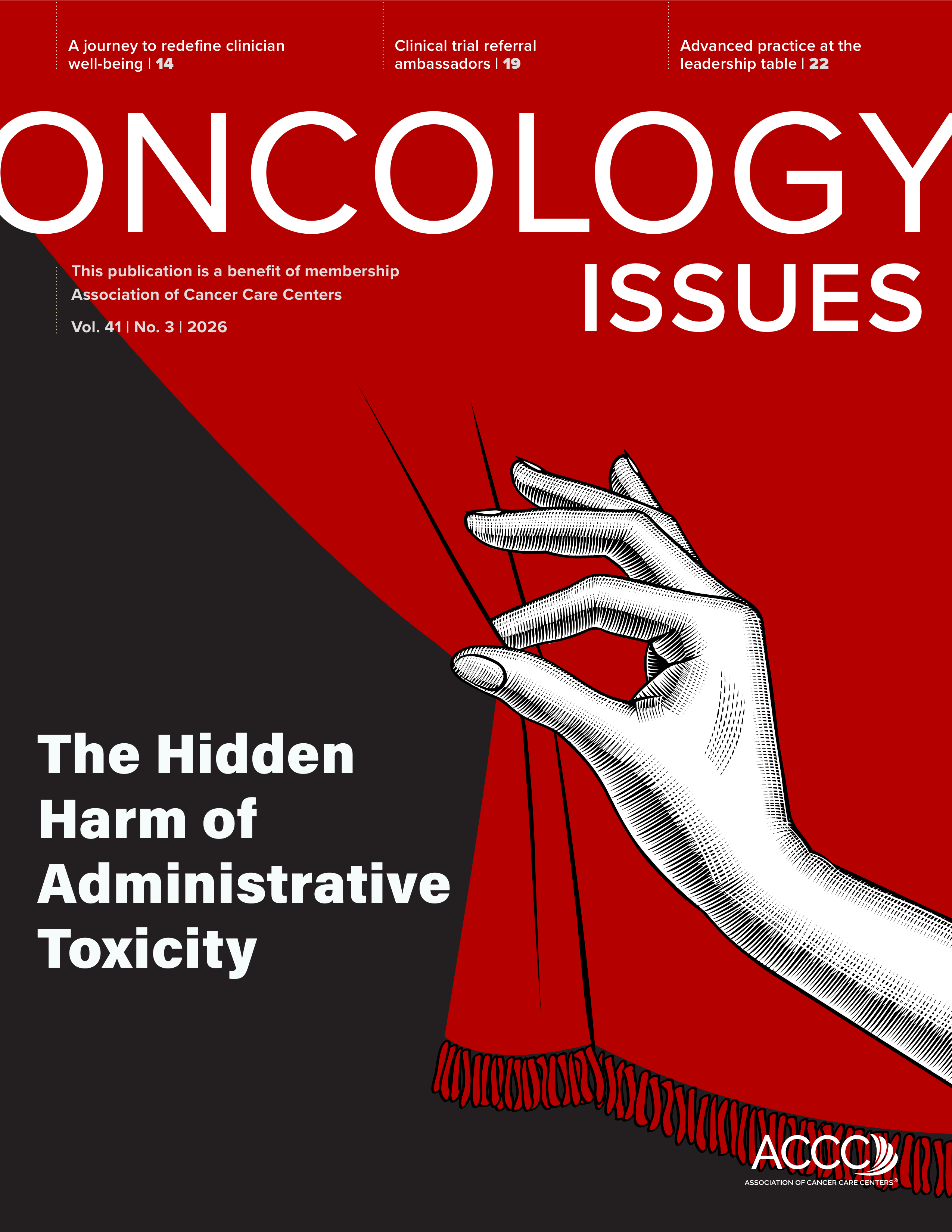
Cover of “HonorHealth Research Institute’s First Steps to Approaching Decentralized Clinical Trials (DCTs),” an ACORI case study on expanding clinical trial access through a community-based pilot.
HonorHealth Research Institute’s First Steps to Approaching Decentralized Clinical Trials (DCTs)
The AI That’s Already Here: Promise, Risk, and the Governance Gap
Fast Facts Vol. 41, No. 3

Related Content

Bringing Phase 1 Clinical Trials to Historically Underserved Patient PopulationsACCCBuzz Blog

Bringing Phase 1 Clinical Trials to Historically Underserved Patient Populations

Rachel Radwan

September 16, 2025

Increasing Access and Representation in Clinical Trials – [Podcast] Ep 202

August 26, 2025

Improving Clinical Trial Access and Support: A Practical e-Course Designed for Patient NavigatorsACCCBuzz Blog

Upcoming Events

ACCC 43rd National Oncology Conference

ACCC 43rd National Oncology Conference

In Person October 21, 2026 at 8:00 AM EDT450 Summer St, Boston, MA 02210, USAOmni Boston Hotel at the Seaport, Boston
Register Now!
ACCC Oncology Reimbursement Meeting | Reno

ACCC Oncology Reimbursement Meeting | Reno

In Person November 4, 2026 at 8:00 AM EST255 North Virginia Street, Reno, NV, USAWhitney Peak Hotel Reno, Tapestry Collection by Hilton,
Register Now!
ACCC Oncology Reimbursement Meeting | Providence

ACCC Oncology Reimbursement Meeting | Providence

In Person November 10, 2026 at 8:00 AM EST5 Avenue of the Arts, Providence, RI, USARenaissance Providence Downtown Hotel,
Register Now!
NMSCO 2026 Fall Conference
Oncology

NMSCO 2026 Fall Conference

In Person Conference & ConventionSeptember 12, 2026 at 7:30 AM MDT2101 Louisiana Boulevard NE Albuquerque, NM, 87110Marriott Albuquerque, Albuquerque
Register Now!
TxSCO 2026 Annual Conference
Oncology

TxSCO 2026 Annual Conference

In Person Conference & ConventionSeptember 18, 2026 at 6:00 PM CDT501 Gaylord Trail, Grapevine, TX, USAGaylord Texan Resort & Convention Center, Grapevine
Register Now!
KYSCO 2026 Fall Oncology Review
Oncology

KYSCO 2026 Fall Oncology Review

In Person Conference & ConventionSeptember 19, 2026 at 7:00 AM EDT500 S 4th St, Louisville, KY, USAThe Seelbach Hilton Louisville, Louisville
Register Now!
ESHOS Horizons 2026
Oncology

ESHOS Horizons 2026

In Person Conference & ConventionSeptember 19, 2026 at 7:30 AM EDT1 Liberty Street, New York, NY, USAConvene at One Liberty Plaza, New York
Register Now!
MSOS 2026 Bozeman Meeting
Oncology

MSOS 2026 Bozeman Meeting

In Person Meeting & NetworkingSeptember 22, 2026 at 5:30 PM EDT5 W Mendenhall St suite 102, Bozeman, MT 59715, USA Urban Kitchen, Bozeman
Register Now!
MSCO 2026 Fall Conference
Oncology

MSCO 2026 Fall Conference

In Person Conference & ConventionSeptember 22, 2026 at 5:00 PM CDT1500 Park Pl Blvd, Minneapolis, MN, USADoubleTree by Hilton Hotel Minneapolis - Park Place, Minneapolis
Register Now!
HSCO 2026 September Dinner Symposium
Oncology

HSCO 2026 September Dinner Symposium

In Person Conference & ConventionSeptember 23, 2026 at 5:30 PM HST3660 Waialae Ave, Honolulu, HI, USA3660 On The Rise, Honolulu
Register Now!
Advertisement
Advertisement

Trending Now on
ACCCBuzz Blog

Highlights From Volume 41, Number 4 Oncology Issues

Highlights From Volume 41, Number 4 Oncology Issues

From precision medicine to psychosocial care to navigation for a diverse population, the latest issue Oncology Issues brings insights into not just institutional and administrative barriers to treatment, but areas of care that directly impact the lived experience of those navigating the cancer care continuum.

Transforming Access to Care Through Pre-Intake Navigation

Transforming Access to Care Through Pre-Intake Navigation

The University of Texas MD Anderson Cancer Center in Houston, Texas, developed a novel Pre-Intake Navigation (PIN) program, which identifies and resolves early financial and insurance barriers, enabling patients to access timely, high-quality cancer care with less anxiety and fewer delays. PIN shifts financial navigation from a late-stage, reactive task to an early, standardized, patient‑centered process embedded in the call center workflow.

Improving Clinical Trial Access and Support: A Practical e-Course Designed for Patient Navigators

Rachel Radwan

July 23, 2025

Precision at Scale: Expanding Rare Molecular Subtype Trials via the Decentralized ModelACCCBuzz Blog

Precision at Scale: Expanding Rare Molecular Subtype Trials via the Decentralized Model

Nicole A. Colwell, MD

June 27, 2025

The Coordinator’s Perspective – Driving Research Growth From the Ground Up – [Video Podcast] Ep 55Podcast

The Coordinator’s Perspective – Driving Research Growth From the Ground Up – [Video Podcast] Ep 55

June 5, 2025

5 Ways to Improve Oncology Clinical Trials – [Mini Podcast] Ep 191

May 21, 2025

Missing Voices: Increasing Black Women’s Engagement in Patient Reported Outcomes in Breast Cancer Treatment - [Podcast] Ep 178

February 6, 2025

Part 2 of a 7 Part Series: Advancing Early Detection, Prevention, and Clinical Trial Diversity in Puerto Rico – [Mini Podcast] Ep 167

November 20, 2024

An APP-Led Outpatient Bispecific Antibody Clinic

An APP-Led Outpatient Bispecific Antibody Clinic

Understanding both the benefits to be had from offering BsAb therapy to its community and the scope of this undertaking, Vanderbilt-Ingram Cancer Center took a novel approach with its APP-led BsAb step-up dosing clinic, which won the program a 2026 ACCC Innovator Award.

Advancing Critical Priorities at the State Level: Louisiana, Iowa, and Washington Awarded for Their Efforts at 2026 ASCO Annual Meeting

Advancing Critical Priorities at the State Level: Louisiana, Iowa, and Washington Awarded for Their Efforts at 2026 ASCO Annual Meeting

At the 2026 ASCO Annual Meeting, the Louisiana Oncology Society received the ASCO Jeffrey C Ward Affiliate Advocacy Award for advancing critical advocacy priorities that have translated into meaningful legislative victories. The Iowa Oncology Society and Washington State Medical Oncology Society were also recognized for their advocacy efforts in 2025 at the meeting, receiving second place awards.

View All ACCCBuzz Blogs

Recently Heard on
CANCER BUZZ Podcast

From Reactive to Proactive: Improving Access to Cancer Care Through Pre-Intake Navigation - [Podcast] Ep. 240

Real-World Oncology Decentralized Trials - [Video Podcast] Ep. 65

The Real Cost of Cancer: Financial Toxicity, Transportation Challenges, and Access Gaps – [Video Podcast] Ep. 65

Closing the Gap in Medical Necessity Review With a Clinical Documentation Integrity Registered Nurse - [Mini Podcast] Ep. 239

View All Podcasts

Latest from Oncology Issues

August 2026
August 2026
June 2026
April 2026
February 2026
December 2025
View All Oncology Issues

Join the Conversation

ACCC eXchange Digital Banner
Login