Author(s):
Fueled by advances in digital health technology and the growing need to address operational constraints in nonacademic settings, decentralized clinical trial designs are poised to redefine how (and where) clinical evidence is generated.

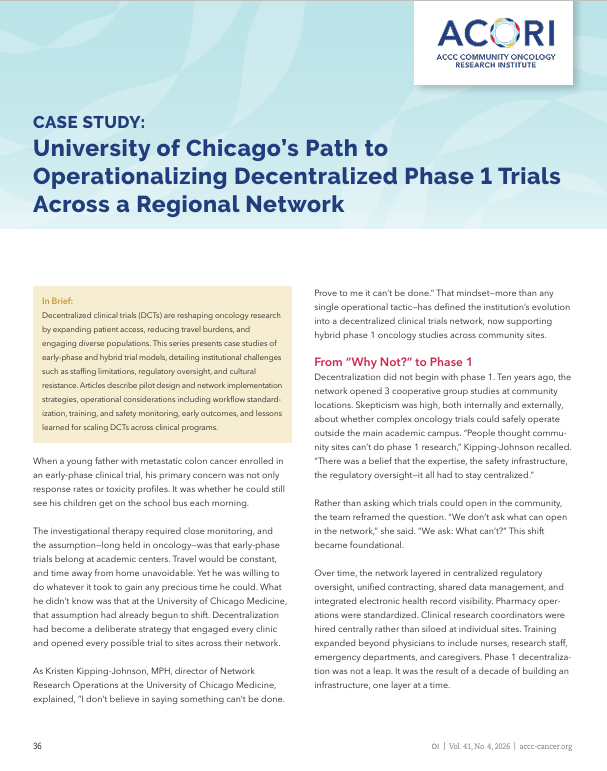
Oncology clinical trials are at an inflection point. As precision medicine advances and clinical development increasingly targets biomarker-defined subpopulations, the limitations of traditional site-based trials have become more apparent. Highlighted by the ACCC Community Oncology Research Institute (ACORI), decentralized clinical trials (DCTs) have recently gained traction as a scalable, patient-centric alternative to traditional academic center-based models. Fueled by advances in digital health technology, changing participant expectations, and the growing need to address operational constraints in nonacademic settings, decentralized and hybrid trial designs are poised to redefine how (and where) clinical evidence is generated.
While the conventional model of in-person visits at centralized study sites has long been the industry standard, it has also created significant barriers to trial participation for many patients. DCTs challenge that paradigm by leveraging remote technologies and community-based infrastructure to minimize the need for site visits, thereby increasing trial accessibility, improving retention, and enhancing real-world relevance.
Decentralized oncology trials incorporate remote or virtual components into protocol design to reduce the need for in-person visits to traditional research centers. Decentralized trial elements may include (but are not limited to):
While some DCTs are fully remote, many adopt a hybrid approach, combining virtual elements with in-person site visits as needed based on trial complexity, patient preference, and safety requirements.
By removing the requirement for patients to travel frequently—often long distances—to designated study sites, decentralized models reduce barriers to participation and support more inclusive recruitment. This model is especially valuable in oncology, which is becoming increasingly defined by molecular subtyping and targeted therapeutics.
In the National Cancer Institute (NCI) podcast episode, “The Future of Clinical Trials: Decentralized and Patient-Centric,” medical oncologist and ACORI advisory committee member Shaalan Beg, MD, MBA, observes, “We’re a victim of our own success. As we start to understand cancer biology and…how cancers are becoming resistant to approved treatments, we have started to classify cancers into smaller and smaller subgroups. So, people don’t just have breast cancer anymore; they now have ER-positive or negative, PR-positive or negative, HER2-positive or negative breast cancer. You don’t just have colon cancer, you have BRAF mutated or wild type, KRAS mutated or wild type…This means that most cancers that we’re doing studies on are [technically] rare tumors.”
Recruiting enough patients with a narrowly defined biomarker profile at a single institution is often infeasible. DCTs, by contrast, allow investigators to reach these patients across a broader geographic footprint, including regions without access to academic cancer centers. This model not only accelerates recruitment but also supports the timely evaluation of novel agents in precisely defined populations.
Beyond improving access and recruitment, DCTs offer substantial operational efficiencies. Traditional trials frequently suffer from high dropout rates, missed visits, and incomplete data capture. In contrast, decentralized designs reduce patient burden and increase participation through personalized digital interactions and localized trial activities.
Continuous, real-time data from wearable devices and ePRO tools enable a richer understanding of treatment effects in real-world settings—providing longitudinal insights that episodic clinic visits may miss. This is particularly relevant in oncology, where symptom burden, functional status, and quality of life are critical endpoints.
Reflecting the broader shift toward decentralization, the NCI recently launched the Virtual Clinical Trials Office (VCTO)—a centralized remote staffing initiative designed to expand research capacity and remove operational bottlenecks at local oncology practices and community sites.
Staffed by research nurses, clinical research associates, and data specialists from the Frederick National Laboratory for Cancer Research, the VCTO provides expert virtual support to participating sites. Services include:
The VCTO was inspired by the success of the Virtual Research Nurse Program piloted by the Gulf South NCI Community Oncology Research Program (NCORP) site in New Orleans, Louisiana. It now extends centralized staffing support to trials conducted across several NCI-supported cooperative groups, including the National Clinical Trials Network (NCTN), the Experimental Therapeutics Clinical Trials Network (ETCTN), and NCORP.
This model alleviates the staffing constraints that often limit trial activation at community sites and offers proof-of-concept for scalable, hybrid trial support that maintains both quality and efficiency.
The adoption of decentralized trials represents more than a technological evolution—it is a cultural and strategic shift in how we approach oncology research, blending innovation with inclusivity to meet the demands of modern clinical science. As digital health becomes more integrated into routine care and patients seek more flexible options for trial participation, DCTs offer a viable pathway to broaden access without compromising scientific integrity. For sponsors, investigators, and health systems, the challenge will be to implement these models thoughtfully—investing in digital infrastructure, fostering cross-disciplinary collaboration, and maintaining rigorous standards for data quality and patient safety.
Ultimately, DCTs offer an opportunity to reimagine community oncology research—connecting patients to cutting-edge therapies regardless of location, relieving operational pressure at trial sites, and accelerating the pace of discovery in cancer care. The question is no longer whether DCTs will shape the future of research, but how effectively we will integrate them to realize their full potential.
ACORI will focus its near-term efforts on expanding the reach of the DCT model within community oncology practices nationwide. To learn more about how to get involved—including opportunities to participate in an upcoming DCT roundtable discussion this fall—please contact Kimberly Demirhan, MBA, BSN, RN, assistant director, education programs at kdemirhan@accc-cancer.org.
For additional updates and insights, be sure to explore the ACORI Quarterly Research Review newsletter.