ACCC association of cancer care centers
Join/Renew
Login
Join/Renew
Login
Education & Resources
ACCC eXchange LogInSponsored Education from ACCC Corporate PartnersACCC eLearning LogInPresentations & Abstracts
Publications
Oncology IssuesPatient Assistance & Reimbursement GuideTrending Now in Cancer CareBusiness Case Studies for Hiring New Staff
Events
2026 ACCC Leadership SummitAnnual Meeting & Cancer Center Business SummitCapitol Hill DayNational Oncology ConferenceOncology Reimbursement MeetingsOncology State Society Meetings
Policy & Advocacy
ACCC 2026 Policy PrioritiesLetters & StatementsAccess, Payment & Reimbursement ReformWhite Bagging & Brown BaggingAdvocacy ResourcesCancer Moonshot
Membership
Join | RenewWho We AreMembership Types & BenefitsCorporate MembersACCC Member Portal FAQMember Directory
Partners
Oncology State SocietiesPartner OrganizationsCME
News
News ReleasesAdvocacy News ReleasesOncology News
About ACCC
Timeline / 50th Anniversary2025 Impact ReportPresident's ThemeACCC Innovator AwardsACCC FellowsBoard of TrusteesACCC Senior Staff
Breast CancerMetastatic Breast Cancer
Gastrointestinal CancerBiliary Tract CancerColorectal CancerGastric CancerLiver Cancer
Genitourinary CancerBladder CancerProstate CancerRenal Cell Carcinoma
Gynecologic Cancer
Head & Neck Cancer
Hematologic MalignanciesAcute Lymphocytic Leukemia (ALL)Acute Myeloid Leukemia (AML)Chronic Lymphocytic Leukemia (CLL)Mantle Cell Lymphoma (MCL)Multiple Myeloma (MM)Myelodysplastic Syndromes (MDS)
Lung CancerNon-Small Cell Lung Cancer (NSCLC)Small Cell Lung Cancer (SCLC)
Sarcoma
Skin CancerMelanomaNon-Melanoma Skin Cancers (NMSC)
Clinical Practice & TreatmentCancer DiagnosticsCare CoordinationEHR Integration for Biomarker TestingQuality Improvement Collaboration: Integration of Precision Medicine in Community OncologyTreatment
Financial NavigationFAN Boot CampFinancial Advocacy Network (FAN) Resource LibraryPatient Assistance & Reimbursement GuidePrior Authorization
Health Equity & Access3, 2, 1, Go! Practical Solutions for Addressing Cancer Care DisparitiesAppalachian Community Cancer AllianceOncology Advanced PractitionersPersonalizing Care for Patients of All BackgroundsSocial Drivers of Health
Patient-Centered CareAddressing Care Disparities for VeteransAdolescent and Young Adult (AYA)Care Action Plans for People with CancerDermatologic ToxicitiesEmpowering CaregiversGeriatric OncologyHealth LiteracyNutritionOncology PharmacyPatient NavigationPsychosocial Care in OncologyShared Decision-MakingSupportive CareSurvivorship Care
Practice Management & OperationsCancer Program FundamentalsLeadership Sustainment and Engagement VideosOncology Practice Transformation and Integration CenterOncology Team Resiliency
ResearchACCC Community Oncology Research Institute (ACORI)
Technology & InnovationTelehealth & Digital Medicine
ACCCBuzz Blog
CANCER BUZZ Podcast
Oncology Issues
Join/Renew
Login
Breast CancerMetastatic Breast Cancer
Gastrointestinal CancerBiliary Tract CancerColorectal CancerGastric CancerLiver Cancer
Genitourinary CancerBladder CancerProstate CancerRenal Cell Carcinoma
Gynecologic Cancer
Head & Neck Cancer
Hematologic MalignanciesAcute Lymphocytic Leukemia (ALL)Acute Myeloid Leukemia (AML)Chronic Lymphocytic Leukemia (CLL)Mantle Cell Lymphoma (MCL)Multiple Myeloma (MM)Myelodysplastic Syndromes (MDS)
Lung CancerNon-Small Cell Lung Cancer (NSCLC)Small Cell Lung Cancer (SCLC)
Sarcoma
Skin CancerMelanomaNon-Melanoma Skin Cancers (NMSC)
Clinical Practice & TreatmentCancer DiagnosticsCare CoordinationEHR Integration for Biomarker TestingQuality Improvement Collaboration: Integration of Precision Medicine in Community OncologyTreatment
Financial NavigationFAN Boot CampFinancial Advocacy Network (FAN) Resource LibraryPatient Assistance & Reimbursement GuidePrior Authorization
Health Equity & Access3, 2, 1, Go! Practical Solutions for Addressing Cancer Care DisparitiesAppalachian Community Cancer AllianceOncology Advanced PractitionersPersonalizing Care for Patients of All BackgroundsSocial Drivers of Health
Patient-Centered CareAddressing Care Disparities for VeteransAdolescent and Young Adult (AYA)Care Action Plans for People with CancerDermatologic ToxicitiesEmpowering CaregiversGeriatric OncologyHealth LiteracyNutritionOncology PharmacyPatient NavigationPsychosocial Care in OncologyShared Decision-MakingSupportive CareSurvivorship Care
Practice Management & OperationsCancer Program FundamentalsLeadership Sustainment and Engagement VideosOncology Practice Transformation and Integration CenterOncology Team Resiliency
ResearchACCC Community Oncology Research Institute (ACORI)
Technology & InnovationTelehealth & Digital Medicine
ACCCBuzz Blog
CANCER BUZZ Podcast
Oncology Issues
    • Education & Resources
    • Publications
    • Events
    • Policy & Advocacy
    • Membership
    • Partners
    • News
    • About ACCC
ACCC association of cancer care centers
5425 Wisconsin Ave #600, Chevy Chase, MD 20815
Tel: 301.984.9496 Email Us
Contact UsVolunteers
Advertise
Career Center
Terms and Conditions
Privacy Policy
ACCC Rebranding
Copyright © 2026 Association of Cancer Care Centers. All Rights Reserved.
HomeACCCBuzz Blog

Decentralized Clinical Trials in Community Oncology: Advancing Access Requires More Than Technology

September 10, 2026

Decentralized clinical trial approaches, including remote consent, telehealth, local laboratory and imaging services, and more, can help reduce some of the many barriers that prevent eligible patients from participating in trials. But as the participants in ACCC’s Advancing Decentralized Clinical Trials in the Community Setting Roundtable Series emphasized, implementing DCT elements is not simply a matter of adopting new technology. Doing so successfully requires thoughtful workflows and oversight structures that consider equity, scalability, and sustainability.

Decentralized Clinical Trials in Community Oncology: Advancing Access Requires More Than Technology

For many patients with cancer, the opportunity to participate in a clinical trial is shaped by far more than eligibility criteria. Distance from a research center, transportation needs, time away from work, caregiving responsibilities, access to local services, and comfort with technology can all determine whether participation is realistically possible.

Decentralized clinical trial (DCT) approaches, including remote consent, telehealth, local laboratory and imaging services, digital health technologies, and mobile health professionals, can help reduce some of these barriers. But as the participants in ACCC’s Advancing Decentralized Clinical Trials in the Community Setting Roundtable Series emphasized, implementing DCT elements is not simply a matter of adopting new technology.

To make decentralized research both equitable and sustainable, community oncology programs need practical workflows, clear oversight structures, engaged sponsors, prepared staff, and organizational cultures that support innovation. The final roundtable in the series explored these issues through the lenses of equity, scalability, and sustainability, which resulted in a central message: Distance equals disparity.

Access Begins Before Enrollment

The promise of decentralization is often framed in terms of convenience, but its implications are more significant. For patients in rural, frontier, and medically underserved communities, geographic distance can limit access to routine oncology care and create an even greater obstacle to clinical-trial participation.

One roundtable participant described results from a 2021 community survey in the Mountain West health system serving rural and frontier populations: Approximately 89% to 90% of rural respondents were unaware of clinical trials. The finding highlights an essential point: Improving access requires more than bringing trial-related activities closer to home. Patients and communities also need opportunities to learn about clinical research well before a trial becomes an immediate treatment option.

“A patient should never hear the words clinical trial for the first time when they need one.” — Roundtable participant

Community outreach, community advisory boards, patient advocates, culturally responsive recruitment materials, and patient representation in trial-review processes can help build awareness and trust. These strategies require time and resources, but roundtable participants viewed them as essential for meaningful engagement with populations that have historically been underserved in clinical research.

Flexibility Must Be Operationalized

FDA guidance on enhancing participation in clinical trials encourages approaches that can broaden access, including digital health technologies, telehealth, remote consent, mobile health professionals, geographic diversity, culturally competent recruitment, and reimbursement of reasonable patient costs. Roundtable participants welcomed these signals but emphasized that high-level guidance does not provide the day-to-day road map needed to implement DCT elements across diverse oncology settings. Community programs must still navigate technology standards, investigational-product logistics, institutional risk tolerance, and the division of responsibilities among research sites and external care partners.

The relevant question, then, is not whether to decentralize an entire study, but which elements can be implemented safely and feasibly for a specific protocol, patient population, and site. These might include protocol-permitted laboratory testing or imaging at local facilities, telehealth follow-up visits, remote consent, utilizing mobile health professionals, or other strategies that allow patients to complete appropriate study activities closer to home.

A right-sized model recognizes that decentralization is not all-or-nothing. The goal is to reduce avoidable burden while maintaining patient safety, protocol fidelity, data quality, and meaningful patient choice.

Technology Is Necessary, but Not Sufficient

Technology can expand access, but the roundtable discussion made it clear that technology itself can also introduce burden. Rather than converging on a smaller set of interoperable systems, the research technology landscape has become increasingly fragmented. Participants reported that sites may be asked to manage 12 or more platforms, each with separate training expectations, security reviews, and sponsor-specific requirements.

This fragmentation is particularly challenging for community sites with limited research staff and information-technology capacity. A new platform may be technically capable of supporting decentralized study activities, but it will not be sustainable if it creates duplicative work, disrupts existing workflows, or requires staff to master yet another system without adequate training and support.

Participants emphasized that successful technology adoption depends on “staff pull, not push.” In other words, coordinators and other users are more likely to adopt a tool when they understand how it improves their work, not when they are simply required to use yet another platform. Sandbox training, workflow simulations, and early user involvement can help clinical staff identify problems before implementation affects a live study or patient.

Scalability Depends on Culture and Infrastructure

Even programs experienced with eConsent, telehealth, or remote phlebotomy may encounter a different combination of regulatory, logistical, technological, and patient-care requirements with every new study. As one participant put it: “Every trial is a snowflake, and when you add all these things in, you…get into a snowstorm.”

Sustainable DCT adoption, therefore, cannot rest solely on a small group of specialized staff. Programs need repeatable processes, clear governance, institutional knowledge, engaged physician champions, and organizational leadership.

Larger institutions may also help community sites participate by centralizing functions such as institutional review board coordination, contracting, standard operating procedures, pharmacy support, and data management while allowing local teams to focus on patient-facing activities.

Equity Also Means Avoiding Unintended Harm

Reducing travel and time burdens is an important component of equitable access to clinical trials, but even well-intentioned support can have unintended consequences. Roundtable participants raised concerns that clinical trial stipends intended to make participation easier may be treated as taxable income, potentially affecting eligibility for safety-net programs such as Medicaid or the Supplemental Nutrition Assistance Program.

Financial support intended to make trial participation feasible should not inadvertently place patients at risk of losing essential benefits. Participants identified the Clinical Trial Modernization Act, H.R. 4184 as a potential policy response to address these concerns and protect access to certain financial and nonmedical supports associated with clinical trial participation.

Moving From Interest to Readiness

There is no single DCT model that will work for every community oncology program. Patient populations, geography, staffing, technology infrastructure, research portfolios, partnerships, and institutional resources vary widely.

What emerged from the ACCC roundtable discussions was not a call for complete decentralization, but for a more flexible, context-specific approach to clinical research—one that asks where unnecessary burdens can be reduced without compromising safety, quality, or patient choice.

Decentralized clinical trials have the potential to bring research opportunities closer to the people who need them. Realizing that potential will require more than technology. It will require intentional design, reliable infrastructure, engaged champions, and a sustained commitment to making clinical research accessible, practical, and patient-centered.

Acknowledgment

This program is made possible with support from Gilead, Lilly, and Merck.
Related Content

Highlights From Volume 41, Number 4 Oncology IssuesACCCBuzz Blog

Highlights From Volume 41, Number 4 Oncology Issues

Gabrielle Stearns

August 20, 2026

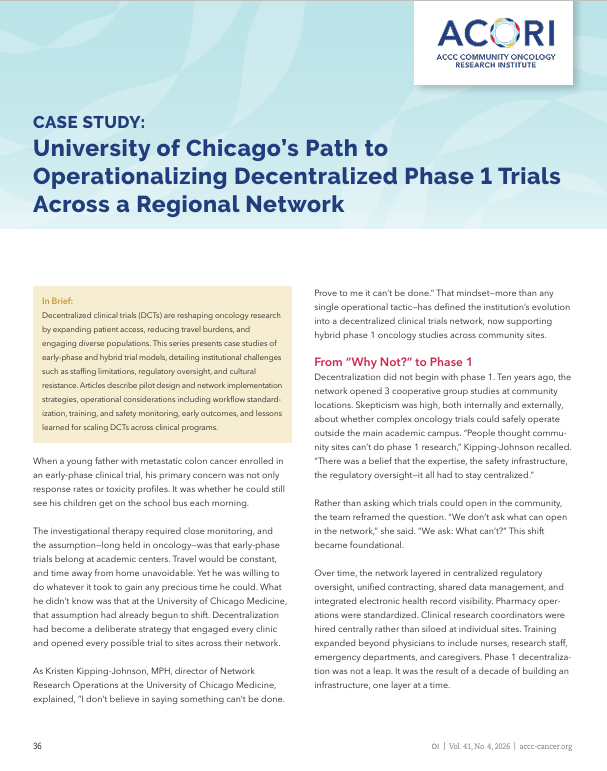
University of Chicago’s Path to Operationalizing Decentralized Phase 1 Trials Across a Regional NetworkOncology Issue

University of Chicago’s Path to Operationalizing Decentralized Phase 1 Trials Across a Regional Network

August 17, 2026

Transforming Access to Care Through Pre-Intake Navigation

Upcoming Events

ACCC 43rd National Oncology Conference

ACCC 43rd National Oncology Conference

In Person October 21, 2026 at 8:00 AM EDT450 Summer St, Boston, MA 02210, USAOmni Boston Hotel at the Seaport, Boston
Register Now!
ACCC Oncology Reimbursement Meeting | Reno

ACCC Oncology Reimbursement Meeting | Reno

In Person November 4, 2026 at 8:00 AM EST255 North Virginia Street, Reno, NV, USAWhitney Peak Hotel Reno, Tapestry Collection by Hilton,
Register Now!
ACCC Oncology Reimbursement Meeting | Providence

ACCC Oncology Reimbursement Meeting | Providence

In Person November 10, 2026 at 8:00 AM EST5 Avenue of the Arts, Providence, RI, USARenaissance Providence Downtown Hotel,
Register Now!
TxSCO 2026 Annual Conference
Oncology

TxSCO 2026 Annual Conference

In Person Conference & ConventionSeptember 18, 2026 at 6:00 PM CDT501 Gaylord Trail, Grapevine, TX, USAGaylord Texan Resort & Convention Center, Grapevine
Register Now!
KYSCO 2026 Fall Oncology Review
Oncology

KYSCO 2026 Fall Oncology Review

In Person Conference & ConventionSeptember 19, 2026 at 7:00 AM EDT500 S 4th St, Louisville, KY, USAThe Seelbach Hilton Louisville, Louisville
Register Now!
ESHOS Horizons 2026
Oncology

ESHOS Horizons 2026

In Person Conference & ConventionSeptember 19, 2026 at 7:30 AM EDT1 Liberty Street, New York, NY, USAConvene at One Liberty Plaza, New York
Register Now!
MSOS 2026 Bozeman Meeting
Oncology

MSOS 2026 Bozeman Meeting

In Person Meeting & NetworkingSeptember 22, 2026 at 5:30 PM EDT5 W Mendenhall St suite 102, Bozeman, MT 59715, USA Urban Kitchen, Bozeman
Register Now!
MSCO 2026 Fall Conference
Oncology

MSCO 2026 Fall Conference

In Person Conference & ConventionSeptember 22, 2026 at 5:00 PM CDT1500 Park Pl Blvd, Minneapolis, MN, USADoubleTree by Hilton Hotel Minneapolis - Park Place, Minneapolis
Register Now!
HSCO 2026 September Dinner Symposium
Oncology

HSCO 2026 September Dinner Symposium

In Person Conference & ConventionSeptember 23, 2026 at 5:30 PM HST3660 Waialae Ave, Honolulu, HI, USA3660 On The Rise, Honolulu
Register Now!
RIOS Fall Meeting
Oncology

RIOS Fall Meeting

In Person Conference & ConventionSeptember 25, 2026 at 5:30 PM EDT139 Mathewson Street, Providence, RI, USAHotel Providence, Providence
Register Now!
Advertisement
Advertisement

Trending Now on
ACCCBuzz Blog

Decentralized Clinical Trials in Community Oncology: Advancing Access Requires More Than Technology

Decentralized Clinical Trials in Community Oncology: Advancing Access Requires More Than Technology

Decentralized clinical trial approaches, including remote consent, telehealth, local laboratory and imaging services, and more, can help reduce some of the many barriers that prevent eligible patients from participating in trials. But as the participants in ACCC’s Advancing Decentralized Clinical Trials in the Community Setting Roundtable Series emphasized, implementing DCT elements is not simply a matter of adopting new technology. Doing so successfully requires thoughtful workflows and oversight structures that consider equity, scalability, and sustainability.

Highlights From Volume 41, Number 4 Oncology Issues

Highlights From Volume 41, Number 4 Oncology Issues

From precision medicine to psychosocial care to navigation for a diverse population, the latest issue Oncology Issues brings insights into not just institutional and administrative barriers to treatment, but areas of care that directly impact the lived experience of those navigating the cancer care continuum.

ACCCBuzz Blog

Transforming Access to Care Through Pre-Intake Navigation

Rachel Radwan

August 6, 2026

An APP-Led Outpatient Bispecific Antibody ClinicACCCBuzz Blog

An APP-Led Outpatient Bispecific Antibody Clinic

Rachel Radwan

August 4, 2026

Advancing Critical Priorities at the State Level: Louisiana, Iowa, and Washington Awarded for Their Efforts at 2026 ASCO Annual MeetingACCCBuzz Blog

Advancing Critical Priorities at the State Level: Louisiana, Iowa, and Washington Awarded for Their Efforts at 2026 ASCO Annual Meeting

Rachel Radwan

July 29, 2026

Designing a Safe, Fully Outpatient CAR T-Cell Program in the CommunityACCCBuzz Blog

Designing a Safe, Fully Outpatient CAR T-Cell Program in the Community

Rachel Radwan

July 27, 2026

Local Staff, Lasting Impact: A New Model for Rural Cancer PreventionACCCBuzz Blog

Local Staff, Lasting Impact: A New Model for Rural Cancer Prevention

Rachel Radwan

July 16, 2026

A Pharmacist-Led Strategy to Improve Care With Oncolytic Virus TreatmentsACCCBuzz Blog

A Pharmacist-Led Strategy to Improve Care With Oncolytic Virus Treatments

Rachel Radwan

July 14, 2026

Transforming Access to Care Through Pre-Intake Navigation

Transforming Access to Care Through Pre-Intake Navigation

The University of Texas MD Anderson Cancer Center in Houston, Texas, developed a novel Pre-Intake Navigation (PIN) program, which identifies and resolves early financial and insurance barriers, enabling patients to access timely, high-quality cancer care with less anxiety and fewer delays. PIN shifts financial navigation from a late-stage, reactive task to an early, standardized, patient‑centered process embedded in the call center workflow.

An APP-Led Outpatient Bispecific Antibody Clinic

An APP-Led Outpatient Bispecific Antibody Clinic

Understanding both the benefits to be had from offering BsAb therapy to its community and the scope of this undertaking, Vanderbilt-Ingram Cancer Center took a novel approach with its APP-led BsAb step-up dosing clinic, which won the program a 2026 ACCC Innovator Award.

View All ACCCBuzz Blogs

Recently Heard on
CANCER BUZZ Podcast

From Reactive to Proactive: Improving Access to Cancer Care Through Pre-Intake Navigation - [Podcast] Ep. 240

Real-World Oncology Decentralized Trials - [Video Podcast] Ep. 66

The Real Cost of Cancer: Financial Toxicity, Transportation Challenges, and Access Gaps – [Video Podcast] Ep. 65

Closing the Gap in Medical Necessity Review With a Clinical Documentation Integrity Registered Nurse - [Mini Podcast] Ep. 239

View All Podcasts

Latest from Oncology Issues

August 2026
August 2026
June 2026
April 2026
February 2026
December 2025
View All Oncology Issues

Join the Conversation

ACCC eXchange Digital Banner
Login