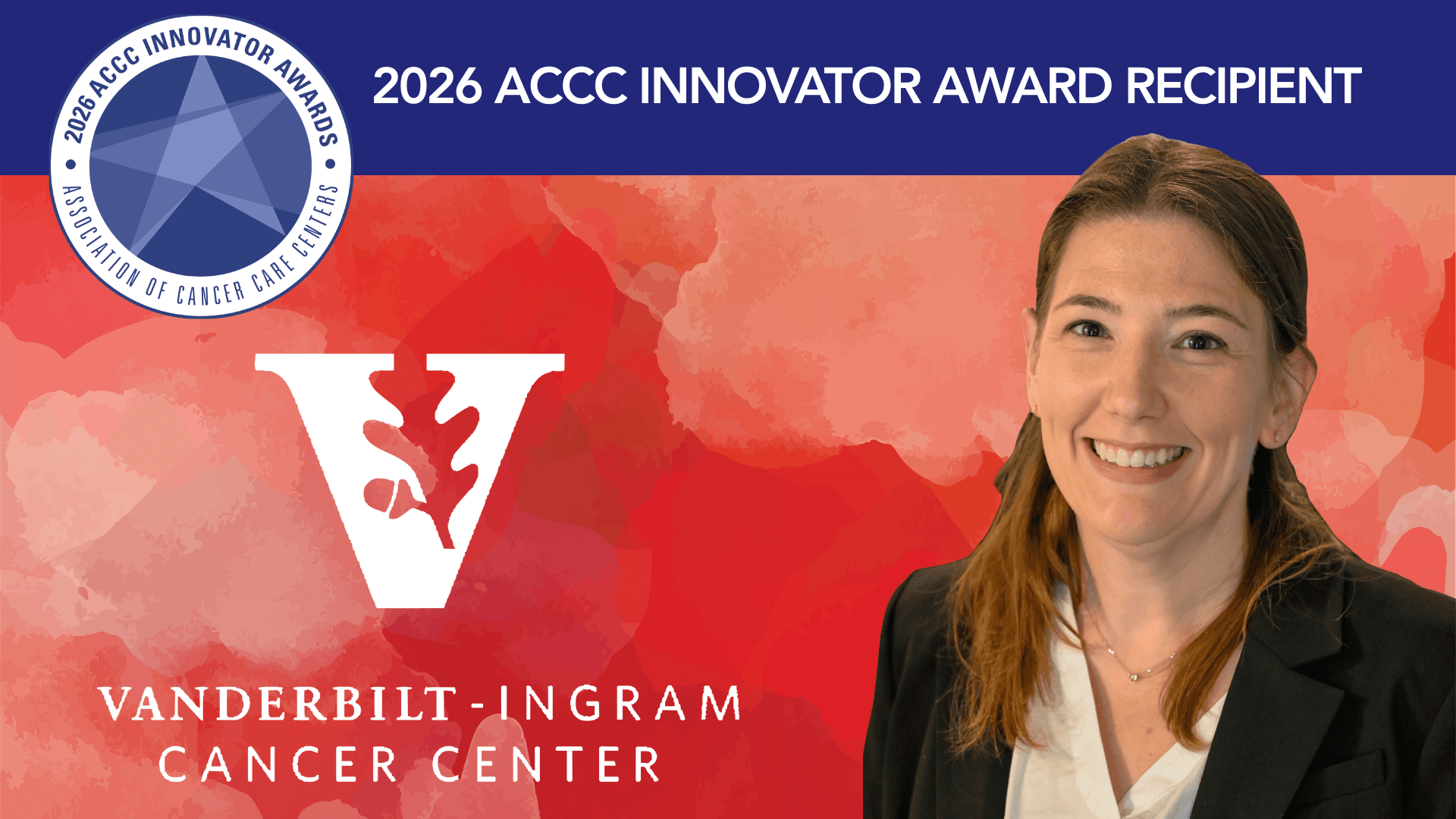
ACCC spoke to Kelly Terrell to capture her insights and tips for community cancer centers to get started with providing bispecific antibody therapies to patients with cancer.

This is the third in a series of 3 blog posts highlighting the Association of Cancer Care Centers (ACCC) education program entitled Successful Integration of Bispecific Antibodies in Community Oncology Practice. You can read the second one here.
As confidence in the use of bispecific antibodies continues to grow, successfully implementing them in community oncology practices is important to help patients access this treatment option, especially for hematologic malignancies in the relapsed/refractory setting. ACCC spoke to Kelly Terrell, MBA, BSN, RN, BMTCN, clinical program manager, Siteman Cancer Center at Barnes-Jewish Hospital & Washington University School of Medicine to capture her insights and tips for community cancer centers to get started with providing bispecific antibody therapies to patients with cancer.
To begin, Terrell emphasizes the importance of community centers to prepare now to implement bispecific antibodies. "Start laying the groundwork now, as more bispecifics will become available for both solid and liquid tumors," she said. This preparation involves not only understanding the science behind these treatments but also establishing the infrastructure needed to support their use.
Terrell recommends selecting one bispecific antibody therapy to implement as a feasible starting point. "You don’t necessarily have to offer all bispecifics, but review your patient population and determine which ones best fit the needs of the patients you serve," Terrell said. “As an academic center, we get everybody, but community centers can identify how many of their patients with lymphoma would qualify for each of the products, and which one would be used the most; same for each indication.”
The step-up phase of bispecific antibodies involves the initial doses of the therapy, which can have side effects such as cytokine release syndrome (CRS). "The bulk of the reactions typically occur before the final step-up is even done," Terrell said.
This phase requires more infrastructure and adverse event management support than continuation of therapy, such as developing protocols and implementing trainings to support health care providers in adverse event management.
In contrast, therapy continuation generally involves fewer side effects and more stable patient management. “By cycle 2 and beyond, most patients aren’t experiencing significant side effects,” Terrell explained. “The majority of reactions tend to occur early in the treatment cycle.”
Given the logistical and financial challenges of onboarding novel therapies, Terrell suggests that community centers consider first building capacity for continuation of therapy and partnering with an academic or tertiary care center that has a well-established program for step-up dosing.
“As an academic center, our goal is not to keep patients—our local area and our own patient load are enough to keep us busy. I know there’s been concern among referring physicians that we might keep patients, especially if they're referred for something beyond transplant or CAR T,” Terrell said. “Being an academic center, and being as established as long as we have, most of our referring physicians don’t feel that way, and we want to partner with them to transition patients back quickly."
According to Terrell, the financial impact of bispecific antibody treatments is a major concern for many community practices. Organizations must assess the cost to patients when implementing this treatment. Community centers should also consider partnerships with other health care systems—including academic centers and local hospitals—to help mitigate these costs and learn best practices.
Terrell also emphasizes the importance of involving partners in medical oncology, finance, and pharmacy early on in discussions about onboarding bispecific therapies. This includes revenue cycle management, Pharmacy & Therapeutics (P&T) and High-Cost Drug committees (or equivalents), and stakeholders at local hospitals who will be involved in adverse event management.
Terrell encourages community centers to work closely with the manufacturers to support staff training, as well as utilizing materials for insurance appeals, adverse event management, and patient education. "Manufacturers often have great resources available for training and support, including billing and coding guides," she explained. "These materials can help ensure that everything is properly covered and that reimbursement issues are minimized."
The support from manufacturers can also help community centers improve health equity, as many offer resources for patients who are undocumented or uninsured. “We are a 340B [drug pricing program] center so we if we can prove that a patient has no resources, and we have exhausted all efforts to get insurance for those patients, then we take those cases and move forward, for transplants as well,” Terrell said. She believes that the resources provided by manufacturers can make all the difference in helping community centers navigate the challenges of onboarding bispecific antibodies.
By fostering collaboration and leveraging resources community cancer centers can successfully integrate bispecific antibodies into their treatment portfolios, ensuring patients benefit from these transformative therapies. As Terrell aptly concludes, “The chair time is less, the quality of life is good, and it’s a great patient satisfier.”
Additional resources for cancer care teams can be found in the ACCC bispecific antibodies resource library. The ACCC Successful Integration of Bispecific Antibodies into Community Practice education program is supported by Genentech and Johnson & Johnson.