BeiGene hosted its second annual Talk About It: Cancer and Mental Health LinkedIn Live event. This year’s theme focused on bridging cancer centers and community partners to help meet acute needs.

The task of meeting the acute needs of patients and caregivers following the COVID-19 pandemic has become bigger than any single cancer program or practice can address on its own. When compounded by the mental health needs of the healthcare workforce and current workforce shortages, triaging mental health has become a significantly complex issue—requiring an all-hands-on deck approach. As a result, more support and resources are needed from within cancer programs and practices, within the hospital and/or health system they belong to, and from local community and advocacy partners.
Understanding this, on January 25, 2024, BeiGene, a global biotechnology company whose core value is putting patients first, hosted its second annual Talk About It: Cancer and Mental Health LinkedIn Live event. This year’s theme, “Mental Health First Aid: Bridging Cancer Centers and Community Partners to Help Meet Acute Needs,” brought together a panel of experts for an interactive conversation on triaging a mental health safety net for patients with cancer and their caregivers.
The panel included experts Barbara Anderson, PhD, professor of Psychology at The Ohio State University Wexner Medical Center’s Institute for Behavioral Medicine Research; Elizabeth Archer-Nanda, DNP, APRN, clinical director and advance practice manager of the Behavioral Oncology Program at the Norton Cancer Institute; and Eucharia Borden, MSW, LCSW, OSW-C, FAOSW, vice president of Programs and Health Equity at Family Reach. The panel was moderated by Vicki Kennedy, LCSW, oncology and advocacy consultant and executive director of Oncology Strategy and Patient Engagement at Cullari Communications Global.
In a series of frank conversations, the panelists highlighted critical topics such as distress screening—now standardized in the United States as a requirement for certification of cancer centers by the American College of Surgeons Commission on Cancer—as well as the limitations and barriers of current care systems in adequately addressing mental health.
“The country is in the midst of a mental health crisis. It was difficult before COVID [-19]and things worsened since,” Dr. Anderson explained. “Resources weren’t adequate to begin with, and they are steadily declining. There aren’t sufficient mental health providers out there…[and] there are other kinds of difficulties with mental health providers.” Dr. Anderson went on to discuss the gradual disappearance of telehealth services for psychological care, which were readily available during the COVID-19 pandemic, and the difficulties associated with linking patients to support services following a distress screening. She believes these are just a few of the many barriers providers currently face.
Providing the perspective of community cancer centers, Dr. Archer-Nanda said, “We’ve created a really challenging environment in which we’re asking our medical colleagues to practice medicine. They’re pretty exhausted with being able to meet all of those measures in addition to compassionately delivering challenging and difficult news to patients.” It is her hope that community mental health workers and community partners in oncology can be used as a critical link to provide high quality support and resources to patients in distress.
Despite progress made through distress screening and other initiatives, barriers to mental health care persist. Borden wagers that the resources dedicated to bridging the care gap are stressed, sorely inadequate, or have been depleted. She went on to highlight the perils inadequate resources and lack of trained mental health staff support can have on patients. “Imagine being that patient who has tried to access resources yourself and you come into a system that can’t really help you to access resources, how does that leave you feeling? You feel like, I don’t—I can’t—get any help,” Borden said. “The patient feels, why should I even bring up what’s really going on for me, because the last few times I did, that referral didn’t work, I couldn’t get there, or there wasn’t the help that I need.”
Kennedy concluded the discussion by summarizing the importance of improving psychosocial care delivery with this: “Even [with] the most innovative medicines, if we cannot provide care to empower and engage and support, not just for the patient, but for caregivers and those around the patient, we won’t really optimize the vision and dream of the best medicines in the world and the best care.”
Designed to spotlight the intersection of mental health and cancer care, BeiGene’s Talk About It program aims to highlight mental healthcare as a critical component to delivering comprehensive cancer care. The program’s mission is to increase awareness on the importance of mental health in cancer care for patients, caregivers, healthcare professionals, as well as policy and decision makers. In doing so, it encourages cancer programs and practices to place mental health and emotional wellness at the foundation of care plans.
This important work aligns with Association of Cancer Care Centers’s (ACCC) longtime commitment to improving the delivery of psychosocial care in oncology. As part of ACCC’s Institute of Comprehensive Cancer Care Services and its education program Psychosocial Care in Oncology—in partnership with the American Psychosocial Oncology Society (APOS) and the Association of Oncology Social Work (AOSW) and with support from BeiGene—ACCC hosted a multistakeholder summit in Washington DC on March 8, 2023. The summit focused on psychosocial care delivery in oncology—culminating in a call to action for sweeping improvements to mental healthcare services and support for patients, caregivers, and healthcare professionals experiencing psychological distress. Among key strategies and priorities identified at the summit was the promotion of an effective collaborative care model and standards for a culture of care. In a recent feature article in Oncology Issues titled “Collaborative Care: A Solution for Increasing Access to Psychosocial Care in Cancer Programs and Practices”, the case was made for the Collaborative Care Model as a solution to the many barriers patients face in accessing psychosocial care.
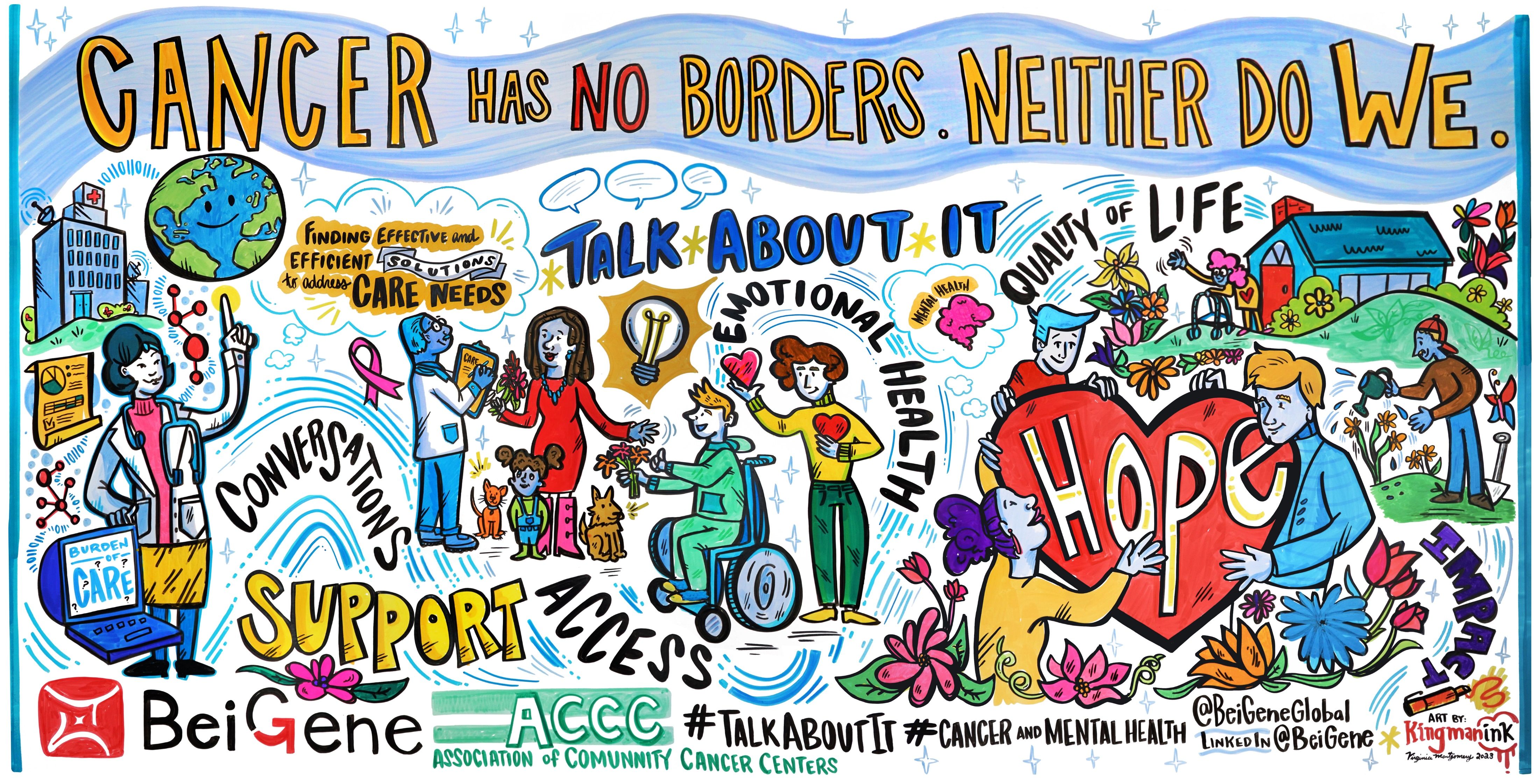
At its 40th National Oncology Conference in Austin, Texas on October 4 -6, 2023, ACCC showcased Talk About It as a collaborative art project on mental health awareness and psychosocial care in oncology, sponsored by BeiGene. Attendees were invited to color and collaborate with one another on this important topic.

In part with its education program, ACCC has released a series of resources and articles focused on improving psychosocial care in oncology:
For more information on the education program Psychosocial Care in Oncology, visit the ACCC website.
The ACCC education program Psychosocial Care in Oncology is made possible with support from BeiGene.