Author(s):
This first installment in the ACCCBuzz Blog 2025 Innovator Award Winners series highlights Penn Medicine Princeton Health, Princeton Cancer Center, and the program's strategy to implement a structured, scalable geriatric oncology program.
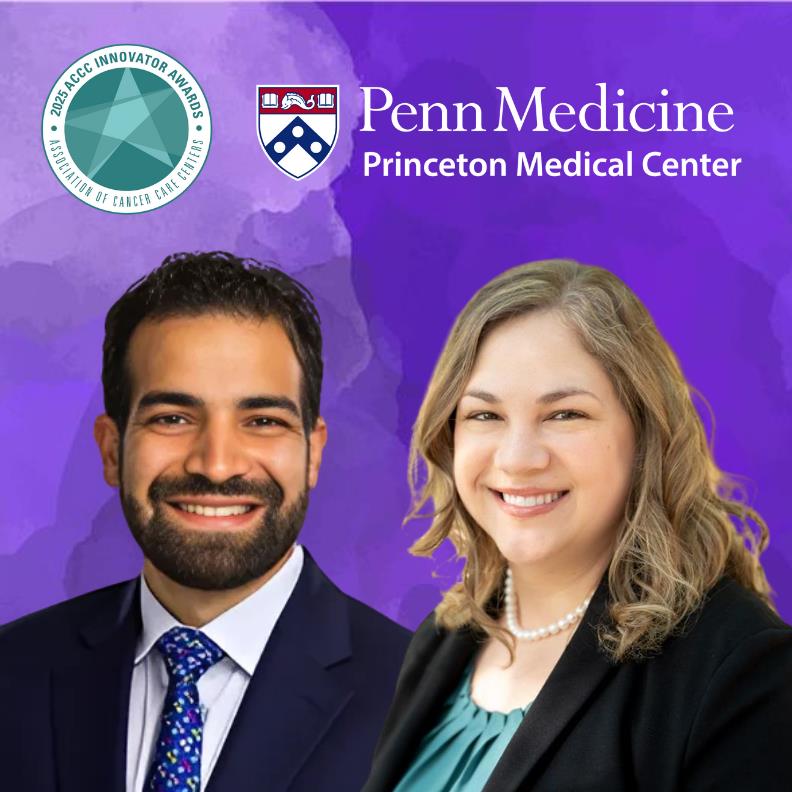
This is the first blog post in a 6-part series recognizing the achievements of the 2025 ACCC Innovator Award winners before their in-depth sessions at the ACCC 42nd National Oncology Conference. Learn more about the innovations being recognized this year and those who pioneered them by joining ACCC in Denver, Colorado, from October 15-17, 2025.
With approximately 60% of cancer cases occurring in adults over age 65, advancing age is a significant risk factor for cancer. Treatment tolerance and outcomes for these patients are also often affected by comorbidities and social drivers of health that may limit access to care. To better identify impairments not typically found in routine oncology exams and facilitate patient-centered treatment decisions, national guidelines recommend that all patients older than 65 should be evaluated with a geriatric assessment—a tool used by clinicians to gather further information about health status, well-being, and social support—prior to initiating systemic therapy.
Despite strong evidence supporting the use of geriatric assessments in improving oncology care for older adults, however, their integration into routine clinical workflows remains inconsistent, as many cancer centers struggle to implement an approach that is both feasible and sustainable. To address this gap in care, Penn Medicine Princeton Health developed and implemented a structured, scalable geriatric oncology program, which earned the cancer program a 2025 Association of Cancer Care Centers (ACCC) Innovator Award. In anticipation of the ACCC 42nd National Oncology Conference this fall, ACCCBuzz spoke to Julianne Ani, MPH, manager of the geriatric oncology program; Kerri Celaya, MA, FACHE, director of cancer services; and Ramy Sedhom, MD, section chief of medical oncology, at Penn Medicine Princeton Health, to learn more about its program.
ACCCBuzz: How long has Princeton Cancer Center been an ACCC member?
Celaya: We have been a member since 2009.
ACCCBuzz: What do you enjoy most about being an ACCC member? Are there specific programs, resources, or tools that you use at your cancer program?
Celaya: I’ve been to the National Oncology Conference twice now, and both events were really excellent experiences in terms of the content and opportunities to connect with other programs. Our financial navigator has also done a lot of work with the ACCC Financial Advocacy Network and we have benefited from that immensely. But I think the most beneficial resource is the community digest email every morning that summarizes activity in the ACCCeXchange. We ask questions in there occasionally, but even just reading about the challenges other cancer centers are having helps us generate ideas. Having that forum to be able to communicate with other cancer centers—that’s my favorite part.
Dr. Sedhom: ACCC is very pragmatic in terms of care implementation. It’s very focused on community-facing clinical care teams, and there are a lot of practical, hands-on resources. When I first received notice that we had funding to start a geriatric oncology program, we heavily utilized the ACCC guidebook on geriatric assessment, which had a lot of great resources, including professionals to reach out to, examples of other programs and what they had done well, and strategies to integrate the multidisciplinary team, which was key to our program.
ACCCBuzz: What makes your cancer center unique?
Celaya: We’re part of Penn Medicine, a large academic health system, which closely aligns us with Penn Medicine’s Abramson Cancer Center, a world leader in cancer research, patient care, and education. This means that we can provide our patients with access to the latest forms of cancer prevention, diagnoses, and treatments close to home. Another unique aspect of our center is that we treat a proportionately high number of geriatric patients compared to other centers in our area, which inspired us to develop a comprehensive, innovative program to address the needs of older patients.
Dr. Sedhom: At Princeton in particular, we have the Penn Medicine affiliation that affords us the balance of cutting-edge treatments—which is what people are often looking for—while maintaining a deep human connection with our patients. This balance is emblematized by our geriatric oncology program, because it is very focused on the whole person. Older adults especially are often forgotten or face a system that’s not always best suited to their individual needs, so we think about our geriatric oncology program as the nexus point of clinical innovation in the spirit of Penn Medicine, with a population health mindset.
ACCCBuzz: It can be challenging for administrators and C-suite members to share a common language with clinicians and others who provide direct patient care. Can you share any tips you used to obtain buy-in and support for your innovation?
Celaya: Constant communication and collaboration from the beginning, both on the part of clinical and administrative staff, was crucial. Having people involved who were thinking about finances, budgets, and ROI helped us determine the type of data we needed to capture.
Dr. Sedhom: It’s important to speak the language of outcomes and operations; they go hand in hand. For programs like this to work, they have to be pragmatic and sustainable. For us, there were 3 important pillars we considered, the first being improving patient outcomes. There is a lot of data demonstrating that older adults with cancer are a vulnerable population that is both over- and undertreated, so we had a strong case for the importance of implementing a geriatric oncology program. The second pillar is improving staff satisfaction, because while this can be a satisfying patient population to treat, it’s sometimes the hardest patient population to treat. Therefore, being able to bring the right resources to these patients and properly identify the domains affecting treatment outcomes can greatly impact staff morale. Our third pillar is improving both downstream utilization—such as shortening length of stays and keeping people out of the emergency room—and revenue generation. Close to 90% of our older adult patients are receiving some sort of cancer treatment, which demonstrates the need for a dedicated geriatric oncology program.
ACCCBuzz: ACCC president Una Hopkins, DNP, MSN, FNP-BC, NE-BC, RN, FACCC, centered her theme on Designing Oncology Care to Meet the Needs of a Growing Patient Population. A key component of that theme is Optimized Oncology Service Line Structures, which was key to your innovation. Can you share any insights you’ve learned in this area?
Dr. Sedhom: Innovation must be embedded into existing workflows—this is a strong belief of ours. This program can’t be a special referral pathway; it has to be something we try to do for every single patient that walks into our clinic. It’s the only way to do this equitably. One phrase I’ve always liked about innovation is, “Practice does not make perfect. Practice makes permanent.” In that spirit, we have made it a habit to constantly refine our program intentionally based on the feedback we receive. We also reach out to clinicians when there’s a missed opportunity of a patient not receiving an assessment, and consequently having a bad, avoidable outcome. It’s also important for us to empower all members of the health care team to work top of license, such as our geriatric social workers and geriatric nurse navigators, who are able to independently do a lot for their patients.
Ani: We invested in innovative technology that would make implementation relatively easy for clinicians and that could be applied to other locations with the same EHR, but with their own infrastructure and their own workflows. We did this incrementally, fine-tuning it along the way, and we’re still refining it today because there are always improvements to be made. As we engage with forward-thinking stakeholders and personnel from many different disciplines to build and refine our innovation, we’re able to address crucial needs of older adults with cancer in a way that is both sustainable and scalable. It’s been key to have the engagement of so many different people throughout the health system, and I’m very appreciative of the support we’ve received.