The Association of Community Cancer Centers (ACCC), building upon the National Cancer Institute’s Multidisciplinary Care Assessment Tool, created a model framework (Improving Care Coordination Model) for cancer care providers to use in improving care coordination for lung cancer patients covered by Medicaid.
The Model is a framework that includes 12 assessment areas with 5 levels. Within each level are service-asset criteria, with Level 1 representing the most basic provision of care and Level 5 representing the optimal best practice for care coordination. The Model is intended to help cancer programs improve to any achievable target level within a selected assessment area.
The Model is intended to be used by a multidisciplinary team that cares for cancer patients, including oncologists, hematologists, physician assistants, nurse practitioners, pharmacists, social workers, financial advocates, and administrators. The Model supports an objective assessment on how cancer care is provided at an institutional level. It serves as a scaffolding to build quality improvement initiatives focused on care coordination for all patients.
Read more about the model below.
This project is supported by Regeneron.
Overview
Guided by an interdisciplinary Advisory Committee, led by physician champion co-principal investigators, and a Technical Expert Panel, ACCC developed the Model in three phases:
Phase One—Research and Beta Model Development
Learn More
Phase Two—Testing the Beta Model
Learn More
Phase Three—Data Analysis and Outcomes
Learn More
Support provided by Bristol Myers Squibb Foundation and Regeneron



ACCC's Improving Care Coordination Model can lead to improved care and treatment outcomes for patients with lung cancer.


The OCCM was designed to be a usable framework that offers lung cancer programs, regardless of setting, size, and resource level, and the flexibility to conduct continuous assessments of care coordination practices and measure strengths and opportunities in the pursuit of optimal patient outcomes.

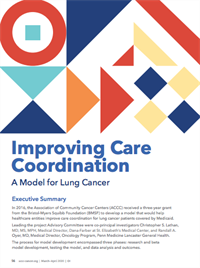
In 2016, the Association of Community Cancer Centers (ACCC) initiated a three-year multiphase project to develop an Optimal Care Coordination Model (OCCM) for Medicaid patients with lung cancer that would help assess and strengthen care delivery systems by facilitating and expanding access to multidisciplinary coordinated care.
In this article, the authors discuss revisions to the Optimal Care Coordination Model following beta testing to develop the final version, rationale for significant revisions, and nationwide dissemination of the Model.
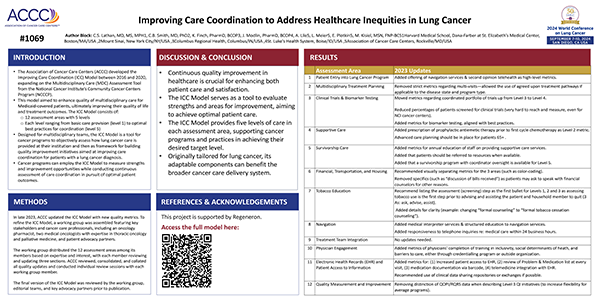
Presented at the IASCL 2024 World Conference on Lung Cancer.
![[Abstract #105] An Optimal Care Coordination Model (OCCM) for Medicaid Patients With Lung Cancer: Results From the Beta Model Testing Phase of a Multisite Initiative in the US](https://cdn.sanity.io/images/0vv8moc6/accc-cancer/c89f5a36d0c36f09d59fce2f3e8d26152ddc7c53-694x474.png)
Presented at the 2020 ASCO Quality Care Symposium.
![[Abstract #104] An Optimal Care Coordination Model (OCCM) for Medicaid Patients With Lung Cancer: Finalization of the Model and Implications for Clinical Practice in the US](https://cdn.sanity.io/images/0vv8moc6/accc-cancer/c0816d67a25d1397bd0e8c3ec1c5c226cc13dc44-518x386.png)
Presented at the 2020 ASCO Quality Care Symposium.
![[Abstract e14010] An Optimal Care Coordination Model for Medicaid Patients with Lung Cancer: Lessons Learned from the Beta Testing Phase of a Multisite Initiative](https://cdn.sanity.io/images/0vv8moc6/accc-cancer/d7450ab43167f577ba770be17b6b4078279e6836-190x236.png)
Presented at the 2020 ASCO Virtual Scientific Program
![[Abstract] Establishing a Multi-Location Quality Improvement Initiative](https://cdn.sanity.io/images/0vv8moc6/accc-cancer/d968275c98c2e6330364fbc8b4c8b575fc594ab2-202x151.png)
Presented at the 2019 Alliance Annual Conference in National Harbor, MD.
![[Abstract #273] Creating an Optimal Care Coordination Model For Lung Cancer Patients on Medicaid](https://cdn.sanity.io/images/0vv8moc6/accc-cancer/472a3daf59d0d21d83639af0632e29687a367116-770x496.png)
Presented at 2018 ASCO Quality Care Symposium in Phoenix, AZ
The care coordination tool [the Model] really helped us formally evaluate our program. We knew that patients diagnosed with lung cancer were getting lost in our system. We had a lot of late-stage lung cancer patients, and we needed to improve our case planning so we could identify those patients sooner.
— Sherri Costa, MS, RN, AOCNS, Manager of Cancer Support Services & Quality Improvement Coordinator, Ascension Wheaton Memorial Medical Center