Three factors that impact caring for older adults in the United States today are occurring simultaneously. Together the factors make a compelling case for cancer providers to better support the needs of older adults and caregivers:
Becoming an Age-Friendly Health System entails reliably providing a set of specific, evidence-based geriatric best practice interventions to all older adults in your health system. This is achieved primarily through redeploying existing health system resources to achieve:
The 4Ms — What Matters, Medication, Mentation, and Mobility — make care of older adults that can be complex, more manageable. The 4Ms identify the core issues that should drive all care and decision making with the care of older adults. They organize care and focus on the older adult’s wellness and strengths rather than solely on disease. The 4Ms are relevant regardless of an older adult’s individual disease(s). They apply regardless of the number of functional problems an older adult may have, or that person’s cultural, ethnic, or religious background.

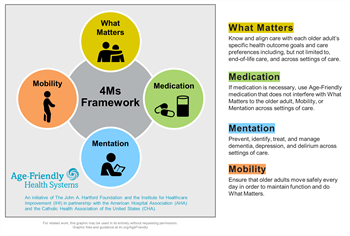
The 4Ms are a framework, not a program, to guide all care of older adults wherever and whenever they touch your cancer program’s care and services. The intention is to incorporate the 4Ms into existing care, rather than layering them on top, to organize the efficient delivery of effective care.
In 2020, the COVID-19 pandemic has put an increased burden on older adults, families, and staff in health systems. Perhaps especially during this challenging time, we have found that the 4Ms can reduce burden on care teams by providing an organizing framework to focus on the most critical care for older adults.
Age-Friendly Health Systems practice the 4Ms in every interaction with older adults. IHI recognizes care locations, such as hospitals, practices, retail-clinics, and nursing homes as Age-Friendly when they share a description of how they assess, document, and act on each of the 4Ms.
Download this one-pager to learn more and share with your colleagues.
The U.S. population is aging. So ACCC—in partnership with the Institute for Healthcare Improvement (IHI)—developed the Oncology Action Community to help participating cancer programs and practices become age-friendly health systems.

On September 16, the National Comprehensive Cancer Network convened experts and stakeholders in D.C. for a policy summit spotlighting today’s cancer screening and prevention landscape. Learn what speakers discussed, including what changes need to happen to create an equitable future for all people at risk—or not—for cancer.
September is Ovarian Cancer and Gynecologic Cancer Awareness Month. In recognition, ACCC shares how its Barriers to Quality Care in Ovarian Cancer Phase II will test the model developed in the previous phase to optimize care for patients with advanced epithelial ovarian cancer.