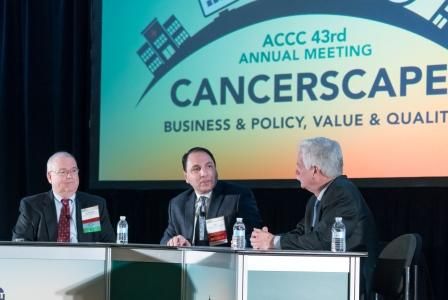
The mantra of “moving from volume to value” is ubiquitous in healthcare today. So what do cancer programs need to know about evolving value frameworks in oncology? Attendees at the ACCC 43rd Annual Meeting, CANCERSCAPE, in Washington, D.C., heard real-time updates on two of the leading frameworks—ASCO’s work-in-progress Value Framework and NCCN’s Evidence Blocks™.
Both value frameworks aim to be tools used in support of patient―physician shared decision-making according to panelists Stephen Grubbs, MD, FASCO, Vice President of Clinical Affairs, American Society of Clinical Oncology, and Robert Carlson, MD, CEO, National Comprehensive Cancer Network.
ASCO’s Value Framework was not built on drug pricing, but to have a discussion with a patient on potential financial toxicity and the benefit of the treatment in the context of how much the treatment will cost the patient, explained Dr. Grubbs. ASCO’s framework uses three primary parameters to calculate value: clinical benefit, toxicities of treatment, and cost. “Our goal at ASCO is to develop a tool that could be customized with information for each individual patient,” said Dr. Grubbs.
After receiving more than 400 comments on its original Value Framework draft, ASCO published a revised version in May 2016. Grubbs made clear, however, that ASCO’s framework is still a work in progress. “It’s not yet ready for use,” he stressed.
In 2017 ASCO is working on improving the framework methodology, Dr. Grubbs explained, noting that a current weakness is that the framework is set up to compare a randomized clinical trial between two different treatments. “If I have a treatment where I use drug A versus drug B, and than I have a trial that compares drug B to drug C—how do I compare drug A to drug C?” Work is underway at ASCO to address cross-trial comparisons and also to “anchor the net health benefit score in some meaningful way,” Grubbs shared. Finally, ASCO will continue work with patient advocates and patients to identify endpoints that are meaningful for patients.
On the other hand, NCCN’s Evidence Blocks are operationalized. NCCN’s goal was to create a “flexible value system that could be used to develop each patient’s equation for what is valuable,” said Robert Carlson, MD, CEO, National Comprehensive Cancer Network. NCCN Evidence Blocks are built on five metrics:
The Evidence Blocks are presented in a graphic format so that a user can look for “30 different options in about 4 or 5 seconds and come up with regimens that would be optimal for a specific circumstance,” Dr. Carlson said.
Like ASCO, NCCN intends the Evidence Blocks to support a patient-centered approach to integrating a value discussion into everyday practice. “We look at Evidence Blocks as a conversation starter, not an answer,” Carlson said. “We don’t tell the patient, because the Evidence Block looks like this, this is what you should do. It’s a question of what’s most important to them.”
Currently, 33 of the NCCN guidelines have Evidence Blocks associated with them. By the end of 2018 all of the NCCN guidelines that have systemic therapies should have Evidence Blocks, according to Carlson. NCCN also intends to expand the Evidence Blocks into other treatment modalities. “We are now starting to look at other modalities, radiation oncology, surgical oncology, and diagnostics . . . in terms of the same sort of scales,” he said.
Rounding out the discussion, panelist Ali McBride, PharmD, MS, BCPS, The University of Arizona Cancer Center added perspective on the cost/value discussion as it may unfold on the frontlines of care. “Many patients may not be able to afford the 20% copay cost for IV therapy, let alone the out of pocket cost for many oral therapies,” he said. “We have to spend a lot of time detailing out those costs for patients, and if they can’t afford it, we have to say, then what’s our next step in that guideline pathway?”
All three panelists noted the need for financial transparency for patients and providers as one component of the value discussion.
In closing, panel moderator Christian Downs, JD, MHA, Executive Director, ACCC, asked panelists to consider what the value framework discussion might look like 10 years down the road.
Acknowledging the difficulty of making any predictions about the future shape of the oncology value discussion, Dr. Carlson envisions technology playing a pivotal role. “My own expectation and hope is that within a decade we will have computer-based systems that patients are able to interact with directly and help define and discover their own value system,” he said. Such a system would enable patients to indicate if they were more concerned with neurotoxicity or cardiotoxicity, for example. Plus the system would also have the capacity to query payers so that patients could know the financial impact of their therapy.
Big data (if the promise is realized) may change the face of value frameworks, noted Dr. Grubbs. The potential of extensive real-world databases will bring “much more information on what happens to patients outside the narrow clinical trial that has the best, the most robust patients. . . [and extend to] what happens in the real-world. . . . if we had a big data system that had all this information about what happened to everybody and you could really home in on what happens to a 75-year-old person who was not in the clinical trial and have the cost data, you might come up with a very different looking value [framework] from what we’re showing you here today.”
Finally, as value frameworks continue to evolve, community cancer programs and practices have an important role to play, panelists agreed. “There’s a huge reservoir of expertise and experience in community oncology, and we’d love to tap that, to learn from that. [One of the] ways you can help us, is to continually give us feedback in terms of whether we have it right or wrong. . . . talk to us,” Dr. Carlson said.
Dr. Grubbs concurred, adding that community oncologists are key to making value frameworks functional. “When you see this come out, please make comments back to ASCO on how to make this better, because nobody is going to get this right…right from the beginning.”