Author(s):
An early contributor to evidence supporting the impact of remote patient monitoring, Highlands Oncology received a 2025 ACCC Innovator Award for its sustainable, scalable remote patient monitoring model.
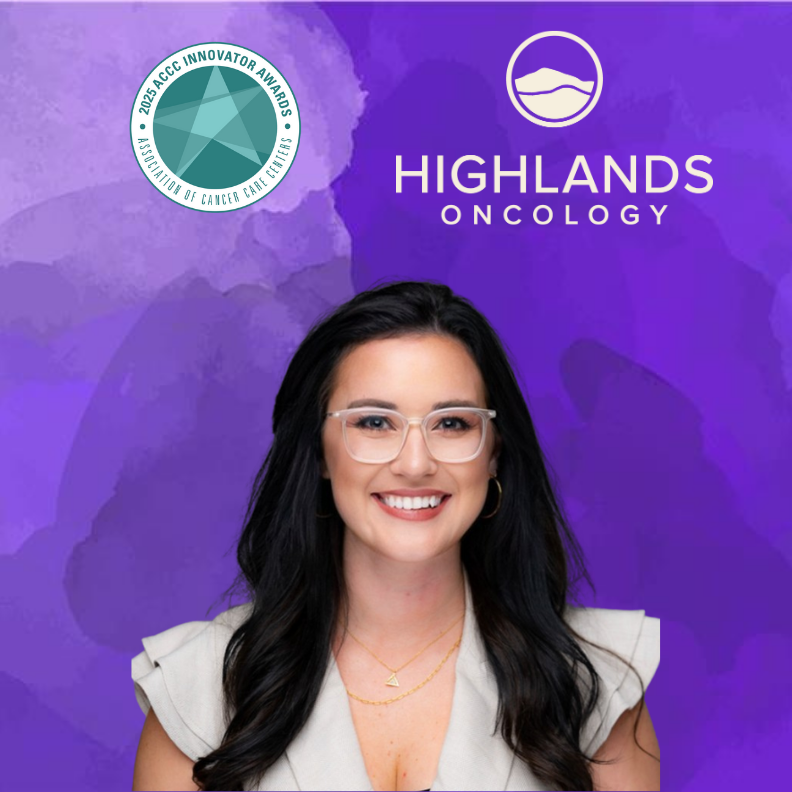
This is the fourth blog post in a 6-part series recognizing the achievements of the 2025 ACCC Innovator Award winners before their in-depth sessions at the ACCC 42nd National Oncology Conference. Learn more about the innovations being recognized this year and those who pioneered them by joining ACCC in Denver, Colorado, from October 15-17, 2025.
Throughout treatment, many patients with cancer experience acute, preventable issues that often land them in the hospital or emergency department (ED). To mitigate unnecessary visits, many cancer programs are exploring remote patient monitoring in the form of electronic patient-reported outcomes, which have been shown to significantly improve patient satisfaction and quality of life, increase time on treatment, reduce ED and hospital utilization, and prolong overall survival.
An early contributor to real-world evidence on the impact of remote patient monitoring, Highlands Oncology received a 2025 Association of Cancer Care Centers (ACCC) Innovator Award for the creation of its sustainable, scalable remote patient monitoring model. In anticipation of the ACCC 42nd National Oncology Conference this fall, ACCCBuzz spoke to Lauren Hughes, RN, director of infusion services at Highlands Oncology, to learn more about the program.
ACCCBuzz: How long has Highlands Oncology been an ACCC member?
Hughes: We have been a member since 2018.
ACCCBuzz: What do you enjoy most about being an ACCC member? Are there specific programs, resources, or tools that you use at your cancer program?
Hughes: We love sending our team to the annual conferences—the Annual Meeting and Cancer Center Business Summit and the National Oncology Conference—especially new hires, when possible. Those events are unique opportunities to informally meet and collaborate with cancer programs across the nation, discuss best practices, and just openly share information with one another. We also get a lot of use out of the ACCCeXchange for the same reasons—it’s really beneficial to connect with the entire ACCC community on that platform and work together to answer questions and problem solve.
One of the things I love most about working in the oncology sector is that practices don’t view each other as competition. Instead, we pull together in these national forums to share information for the good of our patients—because none of us knows it all—and I love that ACCC’s resources and platforms facilitate this exchange of ideas.
ACCCBuzz: What makes your cancer center unique?
Hughes: Highlands Oncology takes a very holistic approach to the patient journey. When a patient comes in and receives a cancer diagnosis, we don’t only focus on that one aspect of care. Rather, we make it a priority to provide every patient with a wide array of supportive care resources to meet all of their needs. That includes resources for nutrition, spiritual support, and screenings for physical therapies and occupational therapies. Most recently, we’ve started offering mental health support with the option for patients to choose a quick intervention where they can meet with a staff member within the week, rather than waiting the typical 4 to 6 months to see a psychiatrist.
I think our holistic approach to care makes Highlands Oncology special, and it’s something patients truly benefit from, because our practice serves as a one-stop shop for them to get everything they need. Even though Highlands is a large practice and we are continuing to scale, it’s important to our leaders that we don’t ever lose that comfortable, individualized environment that our patients and staff appreciate.
ACCCBuzz: It can be challenging for administrators and C-suite members to share a common language with clinicians and others who provide direct patient care. Can you share any tips you used to obtain buy-in and support for your innovation?
Hughes: Our primary employee population is nurses, physicians, and medical assistants. As a clinician myself, I recognize that our brains are wired to be very patient-focused, rather than being attuned to the business side of running a practice. Over the years, I’ve had the opportunity to learn from great leaders with flexible communication styles who know how to take the goals of a company and translate it into a language that resonates with clinicians. The majority of our practice’s initiatives do impact the quality of care we provide, as well as our employees’ day-to-day life, so it’s important to bridge the gap between leadership and clinicians by explaining why our business goals are important and relevant to the latter group.
At the same time, it’s essential to provide ultimate transparency to clinicians when it comes to certain business goals that are more profit-driven. Not every goal ties directly to patient care, but we do need to bring in money to keep our doors open, pay the salaries of clinicians and staff, and continue to provide the high-quality care that we do. So rather than using soft corporate language, I recommend full honesty, because clinicians tend to be more receptive that way.
ACCCBuzz: ACCC president Una Hopkins, DNP, MSN, FNP-BC, NE-BC, RN, FACCC, centered her theme on Designing Oncology Care to Meet the Needs of a Growing Patient Population. A key component of that theme is Capacity Building at Scale, which was key to your innovation. Can you share any insights you’ve learned in this area?
Hughes: One thing I’ve noticed throughout my health care career is that physicians and nurses tend to be doers. They are extremely scrappy, flexible, and creative problem solvers who are good at finding solutions quickly. But when you’re rolling out an initiative like remote patient monitoring and doing so in a way that is scalable and will succeed regardless of changes that occur in the company in the coming years, you can’t solely rely on that scrappiness because then the project will fail. It will work today, but it was only built for today—not for a year from now, when you have 200 more staff members and 2000 more patients.
To avoid that, we find it really important to step back from those natural tendencies, take a breath, and roll initiatives out much more thoughtfully. When implementing a new process, you also need to engage all possible stakeholders who may be impacted from the beginning, so there are no unwelcome surprises that happen down the line after implementation.
Another important piece is identifying what success and failure look like for your project. Not all ideas are going to be successful, no matter how well you roll them out. But if you roll them out without thoughtful planning, they will fail for sure. So, we work hard to ensure that our programs are scalable and strategic, that we have the necessary protocols and testing lined up before we even begin, and that we incorporate regular feedback to make changes as needed.