ACCC association of cancer care centers
Join/Renew
Login
Join/Renew
Login
Education & Resources
ACCC eXchange LogInSponsored Education from ACCC Corporate PartnersACCC eLearning LogInPresentations & Abstracts
Publications
Oncology IssuesPatient Assistance & Reimbursement GuideTrending Now in Cancer CareBusiness Case Studies for Hiring New Staff
Events
2026 ACCC Leadership SummitAnnual Meeting & Cancer Center Business SummitCapitol Hill DayNational Oncology ConferenceOncology Reimbursement MeetingsOncology State Society Meetings
Policy & Advocacy
ACCC 2026 Policy PrioritiesLetters & StatementsAccess, Payment & Reimbursement ReformWhite Bagging & Brown BaggingAdvocacy ResourcesCancer Moonshot
Membership
Join | RenewWho We AreMembership Types & BenefitsCorporate MembersACCC Member Portal FAQMember Directory
Partners
Oncology State SocietiesPartner OrganizationsCME
News
News ReleasesAdvocacy News ReleasesOncology News
About ACCC
Timeline / 50th Anniversary2025 Impact ReportPresident's ThemeACCC Innovator AwardsACCC FellowsBoard of TrusteesACCC Senior Staff
Breast CancerMetastatic Breast Cancer
Gastrointestinal CancerBiliary Tract CancerColorectal CancerGastric CancerLiver Cancer
Genitourinary CancerBladder CancerProstate CancerRenal Cell Carcinoma
Gynecologic Cancer
Head & Neck Cancer
Hematologic MalignanciesAcute Lymphocytic Leukemia (ALL)Acute Myeloid Leukemia (AML)Chronic Lymphocytic Leukemia (CLL)Mantle Cell Lymphoma (MCL)Multiple Myeloma (MM)Myelodysplastic Syndromes (MDS)
Lung CancerNon-Small Cell Lung Cancer (NSCLC)Small Cell Lung Cancer (SCLC)
Sarcoma
Skin CancerMelanomaNon-Melanoma Skin Cancers (NMSC)
Clinical Practice & TreatmentCancer DiagnosticsCare CoordinationEHR Integration for Biomarker TestingQuality Improvement Collaboration: Integration of Precision Medicine in Community OncologyTreatment
Financial NavigationFAN Boot CampFinancial Advocacy Network (FAN) Resource LibraryPatient Assistance & Reimbursement GuidePrior Authorization
Health Equity & Access3, 2, 1, Go! Practical Solutions for Addressing Cancer Care DisparitiesAppalachian Community Cancer AllianceOncology Advanced PractitionersPersonalizing Care for Patients of All BackgroundsSocial Drivers of Health
Patient-Centered CareAddressing Care Disparities for VeteransAdolescent and Young Adult (AYA)Care Action Plans for People with CancerDermatologic ToxicitiesEmpowering CaregiversGeriatric OncologyHealth LiteracyNutritionOncology PharmacyPatient NavigationPsychosocial Care in OncologyShared Decision-MakingSupportive CareSurvivorship Care
Practice Management & OperationsCancer Program FundamentalsLeadership Sustainment and Engagement VideosOncology Practice Transformation and Integration CenterOncology Team Resiliency
ResearchACCC Community Oncology Research Institute (ACORI)
Technology & InnovationTelehealth & Digital Medicine
ACCCBuzz Blog
CANCER BUZZ Podcast
Oncology Issues
Join/Renew
Login
Breast CancerMetastatic Breast Cancer
Gastrointestinal CancerBiliary Tract CancerColorectal CancerGastric CancerLiver Cancer
Genitourinary CancerBladder CancerProstate CancerRenal Cell Carcinoma
Gynecologic Cancer
Head & Neck Cancer
Hematologic MalignanciesAcute Lymphocytic Leukemia (ALL)Acute Myeloid Leukemia (AML)Chronic Lymphocytic Leukemia (CLL)Mantle Cell Lymphoma (MCL)Multiple Myeloma (MM)Myelodysplastic Syndromes (MDS)
Lung CancerNon-Small Cell Lung Cancer (NSCLC)Small Cell Lung Cancer (SCLC)
Sarcoma
Skin CancerMelanomaNon-Melanoma Skin Cancers (NMSC)
Clinical Practice & TreatmentCancer DiagnosticsCare CoordinationEHR Integration for Biomarker TestingQuality Improvement Collaboration: Integration of Precision Medicine in Community OncologyTreatment
Financial NavigationFAN Boot CampFinancial Advocacy Network (FAN) Resource LibraryPatient Assistance & Reimbursement GuidePrior Authorization
Health Equity & Access3, 2, 1, Go! Practical Solutions for Addressing Cancer Care DisparitiesAppalachian Community Cancer AllianceOncology Advanced PractitionersPersonalizing Care for Patients of All BackgroundsSocial Drivers of Health
Patient-Centered CareAddressing Care Disparities for VeteransAdolescent and Young Adult (AYA)Care Action Plans for People with CancerDermatologic ToxicitiesEmpowering CaregiversGeriatric OncologyHealth LiteracyNutritionOncology PharmacyPatient NavigationPsychosocial Care in OncologyShared Decision-MakingSupportive CareSurvivorship Care
Practice Management & OperationsCancer Program FundamentalsLeadership Sustainment and Engagement VideosOncology Practice Transformation and Integration CenterOncology Team Resiliency
ResearchACCC Community Oncology Research Institute (ACORI)
Technology & InnovationTelehealth & Digital Medicine
ACCCBuzz Blog
CANCER BUZZ Podcast
Oncology Issues
    • Education & Resources
    • Publications
    • Events
    • Policy & Advocacy
    • Membership
    • Partners
    • News
    • About ACCC
ACCC association of cancer care centers
5425 Wisconsin Ave #600, Chevy Chase, MD 20815
Tel: 301.984.9496 Email Us
Contact UsVolunteers
Advertise
Career Center
Terms and Conditions
Privacy Policy
ACCC Rebranding
Copyright © 2026 Association of Cancer Care Centers. All Rights Reserved.
HomePublicationsOncology Issues

CMS Drug Price Negotiation

August 18, 2025
Oncology Issues
August 2025
Volume 40
Issue 4

Author(s):

Emily Hope Carroll, MHA

CMS Drug Price Negotiation
Download Issue PDFDownload PDF

The passage of the Inflation Reduction Act in 2022 was the first instance of the federal government allowing Medicare to negotiate drug prices, leading to lower costs for patients who may be prescribed selected high-cost medications. These negotiations with the Department of Health and Human Services involve working directly with pharmaceutical companies and manufacturers to negotiate the maximum fair price, or the highest price that a Medicare Part D plan sponsor can pay for a selected drug.1

There are rules for the number of drugs allowed to be negotiated each year, the type or class of drug, and strict timelines for negotiations. The drugs selected are those that account for the largest portion of Medicare’s spend and have no generic or biosimilar competitors; often, these drugs are prescribed for chronic diseases such as diabetes or heart failure.2 Revised prices for these Medicare Part D drugs typically go into effect 2 years after negotiations, so those drugs finalized in 2024 will be available at the negotiated price beginning in January 2026.

Earlier this year, it was announced that as part of the third cycle of negotiations, the Centers for Medicare & Medicaid Services (CMS) will include select Medicare Part B drugs—injectables or infused drugs, such as chemotherapy—administered in hospitals or outpatient settings. These negotiated drug prices will go into effect beginning in January of 2028.

CMS issued its annual draft guidance for the Medicare Drug Price Negotiation Program on May 12, 2025, which gives the granular details of identified drugs, drug pricing that may be renegotiated, classes of drugs, requirements for manufacturers, and payment stipulations, among other topics.3 When such directives are issued, CMS seeks public comments from patient organizations, professional medical societies, and pharmacy organizations to understand where changes may need to be made or where other issues may arise that may be unaccounted for.

Like many others, the Association of Cancer Care Centers (ACCC) responded to the request for comments and urged CMS to take 2 actions in a public letter sent on June 26, 2025:

1 Protect access, health, and well-being for patients with cancer by ensuring that US cancer centers and cancer care profession­als can continue to provide selected drugs and the full array of support services those patients need.
2 Develop detailed implementation policies for Part B drugs selected for the Medicare Drug Price Negotiation Program and expeditiously issue such policies for public notice and comment.

Drug price negotiations could lead to significantly lower reimbursements, meaning payments for oncology-specific drugs could be drastically reduced. These reductions, in turn, have downstream impacts on health care systems, especially smaller programs or those in rural or underserved areas that are more reliant on Medicare reimbursements. Reimbursement reductions on this scale could force physicians to choose alternative therapies or sacrifice support services, such as patient navigation services, which reimbursements help to cover and are critical when caring for patients with cancer.

The complex nature of cancer care makes adequate reimbursement essential for maintaining high-quality services and coordinated care. Already strained by increasing patient volumes, a workforce shortage, and complex treatments, cancer centers rely on reimbursement to maintain specialized facilities, highly trained staff, and comprehensive support services so their patients can receive safe, effective cancer care.

Additionally, ACCC believes that while acting in good faith to seek comments related to the implementation of drug price negotiations for Part B drugs, CMS must swiftly develop detailed implementation policies related to these drugs. Doing so would give broader protections and guidance for all stakeholders involved in the conversa­tion, including patients and providers, the latter of whom need sufficient time to assess the financial impact of negotiated prices on their unique patient populations.

Now that the public comment period is closed, CMS will spend the next few months analyzing the responses and, in some cases, making changes to the drafted guidance. In the fall of 2025, 2 additional sets of revised guidance will be released, each followed by an open comment period. By February 2026, a list of up to 15 drugs eligible for price negotiations and applicability will be published. ACCC will continue to monitor—and, when appropriate, comment on—the drugs selected for negotiation, as well as initial price applicability as it impacts patients’ health outcomes and providers’ ability to treat.

Emily Hope Carroll, MHA, is a manager of association services for the Association of Cancer Care Centers (ACCC) in Rockville, Maryland.

References
1. Cubanski J, Neuman T, Freed M. Explaining the prescription drug provisions in the Inflation Reduction Act. KFF. January 24, 2023. Accessed June 29, 2025. https://www.kff.org/medicare/issue-brief/ explaining-the-prescription-drug-provisions-in-the­
inflation-reduction-act/


2. Martin K. Medicare drug price negotiations: all you need to know. The Commonwealth Fund. May 15, 2025. Accessed June 29, 2025. https://www.common wealthfund.org/publications/explainer/2025/may/ medicare-drug-price-negotiations-all-you-need-know

3.Centers for Medicare & Medicaid Services. Medicare Drug Price Negotiation Program: Draft Guidance, Implementation of Sections 1191 – 1198 of the Social Security Act for Initial Price Applicability Year 2028 and Manufacturer Effectuation of the Maximum Fair Price in 2026, 2027, and 2028. May 12, 2025. Accessed June 30, 2025. https://www.cms.gov/files/document/ ipay-2028-draft-guidance.pdf
Articles in this issue

Anchored in Purpose: Navigating Oncology’s Shifting Landscape
Empowering Oncology Professionals with Holistic Support to Cultivate Compassion and Resilience
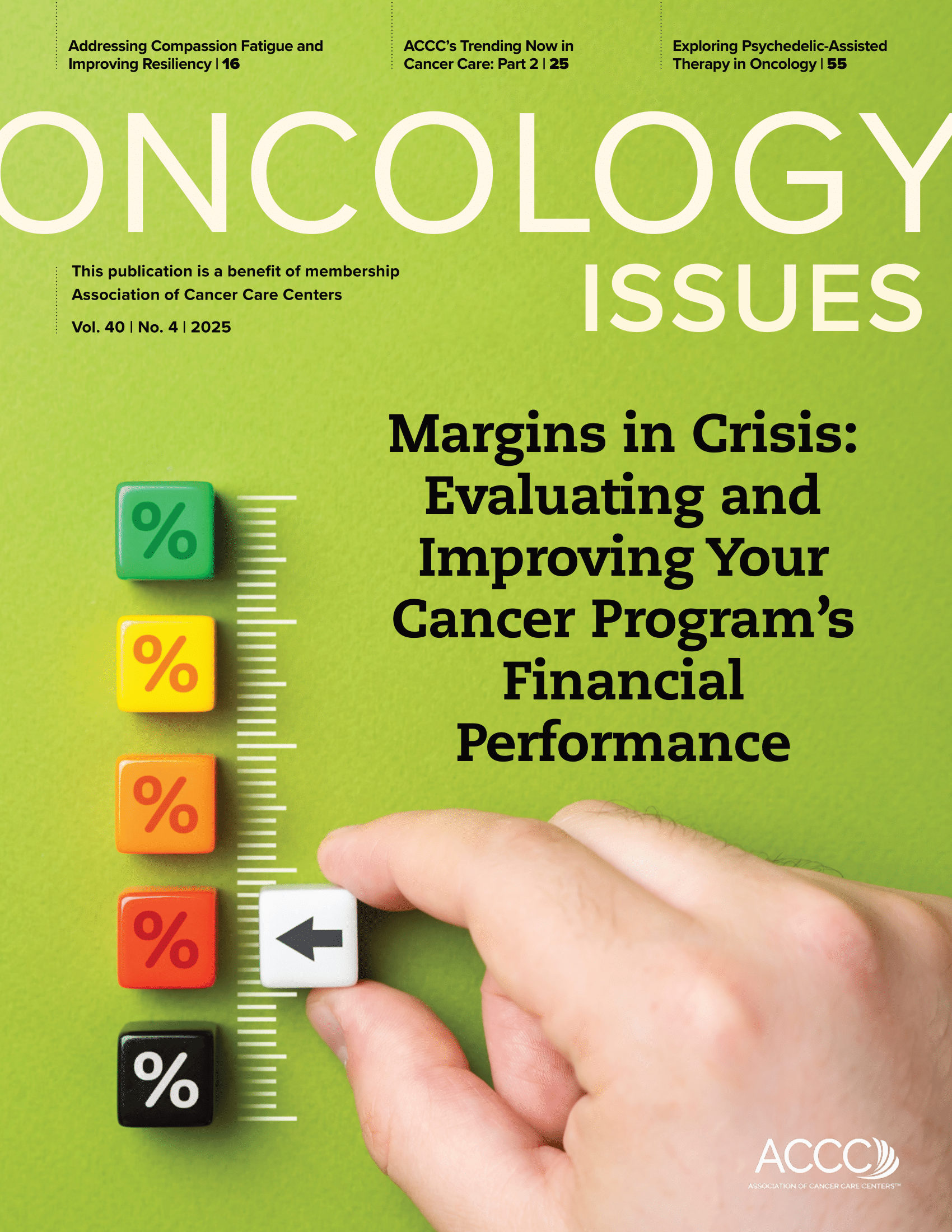
Margins in Crisis: Evaluating and Improving Your Cancer Program’s Financial Performance
Care Code® and Holistic Interventions: Addressing Compassion Fatigue and Improving Resiliency Among Staff
2025 Trending Now in Cancer Care: Part 2
Exploring Psychedelic-Assisted Therapy in Oncology
Breast Cancer Knowledge Gaps and Misconceptions Among Non-Medical Female University Students in Southwestern Nigeria
Lymphedema After Breast Cancer: Addressing Barriers and Building Strategies to Improve Long-Term Self-Management
Advancing Skin Cancer Care With a Specialized Melanoma Clinic
Integrating EHRs With Reference Labs for Biomarker Testing
Fast Facts: Vol 40, No. 4
CMS Drug Price Negotiation
The Physician Is Out: How to Bill Appropriately
Seven Steps to Achieve a Culture of Happiness at Work
Columbia Memorial Hospital-OHSU Knight Cancer Collaborative

Upcoming Events

ACCC 43rd National Oncology Conference

ACCC 43rd National Oncology Conference

In Person October 21, 2026 at 8:00 AM EDT450 Summer St, Boston, MA 02210, USAOmni Boston Hotel at the Seaport, Boston
Register Now!
ACCC Oncology Reimbursement Meeting | Reno

ACCC Oncology Reimbursement Meeting | Reno

In Person November 4, 2026 at 8:00 AM EST255 North Virginia Street, Reno, NV, USAWhitney Peak Hotel Reno, Tapestry Collection by Hilton,
Register Now!
ACCC Oncology Reimbursement Meeting | Providence

ACCC Oncology Reimbursement Meeting | Providence

In Person November 10, 2026 at 8:00 AM EST5 Avenue of the Arts, Providence, RI, USARenaissance Providence Downtown Hotel,
Register Now!
NMSCO 2026 Fall Conference
Oncology

NMSCO 2026 Fall Conference

In Person Conference & ConventionSeptember 12, 2026 at 7:30 AM MDT2101 Louisiana Boulevard NE Albuquerque, NM, 87110Marriott Albuquerque, Albuquerque
Register Now!
TxSCO 2026 Annual Conference
Oncology

TxSCO 2026 Annual Conference

In Person Conference & ConventionSeptember 18, 2026 at 6:00 PM CDT501 Gaylord Trail, Grapevine, TX, USAGaylord Texan Resort & Convention Center, Grapevine
Register Now!
KYSCO 2026 Fall Oncology Review
Oncology

KYSCO 2026 Fall Oncology Review

In Person Conference & ConventionSeptember 19, 2026 at 7:00 AM EDT500 S 4th St, Louisville, KY, USAThe Seelbach Hilton Louisville, Louisville
Register Now!
ESHOS Horizons 2026
Oncology

ESHOS Horizons 2026

In Person Conference & ConventionSeptember 19, 2026 at 7:30 AM EDT1 Liberty Street, New York, NY, USAConvene at One Liberty Plaza, New York
Register Now!
MSOS 2026 Bozeman Meeting
Oncology

MSOS 2026 Bozeman Meeting

In Person Meeting & NetworkingSeptember 22, 2026 at 5:30 PM EDT5 W Mendenhall St suite 102, Bozeman, MT 59715, USA Urban Kitchen, Bozeman
Register Now!
MSCO 2026 Fall Conference
Oncology

MSCO 2026 Fall Conference

In Person Conference & ConventionSeptember 22, 2026 at 5:00 PM CDT1500 Park Pl Blvd, Minneapolis, MN, USADoubleTree by Hilton Hotel Minneapolis - Park Place, Minneapolis
Register Now!
HSCO 2026 September Dinner Symposium
Oncology

HSCO 2026 September Dinner Symposium

In Person Conference & ConventionSeptember 23, 2026 at 5:30 PM HST3660 Waialae Ave, Honolulu, HI, USA3660 On The Rise, Honolulu
Register Now!
Advertisement
Advertisement

Trending Now on
ACCCBuzz Blog

Highlights From Volume 41, Number 4 Oncology Issues

Highlights From Volume 41, Number 4 Oncology Issues

From precision medicine to psychosocial care to navigation for a diverse population, the latest issue Oncology Issues brings insights into not just institutional and administrative barriers to treatment, but areas of care that directly impact the lived experience of those navigating the cancer care continuum.

Transforming Access to Care Through Pre-Intake Navigation

Transforming Access to Care Through Pre-Intake Navigation

The University of Texas MD Anderson Cancer Center in Houston, Texas, developed a novel Pre-Intake Navigation (PIN) program, which identifies and resolves early financial and insurance barriers, enabling patients to access timely, high-quality cancer care with less anxiety and fewer delays. PIN shifts financial navigation from a late-stage, reactive task to an early, standardized, patient‑centered process embedded in the call center workflow.

An APP-Led Outpatient Bispecific Antibody Clinic

An APP-Led Outpatient Bispecific Antibody Clinic

Understanding both the benefits to be had from offering BsAb therapy to its community and the scope of this undertaking, Vanderbilt-Ingram Cancer Center took a novel approach with its APP-led BsAb step-up dosing clinic, which won the program a 2026 ACCC Innovator Award.

Advancing Critical Priorities at the State Level: Louisiana, Iowa, and Washington Awarded for Their Efforts at 2026 ASCO Annual Meeting

Advancing Critical Priorities at the State Level: Louisiana, Iowa, and Washington Awarded for Their Efforts at 2026 ASCO Annual Meeting

At the 2026 ASCO Annual Meeting, the Louisiana Oncology Society received the ASCO Jeffrey C Ward Affiliate Advocacy Award for advancing critical advocacy priorities that have translated into meaningful legislative victories. The Iowa Oncology Society and Washington State Medical Oncology Society were also recognized for their advocacy efforts in 2025 at the meeting, receiving second place awards.

View All ACCCBuzz Blogs

Recently Heard on
CANCER BUZZ Podcast

From Reactive to Proactive: Improving Access to Cancer Care Through Pre-Intake Navigation - [Podcast] Ep. 240

Real-World Oncology Decentralized Trials - [Video Podcast] Ep. 65

The Real Cost of Cancer: Financial Toxicity, Transportation Challenges, and Access Gaps – [Video Podcast] Ep. 65

Closing the Gap in Medical Necessity Review With a Clinical Documentation Integrity Registered Nurse - [Mini Podcast] Ep. 239

View All Podcasts

Latest from Oncology Issues

August 2026
August 2026
June 2026
April 2026
February 2026
December 2025
View All Oncology Issues

Join the Conversation

ACCC eXchange Digital Banner
Login