The U.S. Food and Drug Administration's Oncology Center of Excellence, Project Community, has designated June 17 to June 23 as National Black Family Cancer Awareness Week. The week coincides with Juneteenth—an important date in our nation’s history that marks and celebrates the end of slavery in the United States. By participating in the #BlackFamCan social media effort, ACCC is building support and sharing knowledge with key stakeholders about the importance of including Black patients in cancer clinical trials and genetic databases for oncology research to improve access and effect change in cancer care delivery.
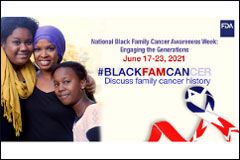
The U.S. Food and Drug Administration's Oncology Center of Excellence, Project Community, has designated June 17 to June 23 as National Black Family Cancer Awareness Week. The week coincides with Juneteenth—an important date in our nation’s history that marks and celebrates the end of slavery in the United States. The goal of this community-based initiative is to increase cancer awareness among Black people in the United States, a vulnerable and underrepresented patient population, by promoting and using #BlackFamCan on social media when tweeting or posting content related to National Black Family Cancer Awareness Week.
According to the American Cancer Society, “African Americans have the highest death rate and shortest survival of any racial and ethnic group in the U.S. for most cancers.” By participating in the #BlackFamCan social media effort, we are building support and sharing knowledge with key stakeholders about the importance of including Black patients in cancer clinical trials and genetic databases for oncology research to improve access and effect change in cancer care delivery.
This need is an important focus for the Association of Cancer Care Centers (ACCC). Immediate-Past President Randall A. Oyer, MD, dedicated his 2020-2021 ACCC president’s theme to improving access to care and cancer clinical trials for patients in underserved communities. Current ACCC President, Krista Nelson, MSW, LCSW, OSW-C, FAOSW, has devoted her 2021-2022 president’s theme—Real-World Lessons from COVID-19: Driving Oncology Care Forward—to improving health equity and social justice in oncology through high-impact psychosocial and supportive care services. Health equity and social justice are critical drivers of quality cancer care, and practice-based solutions, including oncology research and care delivery, are needed to reduce barriers and improve health outcomes for all.
To bridge these two presidential themes, ACCC held an expert panel in March that discussed and taught attendees how healthcare professionals, specifically oncology providers, can integrate bias training and community engagement to develop collaborative strategies that support equity, diversity, and inclusion. Panelist Lailea J. Noel, PhD, assistant professor at the Steve Hicks School of Social Work and assistant professor of oncology and health social work at the Dell Medical School at the University of Texas at Austin, shared that, “social determinants of health, mental health issues, and a lack of access to care, all hinder our ability to get people of color into cancer treatment in a timely fashion.”
In a study of Black women with breast cancer in St. Louis, Mo., Dr. Noel found that many of these women were making critical healthcare decisions—such as whether they should start treatment—in an environment where they have repeatedly had traumatic events happen to them. In particular, these women lived near Ferguson, Mo., and experienced the waves of protests in 2014 and 2015 that occurred as part of the Black Lives Matter movement.
Dr. Noel shared that this principle can be applied to many Black patients, including those who may continue to feel the generational trauma of slavery and distrust in the U.S. healthcare system and those who do not have access to the same resources and support as their White counterparts. Of the women in the study, Dr. Noel noted: “Their kids were healthy, going to school, and the women were able to provide support and safety for their families. If they started treatment, not knowing what would happen if they were to get too sick, who would take care of their family and their homes? The community had an impact on their decision to get treatment.” She concludes that while cancer programs and practices are developing initiatives to address insurance issues, patient navigation, and transportation barriers, many often fail to address the influence of each patient’s community, which include social determinants of health that factor into medical decision-making.
To address these barriers and better engage with communities of color, Dr. Noel suggests that providers need to “respect and honor what our communities bring to the table—not just what we [as providers] bring to them. They are the experts of the sidewalks.” When building a patient advisory or steering committee, oncology providers and researchers need to understand the community they wish to engage, including how to effectively communicate with the people who live in those communities. But the work shouldn’t stop there.
“It’s important to recognize that just because you ask someone of color to participate in a committee or advisory board, it doesn’t equal community engagement. They [members of the community] have to be invested in what you are doing,” said panelist Sanford E. Jeames, DHA, coordinator of health sciences and Austin Independent School District faculty instructor of the adult degree program at Huston-Tillotson University.
For cancer programs looking to find community members invested in their goals, Dr. Jeames noted that modern day bias training can help. “What we need to do is look inward before we look outward,” he said. By looking inward, explained Dr. Jeames, you can better avoid the potential of assimilating into a practice’s dominant culture rather than preserving your own unique identity. By increasing the number of oncology providers from underrepresented groups in your cancer program or practice, you can integrate different perspectives into your care delivery and research so members of underserved communities see themselves represented in your workforce and trust can begin to build.
In closing, Dr. Jeames shared this advice: “All of us come from different cultures, so we must learn each other’s movements, rhythms, and meanings.” By doing so, cancer providers can build sustainable relationships with their communities and improve health equity for all.
To help its members understand and learn from others’ perspectives and experiences, ACCC’s journal Oncology Issues shared the story of Reverend Tammie Denyse, who, despite a lack of evidence on how Black women were responding to a new treatment regimen, enrolled into a clinical trial that resulted in severe treatment-related side effects and a much-diminished quality of life. It was this experience as a Black woman with breast cancer that led her to co-found with her late sister Carrie’s TOUCH—an advocacy organization dedicated to supporting and providing needed resources for all Black women with breast cancer.
Join ACCC on social media as we raise awareness of National Black Family Cancer Awareness Week on social media using #BlackFamCan. A social media toolkit, including sample text and images, is available on the National Black Family Cancer Awareness Week website.
Register to attend the National Black Family Cancer Awareness Week: Engaging the Generations #BlackFamCan panel discussion (via Zoom) on Thursday, June 17, 2pm-3:30pm ET.