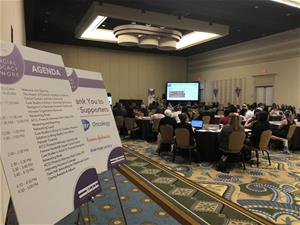
ACCCBuzz is in Orlando for the ACCC's 36th National Oncology Conference kicking off this morning. Two pre-conferences led into today's main event. In case you missed it, below is a recap of yesterday's ACCC Financial Advocacy Network Pre-Conference.
On October 30, financial navigators, clinicians, and patient advocates were joined by other members of the cancer care team—including oncologists, pharmacists, nurses, technicians, administrators, and others—to share case studies and best practices for creating effective oncology financial advocacy programs.
The agenda featured representatives from a broad swath of large and small cancer programs in rural and urban regions across the country. Presenters shared a range of tools and resources they have used to build and enhance financial navigation programs that are having a real impact on the lives of their patients and the well-being of their organizations.
Growing Financial Hardship
Presenters throughout the day shared both startling statistics and heartbreaking anecdotes about the effects of financial toxicity on the everyday lives of patients, families, and caregivers. Underlying many of these numbers and stories is the fact that patient ability to pay has a real impact on both well-being and outcomes.
Presenters emphasized the fact that cancer is one of the most expensive medical conditions to treat in the United States, saddling patients with $3.8 billion in out-of-pocket costs in 2014. With costs increasingly shifting to the patient and steady increases in deductibles and copays outpacing inflation, patients are bearing an increasingly high percentage of their healthcare costs. This is causing many patients to “ration” their care or to go without it completely. Patients have reported not filling prescriptions, emptying savings accounts, and cutting back on essentials like food and shelter in order to afford their care.
Driving Data
Pre-conference participants repeatedly emphasized that the foundation of any effective financial management system is data. Gathering, organizing, analyzing, and monitoring patient data and information helps financial navigators continually track patients’ resources, coverage, and eligibility for assistance programs. When managed well, this data can capture in real time the solid benefits of a financial navigation program both to patients and the organizations that serve them.
Located in Northern Michigan, Munson Healthcare serves a large rural area. Kathleen LaRaia, MS, Executive Director of Munson Healthcare, Cowell Family Cancer Center, says that 70 percent of Munson’s patients suffer from financial toxicity. Munson has had a financial navigation program since 2013. LaRaia says that growing financial burdens on Munson’s patients has spurred the cancer center to expand its financial navigation resources. Munson recently invested in an automated financial navigation system to help the cancer program proactively identify patients with the highest need and maximize available resources to help them.
Munson’s system can dynamically analyze its entire oncology patient population, registering changes to treatment and insurance plans as they occur. It can generate advanced predictive analytics, track new and dynamic sources of grants, accurately measure community benefit, and track the ROI of Munson’s financial navigation system itself. “The system associates each dollar saved with either revenue increase or community benefits,” says LaRaia.
Proving ROI
The diverse presenters at the pre-conference demonstrated that, ultimately, the methodology of data-collection is not as relevant as the accuracy of that data and what you can accomplish with it. When polled, 82 percent of participants said they use either Excel or a home-grown process to measure and report information from their financial navigation programs. The Sidney Kimmel Cancer Center at Thomas Jefferson University Health System has built a dynamic data collection system using Excel.
Angie Santiago, CRCS-I, Lead Financial Counselor-Oncology at Thomas Jefferson Sidney Kimmel, says her team meets with each patient when they are referred for treatment, whether they carry insurance that completely covers them or if they have no resources at all. The data Santiago and her team collects drives all of their financial decisions. “Track everything that aligns with what your financial advocacy goals are,” advises Santiago. “We continually share our numbers with our team, and when they see how much our work is benefiting our patients, it motivates and empowers them.”
Lisa Philipp, RN, MSN OCN, Director of Business Operations at Baptist Health South Florida, Miami Cancer Institute, says her cancer program’s dynamic financial navigation program, which employs 15 patient financial counselors, is able to consistently prove its ROI with exhaustive data collection and reporting. “At a time when reimbursement is lowering, you need to argue for financial counselors,” says Phillipp. “These positions pay for themselves. Their salaries save patients and providers significantly. There is money out there for these patients; all we need is the manpower to find it.”
Helping Across the Care Continuum
Numerous participants observed the increasing importance of the role of the financial navigator within healthcare as a whole. “This will be the largest growing aspect of oncology care,” noted one attendee. “Your financial navigator will be the most important person in your care continuum.”
The financial navigators present commented on the satisfaction they derive from their role in patient care. “Just telling a patient, ‘Hey, we got you. We’ll make sure you get the care you need,’ that can make a world of difference for a patient,” said one participant. “Many financial navigators grow very close to the patients they serve.”
“This is my passion,” summed up another person. “Cancer is scary. We can help alleviate some of the stress that patients feel.