Author(s):
In an exclusive interview with Dr. Modupe Elebute-Odunsi, delegate of the NOC International Panel representing Nigeria, learn about the initiatives she's championed to support women in health care and the innovative care models in her practice.
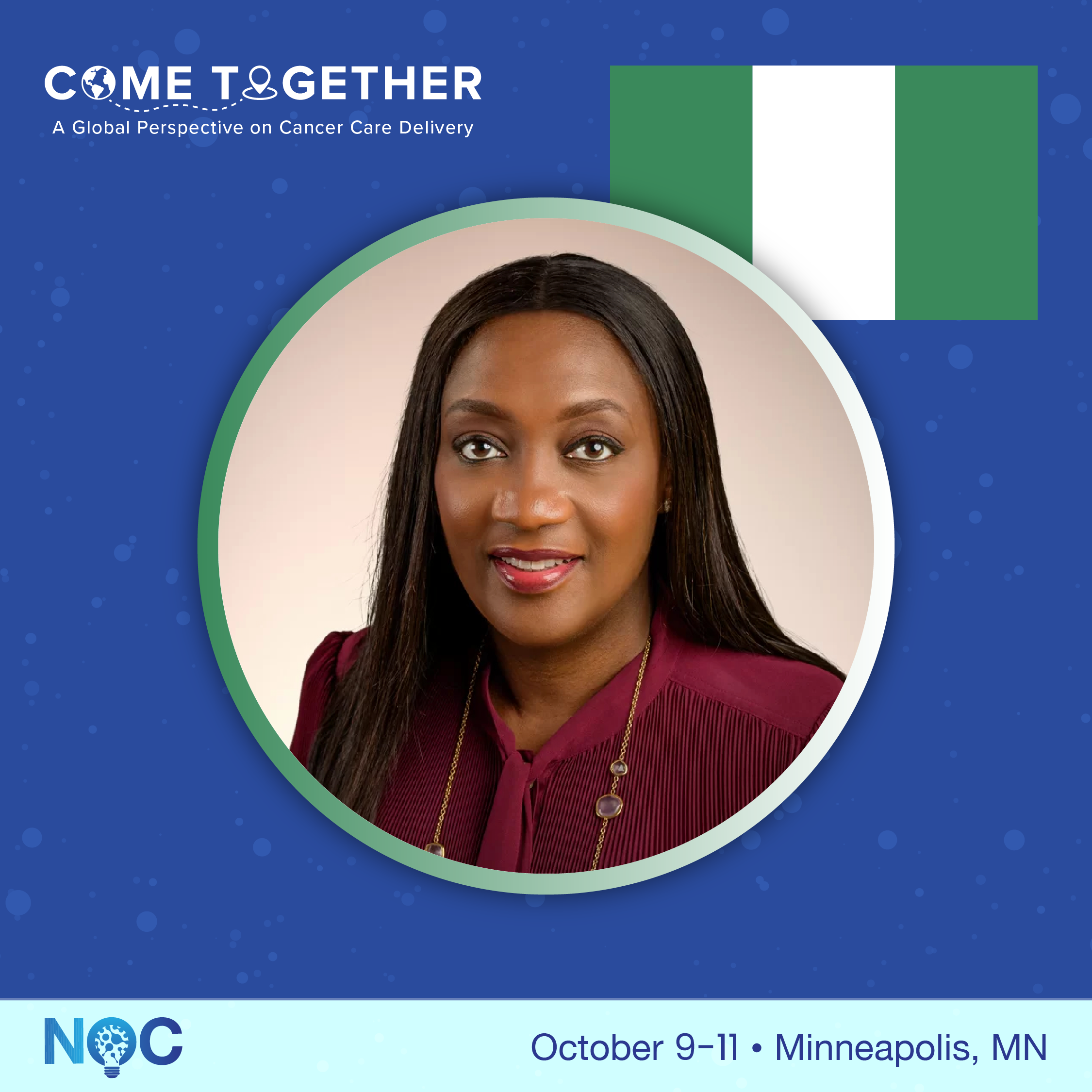
In honor of the inaugural international panel at the Association of Cancer Care Centers’ (ACCC) 41st National Oncology Conference, ACCCBuzz spoke with Modupe Elebute-Odunsi, MBBS, MD, FRCP, FRCPath, founder/CEO of Marcelle Ruth Cancer Centre and Specialist Hospital, founder/Chair Board of Trustees, Women In Healthcare Network, to gain further insight into her experience and the unique challenges faced in Nigeria.
ACCCBuzz: Tell us about your background.
Dr. Elebute-Odunsi: I’m a consultant hematologist by training. I graduated from medical school in Lagos, Nigeria in 1986, then completed my postgraduate studies in the UK for internal medicine and hematology. I did full-time research for 2 years on a leukemia research fellowship and received a doctorate of medicine degree. More recently, I had a passion to go back to Lagos to start a hospital, which will be officially operational for 4 years in December of this year. We’ve seen about 4,000 patients in that time.
ACCCBuzz: Why did you choose to practice in hematology and oncology and what inspires you about caring for patients with cancer?
Dr. Elebute-Odunsi: When I was in medical school, I was fascinated by the fact that you could take blood from a patient, look down the microscope and make the diagnosis, then go to the clinic next door and actually look after the patient. For the oncology side, it was fascinating to see all the new treatments. When I was training, stem-cell transplants were the new thing and increased the ability to cure patients from what before was essentially considered a death sentence. I also like the multidisciplinary approach to looking after patients whereby everybody in the team is important—nurses, pharmacists, social workers. And the fact that we can make a significant impact on the patient’s family by supporting them throughout the care continuum.
For me, hematology/oncology as a specialty in medicine is a very interesting place to be in terms of all the new treatments every few years. We never stay still, because everybody wants to discover how to get rid of cancer completely. Whether it’s in the academic field or the clinical side, we’re always pushing the boundaries, always looking for the answer. Especially more recently with the improvements AI is making in diagnostics, particularly for those of us in low-middle income countries where we have a scarcity of skilled personnel. To have these new techniques that help us make accurate diagnoses is wonderful. I’ve only been living in Nigeria for 4 years now, but one of the significant problems I saw when I went back was being able to make an accurate diagnosis. We’ve cracked the laboratory side and the imaging side, but the histopathology and the immunohistochemistry remain a problem. So to be able to have AI as a tool is really quite comforting. There’s just a lot of interesting work being done.
ACCCBuzz: How do you support and empower women in health care through your initiatives?
Dr. Elebute-Odunsi: When I worked in the UK there were not many women in the places I ended up in my career. I was in an academic role at the top tertiary hospital where the majority of the team was men, especially at the senior level. Coming back to Lagos to set up a comprehensive cancer center, I found I needed to look for opportunities for people to advise and support me, so I was constantly looking for different associations. While I was doing that, it occurred to me that we should find a way to bring women in health care together. Wherever I went, there were not many women in senior leadership roles. And even if there were, they were not very supported.
Eventually I was persuaded to just set it up myself. I researched people in senior leadership in the different sectors of health: medicine, nursing, pharmacy, physiotherapy, health finance, health tech, and research. I called about 30 women. In the end, everybody said yes; that was the first incredible thing. They said, “This is something we always should have been doing.” For those who had gotten to the top of leadership, the phrase that kept coming up was, “It’s lonely at the top. It’s difficult to find any support. I’ve had to struggle my way through this.”
At the end of January, we launched the Women In Healthcare Network with 15 founders from different sectors, and it’s just been incredible. We’re having our first annual conference in November. Before that we’ve had a leadership workshop, and we’re looking at doing some mentorship programs. At our conference, we’re going to focus on the day-to-day issues that women come across, such as struggling through menopause which they can’t discuss at work, but it’s actually really affecting their performance. Or women who have tried to rise to the next level in their career and been told no, whether overtly or not. This is for the women who will sit in the audience and listen to those real-life stories to get that encouragement and confidence that they can do anything they put their minds to.
We do need to support each other because trying to do it on your own is extremely difficult. I’ve been very lucky because I have a really supportive husband, who’s always the first person to encourage me to go for that next role. Not everybody has that. And even with that person, you still question yourself and it’s still difficult in the workplace. I remember struggling in my junior career days in the UK. I didn’t go to medical school in the UK, so I remained that foreigner in their midst for quite a long time. It’s very important for people to seek advice and support from others and learn all that they can.
This network has been incredible. We launched in January and have over 200 paid members already, with a lot of other people who are interested. There are nurses who have gotten their PhDs and physiotherapists who own their own businesses. Some are in policy and working for the government at a very senior level. It’s just incredible to see what women are doing in all these fields, and to watch them excel both here and abroad in unimaginable ways. To get to those top-level jobs, we need support. And the best support is from other women; there’s no doubt about that.
ACCCBuzz: Can you share any innovative care models that have been successful in your practice?
Dr. Elebute-Odunsi: Coming back to Lagos, I found that setting up a center largely for cancer is quite unusual. It’s probably the first of its kind in terms of the amount of infrastructure and services provided in the same place. At Marcelle Ruth we have the chemotherapy day units, outpatient clinics, inpatient clinics, diagnostics from the lab to imaging, 2 modular theaters, and our own radiotherapy machine, which is 1 of about 10 in the whole country. We can treat our patients from one end to the other, and for me that is one of the biggest things in medical care: being able to offer patients everything they need in one place. I do believe it improves the patient outcome because everybody on the team gets to look after the patient group.
After bringing the tumor board to Lagos, there was a huge difference for the patients who couldn’t afford to go abroad. What’s the point of getting on a plane when you can have the same care here? That encourages people to remain and receive care in-country. With cancer care that’s huge because in the past, the majority of patients used to go abroad to India, the UK, the US, or South Africa to access treatments, but they also left behind the support that they would normally get from their family and their friends. Now we’re beginning to see Nigerian patients come back from abroad to receive care at home because they realize the difference.
We’ve also instituted a chemotherapy-led nursing practice, which both improves patient care and the staff’s skillset, consequently improving people’s confidence and interest in medicine. It also allows patients to try to maintain their lifestyle as much as possible. Having outpatient chemotherapy is not something that can be offered everywhere, so being able to do that in Nigeria is very exciting.
Read more content from the inaugural international panel in the Day 3 NOC ACCCBuzz Blog.
Rachel Radwan is an Editorial Coordinator for the Association of Cancer Care Centers.