The 2018 Trending Now in Cancer Care Survey marks the ninth year of an annual ACCC survey designed to identify current and emerging trends across U.S. cancer programs. The comprehensive survey was conducted in partnership with Advisory Board's Oncology Roundtable. More than 200 respondents from 161 organizations participated in the 2018 survey, which provides insights into nationwide developments in the business aspects of cancer care.
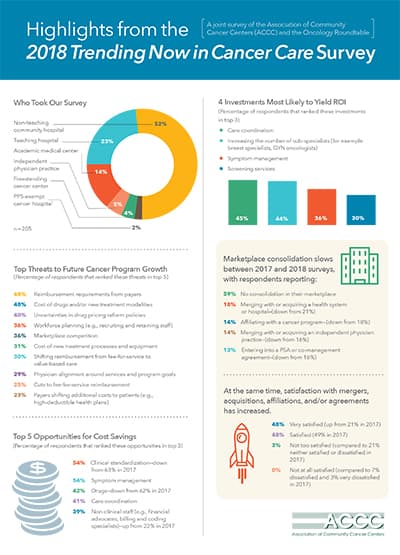
Payer reimbursement requirements and healthcare reform policy bubble to the surface as top threats. Nearly half (48 percent) name reimbursement requirements from payers, 48 percent cite cost of drugs and/or new treatment modalities, and 40 percent find uncertainties in drug pricing reform policies a top threat to future program growth.
Care coordination and symptom management identified as top opportunities for return on investment and cost savings. Proactive symptom management and improved communication between care settings can help keep patients out of the ER and reduce unnecessary hospitalizations—cutting costs and improving the patient experience.
The promise of EHRs to streamline communication and increase efficiency remains unrealized. While 69 percent of respondents report their EHRs either "significantly improved" or "somewhat improved" care coordination, nearly 70 percent say EHRs have made physician and staff workdays longer. Almost half (49 percent) feel that EHRs have had a negative impact on provider-patient interactions.
Patients are refusing treatment due to high costs. Nearly half (49 percent) have had a cancer patient refuse treatment because of financial worries in the past year; 79 percent report being “very concerned” or “somewhat concerned” about this trend.
Precision medicine and immunotherapy challenges. Insurance coverage (68 percent) and payer reimbursement requirements (63 percent) hinder survey respondents' ability to conduct biomarker testing. Nearly three-fourths (72 percent) report that cost and reimbursement are the greatest challenges to offering immunotherapy treatments.
The full 2018 Trending Now in Cancer Care Survey is available to ACCC members only.
If you have any questions about the survey, please contact Provider Resources.
Jul 20, 2021
In this episode, we focus on the mental and emotional toll that COVID-19 continues to have on cancer care professionals—while much of the public experiences a 'summer of joy' due to rising vaccinations.
Jun 29, 2021
As the COVID-19 pandemic recedes and restrictions loosen for most of the U.S., we'll discuss how patient education has become even more critical during this transition.
May 25, 2021
We’ll delve into the dramatic changes in care delivery that Montefiore Health System underwent during the pandemic, lessons learned along the way that can help pave the way forward, and how the spirit of collaboration and innovation that emerged in 2020 will remain long after the pandemic.
May 18, 2021
Explores the impact of the COVID-19 pandemic on the financial health of cancer programs and practices across the country, from lower patient volume and screening interventions and decreased revenue streams.
Aug 28, 2019
On this episode of CANCER BUZZ, learn how cancer programs are finding ways to justify and implement services that are vital to truly “whole-person” cancer care.
Jul 31, 2019
Learn how organizations like Vidant Health and The Outer Banks Hospital are creating a healthier, more rewarding workplace by making employee wellness a strategic priority.
Jun 26, 2019
In this episode, Tina Curtis and Elizabeth Malosh of the Froedtert & the Medical College of Wisconsin Clinical Cancer Center at Froedtert Hospital Campus talk about why and how their program decided to launch its 24-Hour Cancer Clinic in 2016.