ACCC association of cancer care centers
Join/Renew
Login
Join/Renew
Login
Education & Resources
ACCC eXchange LogInCorporate Member Sponsored ResourcesPresentations & AbstractsACCC Connect eLearning LogIn
Publications
Oncology IssuesPatient Assistance & Reimbursement GuideTrending Now in Cancer CareBusiness Case Studies for Hiring New Staff
Events
2026 ACCC Leadership SummitAnnual Meeting & Cancer Center Business SummitCapitol Hill DayNational Oncology ConferenceOncology Reimbursement MeetingsOncology State Society Meetings
Policy & Advocacy
ACCC 2026 Policy PrioritiesLetters & StatementsAccess, Payment & Reimbursement ReformWhite Bagging & Brown BaggingAdvocacy ResourcesCancer Moonshot
Membership
Join | RenewWho We AreMembership Types & BenefitsCorporate MembersACCC Member Portal FAQMember Directory
Partners
Oncology State SocietiesPartner OrganizationsCME
News
News ReleasesAdvocacy News ReleasesOncology News
About ACCC
Timeline / 50th Anniversary2025 Impact ReportPresident's ThemeACCC Innovator AwardsACCC FellowsBoard of TrusteesACCC Senior Staff
Breast CancerMetastatic Breast Cancer
Gastrointestinal CancerBiliary Tract CancerColorectal CancerGastric CancerLiver Cancer
Genitourinary CancerBladder CancerProstate CancerRenal Cell Carcinoma
Gynecologic CancerOvarian Cancer
Head & Neck Cancer
Hematologic MalignanciesAcute Lymphocytic Leukemia (ALL)Acute Myeloid Leukemia (AML)Chronic Lymphocytic Leukemia (CLL)Mantle Cell Lymphoma (MCL)Multiple Myeloma (MM)Myelodysplastic Syndromes (MDS)
Lung CancerNon-Small Cell Lung Cancer (NSCLC)Small Cell Lung Cancer (SCLC)
Sarcoma
Skin CancerMelanomaNon-Melanoma Skin Cancers (NMSC)
Clinical Practice & TreatmentCancer DiagnosticsCare CoordinationEHR Integration for Biomarker TestingQuality Improvement Collaboration: Integration of Precision Medicine in Community OncologyTreatment
Financial NavigationFAN Boot CampFinancial Advocacy Network (FAN) Resource LibraryPatient Assistance & Reimbursement GuidePrior Authorization
Health Equity & Access3, 2, 1, Go! Practical Solutions for Addressing Cancer Care DisparitiesAppalachian Community Cancer AllianceOncology Advanced PractitionersPersonalizing Care for Patients of All BackgroundsSocial Drivers of Health
Patient-Centered CareAddressing Care Disparities for VeteransAdolescent and Young Adult (AYA)Care Action Plans for People with CancerDermatologic ToxicitiesEmpowering CaregiversGeriatric OncologyHealth LiteracyNutritionOncology PharmacyPatient NavigationPsychosocial Care in OncologyShared Decision-MakingSupportive CareSurvivorship Care
Practice Management & OperationsCancer Program FundamentalsLeadership Sustainment and Engagement VideosOncology Practice Transformation and Integration CenterOncology Team Resiliency
ResearchACCC Community Oncology Research Institute (ACORI)
Technology & InnovationTelehealth & Digital Medicine
ACCCBuzz Blog
CANCER BUZZ Podcast
Oncology Issues
Join/Renew
Login
Breast CancerMetastatic Breast Cancer
Gastrointestinal CancerBiliary Tract CancerColorectal CancerGastric CancerLiver Cancer
Genitourinary CancerBladder CancerProstate CancerRenal Cell Carcinoma
Gynecologic CancerOvarian Cancer
Head & Neck Cancer
Hematologic MalignanciesAcute Lymphocytic Leukemia (ALL)Acute Myeloid Leukemia (AML)Chronic Lymphocytic Leukemia (CLL)Mantle Cell Lymphoma (MCL)Multiple Myeloma (MM)Myelodysplastic Syndromes (MDS)
Lung CancerNon-Small Cell Lung Cancer (NSCLC)Small Cell Lung Cancer (SCLC)
Sarcoma
Skin CancerMelanomaNon-Melanoma Skin Cancers (NMSC)
Clinical Practice & TreatmentCancer DiagnosticsCare CoordinationEHR Integration for Biomarker TestingQuality Improvement Collaboration: Integration of Precision Medicine in Community OncologyTreatment
Financial NavigationFAN Boot CampFinancial Advocacy Network (FAN) Resource LibraryPatient Assistance & Reimbursement GuidePrior Authorization
Health Equity & Access3, 2, 1, Go! Practical Solutions for Addressing Cancer Care DisparitiesAppalachian Community Cancer AllianceOncology Advanced PractitionersPersonalizing Care for Patients of All BackgroundsSocial Drivers of Health
Patient-Centered CareAddressing Care Disparities for VeteransAdolescent and Young Adult (AYA)Care Action Plans for People with CancerDermatologic ToxicitiesEmpowering CaregiversGeriatric OncologyHealth LiteracyNutritionOncology PharmacyPatient NavigationPsychosocial Care in OncologyShared Decision-MakingSupportive CareSurvivorship Care
Practice Management & OperationsCancer Program FundamentalsLeadership Sustainment and Engagement VideosOncology Practice Transformation and Integration CenterOncology Team Resiliency
ResearchACCC Community Oncology Research Institute (ACORI)
Technology & InnovationTelehealth & Digital Medicine
ACCCBuzz Blog
CANCER BUZZ Podcast
Oncology Issues
    • Education & Resources
    • Publications
    • Events
    • Policy & Advocacy
    • Membership
    • Partners
    • News
    • About ACCC
ACCC association of cancer care centers
1801 Research Boulevard, Suite 400, Rockville, MD 20850
Tel: 301.984.9496 Email Us
Contact UsVolunteers
Advertise
Career Center
Terms and Conditions
Privacy Policy
ACCC Rebranding
Copyright © 2026 Association of Cancer Care Centers. All Rights Reserved.
Home / Education And Resources / Practice Management Operations / Fundamentals / Comprehensive Care / Nutrition Services
Comprehensive Care Services
  • Fertility Services
  • Financial Advocacy Services
  • Genetic Counseling & Risk Assessment
  • Integrative Care
  • Nutrition Services
  • Palliative Care
  • Patient Navigation
  • Psychosocial Oncology Care
  • Rehabilitation

NUTRITION SERVICES

Recommendation:

Nutrition services are available for patients and their families and caregivers offering surveillance, education, and coordination of services needed to maintain hydration, weight, and nutritional status, as well as dietary and lifestyle guidance associated with reduced cancer risk.


Overview

Proactive nutrition services help patients thrive, with better adherence to cancer treatment and supportive care goals, improving their continuity of treatment. Nutrition has quickly become a service that patients expect, and one that can determine their choice of treatment center.

The Commission on Cancer requires accredited programs to have a referral system for nutrition services. While this can be on- or off-site under current standards, the strong preference would be for easy/on-site access for patients. The National Accreditation for Breast Centers standard 2.15 lists nutrition counseling as a support service, though again not as a requirement.

Dietitian responsibilities:

  • Collaboration and coordination of care in a multidisciplinary team setting, managing issues impacting the patient’s nutrition and hydration status through appropriate nutrition screening, assessment, and intervention across the care continuum.
  • Addresses and integrates side effect management amd integrative medicine issues in the context of evidence-based nutrition care and services.
  • Provides nutrition and diet information about reducing cancer risk and cancer recurrence risk through direct education, educational materials, and services to the community.

Standard

  • American College of Surgeons Commission on Cancer Optimal Resources for Cancer Care: 2020 Standards, Standard 4.7 Oncology Nutrition Services

Certification

A Registered Dietitian (RD)/Registered Dietitian Nutritionist (RDN), who has worked in clinical practice for at least 2 years, including 2,000 hours working with oncology patients during the past 5 years, can sit for an exam to become a board certified as a specialist in oncology nutrition (CSO) This credential is offered through the Commission on Dietetic Registration (CDR), on successful passing of this exam. As of 2016, there were 744 CSOs in the U.S., with representation in every state. Learn more.


Resources to Help

  • ACCC Nutrition Resources
  • National Academy of Medicine (formerly, Institute of Medicine) Workshop on Nutrition and Cancer, Examining Access to Nutrition in Outpatient Cancer Centers
  • Complete Resource Kit for Oncology Nutrition
  • Oncology Nutrition for Clinical Practice, Academy of Nutrition and Dietetics
  • oncologynutrition.org: Website from the Oncology Dietitians Practice Group (ONDPG). Reliable information on selected topics is available to healthcare providers and patients. However, full access requires membership in the Academy of Nutrition and Dietetics, and the ONDPG subgroup, permitting participation in their electronic mailing list, and free access to multiple resources and the following articles:
    • Oncology Evidence-Based Nutrition Practice Guidelines For Adults, 2017
    • Revised Standards of Practice and Standards of Professional performance for registered dietitians in oncology nutrition care
    • Patient-Generated Subjective Global Assessment

Insurance Considerations

Coverage for nutrition services is limited under Medicare to those with a renal or diabetic diagnosis, but is often available for patients with commercial insurance. At this time, most cancer program report that they do not bill for nutrition services, in order to eliminate any financial barrier to care. Nutrition is considered supportive care, keeping patients on therapies that are reimbursable and improving the cancer program's bottom line by attracting patients with the “added value.” Additional information can be found at eatright.org, under medical nutrition therapy, with information on templates, forms and reimbursement issues.

Featured Resources

ACCC Member Program: Good Samaritan Regional Medical Center, Samaritan Pastega Cancer Program, Corvallis, Oregon

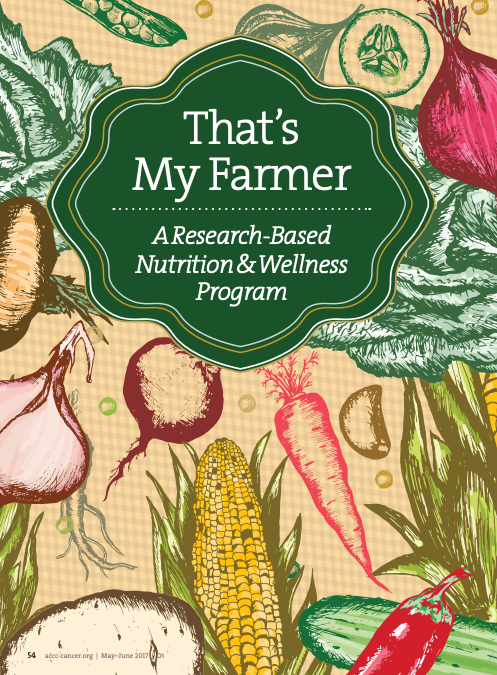
In 2014 the Samaritan Cancer Resource Center, the local free medical clinic, and Samaritan Health Services’ dietitians collaborated to pilot That’s My Farmer, a program specifically for cancer survivors. This research-based nutrition and wellness program educates cancer survivors through hands-on learning about anti-inflammatory nutrition, healthy food shopping and preparation, the benefits of eating local fresh fruits and vegetables, and the positive impact these foods can have for patients recovering from cancer.

Samaritan Cancer Resource Center leadership championed the program, successfully engaging other organizations and support throughout the Samaritan Health Services system to provide local cancer survivors with research-based information to help improve their overall well-being. Cancer survivors (participants) were invited to bring their spouse or caregiver with them to weekly classes and trips to local farmers’ markets.
Learn More
ACCC Member Program: Good Samaritan Regional Medical Center, Samaritan Pastega Cancer Program, Corvallis, Oregon