ACCC association of cancer care centers
Join/Renew
Login
Join/Renew
Login
Education & Resources
ACCC eXchange LogInSponsored Education from ACCC Corporate PartnersACCC eLearning LogInPresentations & Abstracts
Publications
Oncology IssuesPatient Assistance & Reimbursement GuideTrending Now in Cancer CareBusiness Case Studies for Hiring New Staff
Events
2026 ACCC Leadership SummitAnnual Meeting & Cancer Center Business SummitCapitol Hill DayNational Oncology ConferenceOncology Reimbursement MeetingsOncology State Society Meetings
Policy & Advocacy
ACCC 2026 Policy PrioritiesLetters & StatementsAccess, Payment & Reimbursement ReformWhite Bagging & Brown BaggingAdvocacy ResourcesCancer Moonshot
Membership
Join | RenewWho We AreMembership Types & BenefitsCorporate MembersACCC Member Portal FAQMember Directory
Partners
Oncology State SocietiesPartner OrganizationsCME
News
News ReleasesAdvocacy News ReleasesOncology News
About ACCC
Timeline / 50th Anniversary2025 Impact ReportPresident's ThemeACCC Innovator AwardsACCC FellowsBoard of TrusteesACCC Senior Staff
Breast CancerMetastatic Breast Cancer
Gastrointestinal CancerBiliary Tract CancerColorectal CancerGastric CancerLiver Cancer
Genitourinary CancerBladder CancerProstate CancerRenal Cell Carcinoma
Gynecologic Cancer
Head & Neck Cancer
Hematologic MalignanciesAcute Lymphocytic Leukemia (ALL)Acute Myeloid Leukemia (AML)Chronic Lymphocytic Leukemia (CLL)Mantle Cell Lymphoma (MCL)Multiple Myeloma (MM)Myelodysplastic Syndromes (MDS)
Lung CancerNon-Small Cell Lung Cancer (NSCLC)Small Cell Lung Cancer (SCLC)
Sarcoma
Skin CancerMelanomaNon-Melanoma Skin Cancers (NMSC)
Clinical Practice & TreatmentCancer DiagnosticsCare CoordinationEHR Integration for Biomarker TestingQuality Improvement Collaboration: Integration of Precision Medicine in Community OncologyTreatment
Financial NavigationFAN Boot CampFinancial Advocacy Network (FAN) Resource LibraryPatient Assistance & Reimbursement GuidePrior Authorization
Health Equity & Access3, 2, 1, Go! Practical Solutions for Addressing Cancer Care DisparitiesAppalachian Community Cancer AllianceOncology Advanced PractitionersPersonalizing Care for Patients of All BackgroundsSocial Drivers of Health
Patient-Centered CareAddressing Care Disparities for VeteransAdolescent and Young Adult (AYA)Care Action Plans for People with CancerDermatologic ToxicitiesEmpowering CaregiversGeriatric OncologyHealth LiteracyNutritionOncology PharmacyPatient NavigationPsychosocial Care in OncologyShared Decision-MakingSupportive CareSurvivorship Care
Practice Management & OperationsCancer Program FundamentalsLeadership Sustainment and Engagement VideosOncology Practice Transformation and Integration CenterOncology Team Resiliency
ResearchACCC Community Oncology Research Institute (ACORI)
Technology & InnovationTelehealth & Digital Medicine
ACCCBuzz Blog
CANCER BUZZ Podcast
Oncology Issues
Join/Renew
Login
Breast CancerMetastatic Breast Cancer
Gastrointestinal CancerBiliary Tract CancerColorectal CancerGastric CancerLiver Cancer
Genitourinary CancerBladder CancerProstate CancerRenal Cell Carcinoma
Gynecologic Cancer
Head & Neck Cancer
Hematologic MalignanciesAcute Lymphocytic Leukemia (ALL)Acute Myeloid Leukemia (AML)Chronic Lymphocytic Leukemia (CLL)Mantle Cell Lymphoma (MCL)Multiple Myeloma (MM)Myelodysplastic Syndromes (MDS)
Lung CancerNon-Small Cell Lung Cancer (NSCLC)Small Cell Lung Cancer (SCLC)
Sarcoma
Skin CancerMelanomaNon-Melanoma Skin Cancers (NMSC)
Clinical Practice & TreatmentCancer DiagnosticsCare CoordinationEHR Integration for Biomarker TestingQuality Improvement Collaboration: Integration of Precision Medicine in Community OncologyTreatment
Financial NavigationFAN Boot CampFinancial Advocacy Network (FAN) Resource LibraryPatient Assistance & Reimbursement GuidePrior Authorization
Health Equity & Access3, 2, 1, Go! Practical Solutions for Addressing Cancer Care DisparitiesAppalachian Community Cancer AllianceOncology Advanced PractitionersPersonalizing Care for Patients of All BackgroundsSocial Drivers of Health
Patient-Centered CareAddressing Care Disparities for VeteransAdolescent and Young Adult (AYA)Care Action Plans for People with CancerDermatologic ToxicitiesEmpowering CaregiversGeriatric OncologyHealth LiteracyNutritionOncology PharmacyPatient NavigationPsychosocial Care in OncologyShared Decision-MakingSupportive CareSurvivorship Care
Practice Management & OperationsCancer Program FundamentalsLeadership Sustainment and Engagement VideosOncology Practice Transformation and Integration CenterOncology Team Resiliency
ResearchACCC Community Oncology Research Institute (ACORI)
Technology & InnovationTelehealth & Digital Medicine
ACCCBuzz Blog
CANCER BUZZ Podcast
Oncology Issues
    • Education & Resources
    • Publications
    • Events
    • Policy & Advocacy
    • Membership
    • Partners
    • News
    • About ACCC
ACCC association of cancer care centers
5425 Wisconsin Ave #600, Chevy Chase, MD 20815
Tel: 301.984.9496 Email Us
Contact UsVolunteers
Advertise
Career Center
Terms and Conditions
Privacy Policy
ACCC Rebranding
Copyright © 2026 Association of Cancer Care Centers. All Rights Reserved.
HomeACCCBuzz Blog

Patient Navigation: Taking Stock of the Past and Looking to the Future

January 11, 2023
By Chidi Ike

Dr. Harold P. Freeman channeled his experience growing up in a segregated society to implement the first patient navigation program in the United States.

Patient Navigation: Taking Stock of the Past and Looking to the Future

The concept of patient navigation in healthcare owes its origin to Harold P. Freeman, MD. A D.C. native, Dr. Freeman received his medical degree from Howard University College of Medicine, where he completed his residency in general surgery at Freedmen’s Hospital (now Howard University Hospital). Upon graduating, he moved to New York City to take an advanced residency position at Memorial Sloan Kettering Cancer Center before beginning his career as a practicing physician at Harlem Hospital Center (now NYC Health + Hospitals) in 1967. In 1990, following an observation on the number of Black women who were being diagnosed with terminal breast cancer at Harlem Hospital Center and in combination with American Cancer Society findings on the effects poverty has on the treatment of cancer and other chronic diseases, Dr. Freeman launched the first ever patient navigation program.

“The social environment in which I grew up in, which was really separation of races,” Dr. Freeman said in an interview for The Cancer Letter with Robert Winn, MD, director of the Virginia Commonwealth University (VCU) Health System, VCU Massey Cancer Center, and John Stewart IV, MD, MBA, director of Louisiana State University Health-Louisiana Children’s Medical Center Cancer Center. “The concept of patient navigation came out of that experience. People, who did not have that background, wouldn’t think of this, wouldn’t be challenged like this, [and] wouldn’t care, perhaps, like I did about it.”

Understanding the Need for Patient Navigation

While the experience of being socialized in a segregated society allowed Dr. Freeman to adopt a sociologically imaginative perspective—an ability to connect personal challenges to larger social issues—in his practice, the severe effects of health disparities on access to care and patient outcomes were unknown to him. Dumfounded by the number of Black patients who presented to the breast cancer clinic in Harlem with tumors, which he describes as “ulcerated,” Dr. Freeman sought to understand the root of the problem. He asked himself, “Are they dying because they’re Black? Or are they dying because they’re poor? Or are they dying because of some combination of being Black and poor?”

The answers to his questions came following interviews with 25 women who presented to the clinic with terminal breast cancer. Each patient had the same story. They had previously visited an emergency room to discuss the lump in their breast, and they would wait for hours to be seen by a provider to only be told that the lump in their breast was not an emergency. The provider would then recommend an oncologist they could visit if they had insurance. “She’d have children. She’d be worried about food, clothing, and shelter, and the avoidance of crime in Harlem, which was high at that time. And she’d been told to go 100 blocks south of the Harlem Hospital and come back with [her] Medicaid card,” Dr. Freeman said to Drs. Winn and Stewart. “To that woman, the process that was being recommended for her to solve her problems was more painful than the painless lump, which she came in for.”

Dr. Freeman described the conversations with those patients as a “turning point” in his life. Although he came to Harlem to “help his people,” he realized that surgical skills alone would not be enough. “I know how to cut cancer out,” he said to The Cancer Letter. I want to cut it [cancer] out of Harlem. I can’t do that. I can’t cut it out….It won’t yield to the surgeon’s knife. It’s surely good to be able to be a surgeon and to operate, but you can’t operate because something in the community is overwhelming. It was a socio-economic invasion that was deeper than the cancer invasion in the community.” This realization helped Dr. Freeman understand the importance of navigating patients through the healthcare system and cancer care continuum—giving way to practice of patient navigation.

Patient Navigation Today

Dr. Freeman likens patient navigation to a mile-long relay race, where the patient is the baton. “In the mile relay, there are four runners. I want you to think of those runners as navigators,” he explained to The Cancer Letter. According to Dr. Freeman, each runner/navigator bears a responsibility to the patient—from the first mammogram to the first chemotherapy session. He also believes that a functional patient navigation program needs a coach. “You’ll never win an Olympic race if you don’t have a good coach. Someone overseeing the whole race from beginning to the end, while runners are carrying it out, carrying the patient through it,” he said to Drs. Winn and Stewart. “So that’s the concept of patient navigation, which I think is one of the real advances in helping people who have disparities in cancer.” Like Dr. Freeman, the Association of Community Cancer Center (ACCC) understands the importance of optimized patient navigation programs.

And while modern-day patient navigation roles and programs nationwide have taken on a life of their own, they are adapting to the unique needs of the cancer program or practice’s patient population. Some have expanded to include financial advocacy services to help address the costs of cancer care, and some have prioritized access to mental health services and more to support patients’ entire being (mind, body, and soul), while others may be doing it all.

This year, ACCC will be supporting cancer programs and practices everywhere in adding dedicated financial advocacy roles and building formal financial navigation programs through key efforts from the association’s Financial Advocacy Network. One of the most exciting resources the network is looking forward to disseminating to the greater oncology community in 2023 is the final manuscript on its updated Financial Advocacy Services Guidelines. These guidelines were created using a collaborative, consensus-based process to promote and guide the implementation of critical financial advocacy services in cancer programs and practices across the nation. And it is understood by many that financial advocacy services are critical to effective patient navigation/care coordination in addressing inequities throughout the cancer care continuum today. Look out for more information on the final guidelines to be released by the network in early 2023.
Related Content

Addressing the In-Between: AYAs and Multifaceted Cancer TreatmentACCCBuzz Blog

Addressing the In-Between: AYAs and Multifaceted Cancer Treatment

Jenna Pierson

September 30, 2026

From Diagnosis to Survivorship: Understanding AML and CLL From End to EndACCCBuzz Blog

From Diagnosis to Survivorship: Understanding AML and CLL From End to End

Rachel Radwan

September 28, 2026

Upcoming Events

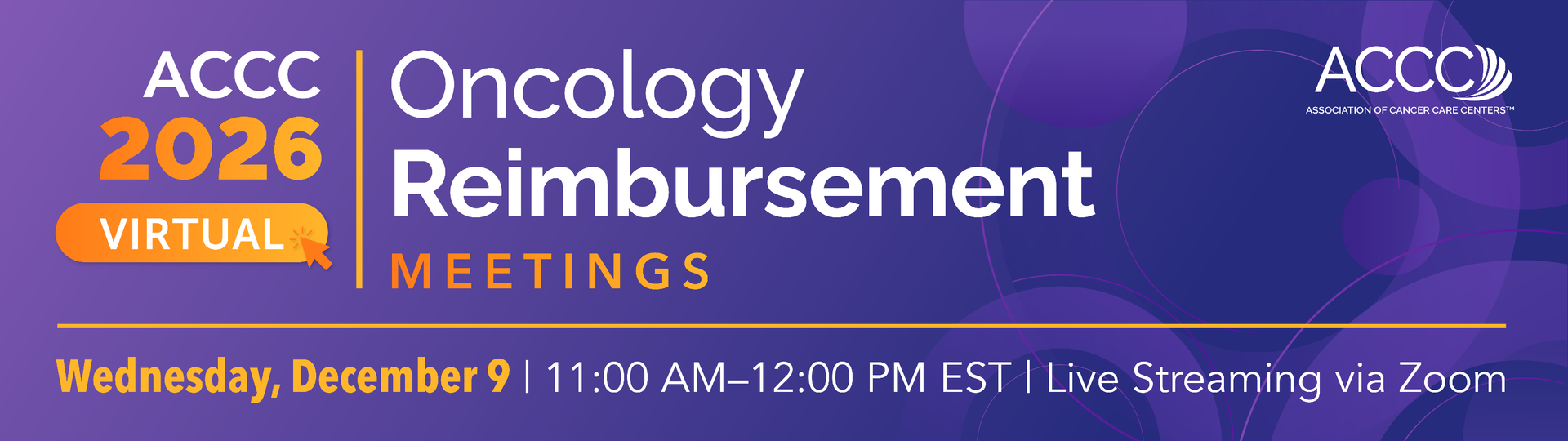
Virtual Oncology Reimbursement Meeting (ORM) | Winter 2026

Virtual Oncology Reimbursement Meeting (ORM) | Winter 2026

Virtual December 9, 2026 at 11:00 AM EST
Register Now!
2027 ACCC Leadership Summit

2027 ACCC Leadership Summit

In Person April 22, 2027 at 6:00 PM EDTWillard InterContinental Hotel, 1401 Pennsylvania Avenue Northwest, Washington, DC, USAWashington
Register Now!
DOS 2026 Fall Conference
Oncology

DOS 2026 Fall Conference

In Person Meeting & NetworkingNovember 19, 2026 at 5:30 PM EST215 Broadway N. Fargo, ND 58102Jasper Hotel, Fargo
Register Now!
RIOS Year-End Wrap-Up
Oncology

RIOS Year-End Wrap-Up

In Person Conference & ConventionDecember 1, 2026 at 6:00 PM EST1 Bannister Street, Providence, RI, USABrown University - Brown Faculty Club , Providence
Register Now!
NOS 2027 Official SABCS Review and Hematology Update
Hematology

NOS 2027 Official SABCS Review and Hematology Update

In Person Conference & ConventionFebruary 6, 2027 at 7:00 AM PST221 N Rampart Blvd, Las Vegas, NV, USAJW Marriott Las Vegas Resort & Spa, Las Vegas
Register Now!
ESHOS 2027 Official SABCS Review
Oncology

ESHOS 2027 Official SABCS Review

In Person Meeting & NetworkingFebruary 27, 2027 at 7:00 AM EST205 Lakeshore Dr, Canandaigua, NY 14424, USAHotel Canandaigua, Tapestry Collection by Hilton, Canandaigua
Register Now!
WAHO ASH Highlights & Insights
Oncology

WAHO ASH Highlights & Insights

In Person Conference & ConventionFebruary 27, 2027 at 7:00 AM CST1 West Dayton Street, Madison, WI, USAThe Madison Concourse Hotel, Madison
Register Now!
IOS 2027 Spring Hematology Conference
Hematology

IOS 2027 Spring Hematology Conference

In Person Conference & ConventionMarch 6, 2027 at 8:00 AM CST1000 Walnut St, Des Moines, IA, USAHotel Fort Des Moines, Curio Collection by Hilton, Des Moines
Register Now!
NCOA 2027 Annual Conference
Oncology

NCOA 2027 Annual Conference

In Person Conference & ConventionMarch 6, 2027 at 12:00 PM EST201 Harrison Oaks Blvd, Cary, NC 27513, USAEmbassy Suites by Hilton Raleigh-Durham/Research Triangle, Cary
Register Now!
Advertisement
Advertisement

Trending Now on
ACCCBuzz Blog

Addressing the In-Between: AYAs and Multifaceted Cancer Treatment

Addressing the In-Between: AYAs and Multifaceted Cancer Treatment

From mental health concerns to fertility preservation, adolescents and young adults with cancer require a specialized approach to treatment and survivorship care. In honor of Childhood Cancer Awareness Month, ACCC highlights a pivotal program from the University of North Carolina Lineberger Comprehensive Cancer Center and resources that meet the critical needs of these patients.

From Diagnosis to Survivorship: Understanding AML and CLL From End to End

From Diagnosis to Survivorship: Understanding AML and CLL From End to End

In recognition of Leukemia and Lymphoma Awareness Month, ACCC compiled a group of resources to help care teams navigate two of the most commonly diagnosed adult leukemias: acute myeloid leukemia and chronic lymphocytic leukemia.

Gynecologic Cancer Awareness Month: Expanding Access and Improving Outcomes
ACCCBuzz Blog

Gynecologic Cancer Awareness Month: Expanding Access and Improving Outcomes

Jenna Pierson; Gabrielle Stearns

September 25, 2026

ACCC’s Comments on the 2026 CMS Interim Final RuleACCCBuzz Blog

ACCC’s Comments on the 2026 CMS Interim Final Rule

Rachel Radwan

September 24, 2026

Decentralized Clinical Trials in Community Oncology: Advancing Access Requires More Than TechnologyACCCBuzz Blog

Decentralized Clinical Trials in Community Oncology: Advancing Access Requires More Than Technology

September 10, 2026

Highlights From Volume 41, Number 4 Oncology IssuesACCCBuzz Blog

Highlights From Volume 41, Number 4 Oncology Issues

Gabrielle Stearns

August 20, 2026

Transforming Access to Care Through Pre-Intake NavigationACCCBuzz Blog

Transforming Access to Care Through Pre-Intake Navigation

Rachel Radwan

August 6, 2026

An APP-Led Outpatient Bispecific Antibody ClinicACCCBuzz Blog

An APP-Led Outpatient Bispecific Antibody Clinic

Rachel Radwan

August 4, 2026

Gynecologic Cancer Awareness Month: Expanding Access and Improving Outcomes

Gynecologic Cancer Awareness Month: Expanding Access and Improving Outcomes

An at-home option for cervical cancer screening breaks down barriers to care and offers the same level of precision as screening in the clinic.

ACCC’s Comments on the 2026 CMS Interim Final Rule

ACCC’s Comments on the 2026 CMS Interim Final Rule

On June 1, 2026, CMS published its interim final rule (IFR), Medicaid Program; Community Engagement Requirement for Certain Individuals in the Federal Register, followed by a public comment period, during which time ACCC submitted a comment letter requesting amendments to the IFR.

View All ACCCBuzz Blogs

Recently Heard on
CANCER BUZZ Podcast

Bringing CAR T-Cell Therapy to the Community Setting - Mini Podcast [Ep. 242]

Embedding Local Expertise in Rural Cancer Prevention - Podcast [Ep. 241]

From Reactive to Proactive: Improving Access to Cancer Care Through Pre-Intake Navigation - [Podcast] Ep. 240

Real-World Oncology Decentralized Trials - [Video Podcast] Ep. 66

View All Podcasts

Latest from Oncology Issues

August 2026
August 2026
June 2026
April 2026
February 2026
December 2025
View All Oncology Issues

Join the Conversation

ACCC eXchange Digital Banner
Login