ACCC association of cancer care centers
Join/Renew
Login
Join/Renew
Login
Education & Resources
ACCC eXchange LogInSponsored Education from ACCC Corporate PartnersACCC eLearning LogInPresentations & Abstracts
Publications
Oncology IssuesPatient Assistance & Reimbursement GuideTrending Now in Cancer CareBusiness Case Studies for Hiring New Staff
Events
2026 ACCC Leadership SummitAnnual Meeting & Cancer Center Business SummitCapitol Hill DayNational Oncology ConferenceOncology Reimbursement MeetingsOncology State Society Meetings
Policy & Advocacy
ACCC 2026 Policy PrioritiesLetters & StatementsAccess, Payment & Reimbursement ReformWhite Bagging & Brown BaggingAdvocacy ResourcesCancer Moonshot
Membership
Join | RenewWho We AreMembership Types & BenefitsCorporate MembersACCC Member Portal FAQMember Directory
Partners
Oncology State SocietiesPartner OrganizationsCME
News
News ReleasesAdvocacy News ReleasesOncology News
About ACCC
Timeline / 50th Anniversary2025 Impact ReportPresident's ThemeACCC Innovator AwardsACCC FellowsBoard of TrusteesACCC Senior Staff
Breast CancerMetastatic Breast Cancer
Gastrointestinal CancerBiliary Tract CancerColorectal CancerGastric CancerLiver Cancer
Genitourinary CancerBladder CancerProstate CancerRenal Cell Carcinoma
Gynecologic Cancer
Head & Neck Cancer
Hematologic MalignanciesAcute Lymphocytic Leukemia (ALL)Acute Myeloid Leukemia (AML)Chronic Lymphocytic Leukemia (CLL)Mantle Cell Lymphoma (MCL)Multiple Myeloma (MM)Myelodysplastic Syndromes (MDS)
Lung CancerNon-Small Cell Lung Cancer (NSCLC)Small Cell Lung Cancer (SCLC)
Sarcoma
Skin CancerMelanomaNon-Melanoma Skin Cancers (NMSC)
Clinical Practice & TreatmentCancer DiagnosticsCare CoordinationEHR Integration for Biomarker TestingQuality Improvement Collaboration: Integration of Precision Medicine in Community OncologyTreatment
Financial NavigationFAN Boot CampFinancial Advocacy Network (FAN) Resource LibraryPatient Assistance & Reimbursement GuidePrior Authorization
Health Equity & Access3, 2, 1, Go! Practical Solutions for Addressing Cancer Care DisparitiesAppalachian Community Cancer AllianceOncology Advanced PractitionersPersonalizing Care for Patients of All BackgroundsSocial Drivers of Health
Patient-Centered CareAddressing Care Disparities for VeteransAdolescent and Young Adult (AYA)Care Action Plans for People with CancerDermatologic ToxicitiesEmpowering CaregiversGeriatric OncologyHealth LiteracyNutritionOncology PharmacyPatient NavigationPsychosocial Care in OncologyShared Decision-MakingSupportive CareSurvivorship Care
Practice Management & OperationsCancer Program FundamentalsLeadership Sustainment and Engagement VideosOncology Practice Transformation and Integration CenterOncology Team Resiliency
ResearchACCC Community Oncology Research Institute (ACORI)
Technology & InnovationTelehealth & Digital Medicine
ACCCBuzz Blog
CANCER BUZZ Podcast
Oncology Issues
Join/Renew
Login
Breast CancerMetastatic Breast Cancer
Gastrointestinal CancerBiliary Tract CancerColorectal CancerGastric CancerLiver Cancer
Genitourinary CancerBladder CancerProstate CancerRenal Cell Carcinoma
Gynecologic Cancer
Head & Neck Cancer
Hematologic MalignanciesAcute Lymphocytic Leukemia (ALL)Acute Myeloid Leukemia (AML)Chronic Lymphocytic Leukemia (CLL)Mantle Cell Lymphoma (MCL)Multiple Myeloma (MM)Myelodysplastic Syndromes (MDS)
Lung CancerNon-Small Cell Lung Cancer (NSCLC)Small Cell Lung Cancer (SCLC)
Sarcoma
Skin CancerMelanomaNon-Melanoma Skin Cancers (NMSC)
Clinical Practice & TreatmentCancer DiagnosticsCare CoordinationEHR Integration for Biomarker TestingQuality Improvement Collaboration: Integration of Precision Medicine in Community OncologyTreatment
Financial NavigationFAN Boot CampFinancial Advocacy Network (FAN) Resource LibraryPatient Assistance & Reimbursement GuidePrior Authorization
Health Equity & Access3, 2, 1, Go! Practical Solutions for Addressing Cancer Care DisparitiesAppalachian Community Cancer AllianceOncology Advanced PractitionersPersonalizing Care for Patients of All BackgroundsSocial Drivers of Health
Patient-Centered CareAddressing Care Disparities for VeteransAdolescent and Young Adult (AYA)Care Action Plans for People with CancerDermatologic ToxicitiesEmpowering CaregiversGeriatric OncologyHealth LiteracyNutritionOncology PharmacyPatient NavigationPsychosocial Care in OncologyShared Decision-MakingSupportive CareSurvivorship Care
Practice Management & OperationsCancer Program FundamentalsLeadership Sustainment and Engagement VideosOncology Practice Transformation and Integration CenterOncology Team Resiliency
ResearchACCC Community Oncology Research Institute (ACORI)
Technology & InnovationTelehealth & Digital Medicine
ACCCBuzz Blog
CANCER BUZZ Podcast
Oncology Issues
    • Education & Resources
    • Publications
    • Events
    • Policy & Advocacy
    • Membership
    • Partners
    • News
    • About ACCC
ACCC association of cancer care centers
5425 Wisconsin Ave #600, Chevy Chase, MD 20815
Tel: 301.984.9496 Email Us
Contact UsVolunteers
Advertise
Career Center
Terms and Conditions
Privacy Policy
ACCC Rebranding
Copyright © 2026 Association of Cancer Care Centers. All Rights Reserved.
HomeACCCBuzz Blog

The Long Road to Recovery, Part II: Cancer Screening in the U.S. (St. Elizabeth Healthcare, Kentucky)

January 13, 2022

In 2020, medical experts warned that COVID-19 could, over time, have a substantial impact on cancer outcomes due to delayed or missed cancer screenings for patients. To obtain a better perspective of how cancer programs’ screening and outreach education efforts are recovering from pandemic pressures, ACCCBuzz spoke to four cancer programs across the country.

The Long Road to Recovery, Part II: Cancer Screening in the U.S. (St. Elizabeth Healthcare, Kentucky)

In the second post in our series on the impact of COVID-19 on cancer screening rates in the U.S., ACCCBuzz visits with ACCC Cancer Program Member St. Elizabeth Healthcare in Kentucky. Our first post explores changes in cancer screening rates at Mary Bird Perkins Cancer Center in Baton Rouge, Louisiana.

Lung cancer is the leading cause of cancer deaths in the U.S., accounting for nearly one-quarter (23 percent) of such deaths in 2019. For those at high risk for lung cancer, screening with low-dose computed tomography (LDCT) can detect disease at an early stage, when there are the most options for treatment and the potential for cure.Since 2013, the United States Preventive Services Task Force (USPSTF) has recommended LDCT screening for lung cancer for specific at-risk patient populations. But, despite this, national lung cancer screening rates are suboptimal. One 2021 study found that, in 2020, only 1 in 20 adults eligible for LDCT lung cancer screening received it.

There are outliers. Take Kentucky, for example. The Bluegrass State has achieved the second-highest screening rate in the nation. More than 17 percent of Kentucky’s eligible patient population has received LDCT lung cancer screening. This accomplishment is the result of a state-wide focus on lessening Kentucky’s disproportionate burden of lung cancer. The state has the highest age-adjusted incidence of lung cancer in the U.S. at 89.4 per 100,000 people,andthe highest age-adjusted lung cancer death rate.In 2018, 23.4 percent of Kentucky adults (aged 18 and older) reported being current smokers, compared to a national rate of 14 percent (2019 data).

Michael Gieske, MD, director of the Lung Cancer Screening Program at St. Elizabeth Healthcare, is passionate about improving lung cancer screening and outcomes. A primary care physician and Kentucky native, Dr. Gieske leads a nationally recognized program that has received recognition from the GO2 Foundation in 2020 as a Care Continuum Center of Excellence. St. Elizabeth Healthcare’s imaging centers have earned Diagnostic Imaging Center of Excellence designation from the American College of Radiology.

Over the past eight years, St. Elizabeth’s Lung Cancer Screening Program has played an integral role in improving lung cancer screening rates in the state of Kentucky, said Dr. Gieske: “We’ve worked with the University of Kentucky through the KY LEADS Collaborative, a state-based research project aimed at improving the quality of lung cancer screening in Kentucky, and we work closely with the Kentucky Health Collaborative.” The latter comprises 10 hospital systems that encompass more than 70 hospitals and imaging centers. “Through our work, we’ve helped increase adherence to lung cancer screening,” said Dr. Gieske. “We’re looking very specifically at improving screening rates across our state right now.”

St. Elizabeth Healthcare’s mission is to improve the health of the communities it serves. In partnership with St. Elizabeth Physicians—a multispecialty physician group of 451 physicians, 244 advanced practice providers, and 1,500 non-provider associates—the health system delivers care to more than 364,000 patients in Kentucky, Indiana, and Ohio. The integrated network operates six hospitals and 169 St. Elizabeth physician specialty and primary care clinics. Lung cancer screening is offered in eight locations: Covington, Edgewood, Florence, Fort Thomas, Grant County, Hebron, and Owenton in Kentucky, and Dearborn in Indiana. The St. Elizabeth Healthcare Lung Cancer Screening Program participates in the White Ribbon Project, which seeks to raise awareness and destigmatize lung cancer.

A Dramatic Recovery

ACCCBuzz asked Dr. Gieske to share his perspective on how the shifting circumstances of the COVID-19 pandemic may have affected the progress that had been achieved through this highly successful, comprehensive cancer screening program.

In March 2020, St. Elizabeth’s Lung Cancer Screening Program—like others around the country—was significantly affected by the pandemic’s initial surge. “At that time, the program was providing about 350 to 400 LDCT screenings for lung cancer per month,” Dr. Gieske said. With the restrictions mandated by the national public health emergency, LDCT screening dropped precipitously—13 LDCT lung cancer screens were performed in April 2020. The program rebounded quickly, however. “Once things started to return to some semblance of normalcy, we had a pretty dramatic V-shaped recovery,” said Dr. Gieske. “We ended up finishing the year down just 5.8 percent in 2020, compared to what we had done in 2019. Looking at total volume of screens, we finished just shy of 4,000 screens for the year [in 2020].”

Despite the relentless uncertainty of the COVID-19 pandemic during 2021, St. Elizabeth Healthcare has seen a “significant resurgence” in cancer screening rates, Dr. Gieske said. He credits St. Elizabeth’s ability to rebound successfully to multiple factors. “We really have gone after a lot of our outstanding orders,” Dr. Gieske explained, “and we’ve tried to impress on our patients in the community and our providers that we are returning to normal screening.” With cancer screenings a system-wide priority, St. Elizabeth’s continues to urge patients to come in for them. “We’re on track to do 6,000 LDCT screens this year,” Dr. Gieske said. “We have a very robust program, and we’re averaging 500 screens per month now.” As of November 2021, St. Elizabeth Healthcare’s Lung Cancer Screening Program has completed 20,000 screenings since its launch in 2013.

Spreading the Word

“Taking advantage of multiple touchpoints is key,” Dr. Gieske said. As was the case with the outreach and screening program at Mary Bird Perkins Cancer Center in Louisiana, the marketing team at St. Elizabeth’s was instrumental in spreading the word about its lung screenings. This included promoting cancer screening on the health system’s website, communicating to patients about COVID-19 safety precautions, and reaching out to the St. Elizabeth provider network. “We have a leadership meeting every month where all the managers and directors get together,” explained Dr. Gieske. “Once you get the word out to that team, they get the word to their providers and medical assistants as well. And there is also a lot of communication with our providers through either primary care leadership or through all-provider meetings.”

Dr. Gieske is an advocate for engaging and involving primary care physicians from the start to develop a successful lung cancer screening program. “I’m a huge proponent of primary care input and influence, involving primary care in the process, and identifying a primary care champion for the program,” he said. At the start of the lung screening process, Dr. Gieske supports a “fairly decentralized” approach, so that any provider (primary care, advanced practice provider, pulmonologist, or specialty care provider) can order the screening test. But once that test is ordered, the process transitions to a more centralized, programmatic path for managing scans and incidental findings.

A key component of this comprehensive multidisciplinary approach is nurse navigation. “We’ve had navigation in place at St. Elizabeth for four years,” said Dr. Gieske. “If a patient presents with a lung cancer screen with a lung-RADS category 4 (i.e., highly suspicious), they are presented to our nodule review board, which meets every Monday morning at 7:00 am. If the radiologist sees something on either an incidental or a symptomatic scan, the scan is tagged [in the EHR with] code ‘lung management,’ and the patient’s scan is included for nodule review on Monday morning.”

One early challenge was getting buy-in and gaining the confidence of the primary care community and specialist providers. “That was a little bit of a culture change,” Dr. Gieske acknowledged. “We encourage our providers once the test has been ordered to let the nodule review board, the panel of experts, and the nurse navigators take the reins on the care and the direction of that patient. At this point, we have gained the confidence and buy-in of our providers. We encourage them to take their hands off the wheel and allow a programmatic approach for these patients, especially patients with scans categorized as Lung-RADS 4 or a significant nodule detected through the incidental or symptomatic pathway.”

By the Numbers

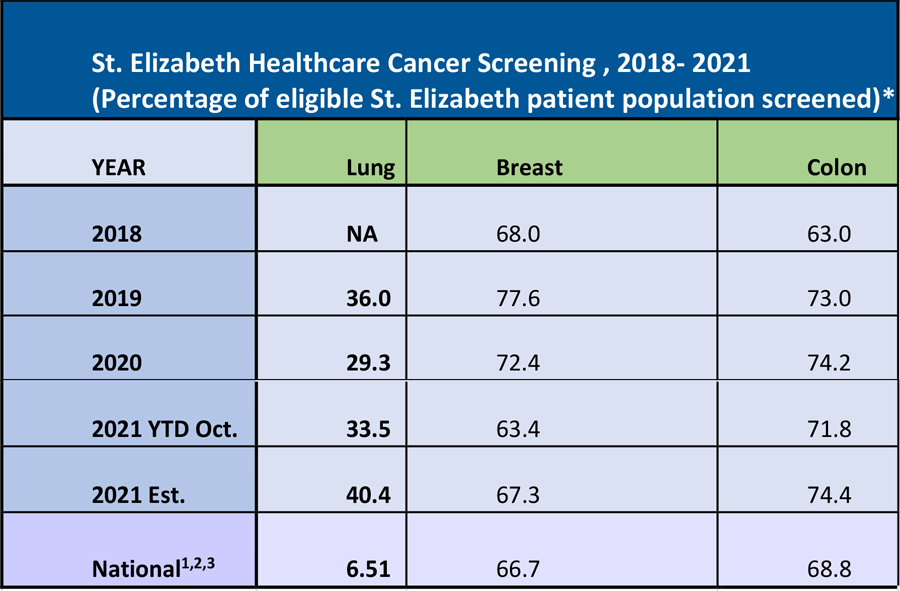
At St. Elizabeth Healthcare, screening rates for breast cancer have not yet returned to pre-pandemic levels, Gieske noted. In contrast, screening rates for colon cancer have continued to improve year over year from 2018 through 2021. (See table.)

healthcare-table-900x591

1Fedewa SA. Chest. Aug. 3, 2021. https://journal.chestnet.org/article/S0012-3692(21)01364-7/fulltext
2CDC. National Center for Health Statistics. Health, United States, 2019. Hyattsville, MD. 2021.https://dx.doi.org/10.15620/cdc:100685
3CDC Colorectal Cancer Statistics | CDC
*The “eligible St. Elizabeth patient population” referenced above is specific to patients in the St. Elizabeth Healthcare system who are attributed to primary care physicians in St. Elizabeth Healthcare and who meet the 2015 CMS criteria as determined in the EHR.

Among the factors that may account for the slower return to pre-pandemic breast cancer screening rates is patients’ fear of coming into health facilities during the pandemic. One side effect of a patient’s immune system response to the COVID-19 vaccine may be temporary swelling of the lymph nodes under the arm that received the shot. For that reason, the Society for Breast Imaging issued Screening Mammograph Recommendations for Women Receiving the COVID-19 Vaccine, which recommend that patients try to schedule their routine mammograms either before their first vaccination shot or four to six weeks after their last shot.

Remarkably, St. Elizabeth Healthcare has achieved a steady increase in colon cancer screenings over the past four years. “In 2018, we were at 63 percent [of the eligible St. Elizabeth patient population screened],” said Dr. Gieske. “In 2019, we increased to 73 percent, and in 2020, we increased that to 74.2 percent—despite the pandemic.” Improving colon cancer screening is a system-wide priority for St. Elizabeth Healthcare. The successful increase in colon cancer screening may be attributable, in part, to the health system-wide uptake of non-invasive Cologuard tests and FIT tests that do not require individuals to come into a facility for screening, Dr. Gieske said.

The team-based approach implemented for the lung cancer screening program is now being adapted to mammography and colorectal cancer screening, along with a centralized process for outreach data collection. Under the umbrella of the health system’s value-based performance team, in August 2021, St. Elizabeth’s established an eight-person, full-time team of nurse outreach specialists. “They’ve had 938 outreaches for lung cancer screening; 13 outreaches for mammography; and 800 outreaches for colon cancer screening,” Dr. Gieske said. Each outreach effort is documented in the patient’s EHR. For example, a nurse may make note that an appointment is scheduled, the patient refused screening, the nurse left a message, etc.

Data on outreach results will be used to guide future screening approaches. “It’s a very orchestrated approach, and it’s going to be integral to making sure patients don’t fall between the cracks,” said Dr. Gieske. “If you schedule a patient with an appointment and you get them plugged into the system, it’s much more likely they’ll come in for screening.”




Related Content

Decentralized Clinical Trials in Community Oncology: Advancing Access Requires More Than TechnologyACCCBuzz Blog

Decentralized Clinical Trials in Community Oncology: Advancing Access Requires More Than Technology

September 10, 2026

Highlights From Volume 41, Number 4 Oncology IssuesACCCBuzz Blog

Highlights From Volume 41, Number 4 Oncology Issues

Gabrielle Stearns

August 20, 2026

Transforming Access to Care Through Pre-Intake Navigation

Upcoming Events

ACCC 43rd National Oncology Conference

ACCC 43rd National Oncology Conference

In Person October 21, 2026 at 8:00 AM EDT450 Summer St, Boston, MA 02210, USAOmni Boston Hotel at the Seaport, Boston
Register Now!
ACCC Oncology Reimbursement Meeting | Reno

ACCC Oncology Reimbursement Meeting | Reno

In Person November 4, 2026 at 8:00 AM EST255 North Virginia Street, Reno, NV, USAWhitney Peak Hotel Reno, Tapestry Collection by Hilton,
Register Now!
ACCC Oncology Reimbursement Meeting | Providence

ACCC Oncology Reimbursement Meeting | Providence

In Person November 10, 2026 at 8:00 AM EST5 Avenue of the Arts, Providence, RI, USARenaissance Providence Downtown Hotel,
Register Now!
TxSCO 2026 Annual Conference
Oncology

TxSCO 2026 Annual Conference

In Person Conference & ConventionSeptember 18, 2026 at 6:00 PM CDT501 Gaylord Trail, Grapevine, TX, USAGaylord Texan Resort & Convention Center, Grapevine
Register Now!
KYSCO 2026 Fall Oncology Review
Oncology

KYSCO 2026 Fall Oncology Review

In Person Conference & ConventionSeptember 19, 2026 at 7:00 AM EDT500 S 4th St, Louisville, KY, USAThe Seelbach Hilton Louisville, Louisville
Register Now!
ESHOS Horizons 2026
Oncology

ESHOS Horizons 2026

In Person Conference & ConventionSeptember 19, 2026 at 7:30 AM EDT1 Liberty Street, New York, NY, USAConvene at One Liberty Plaza, New York
Register Now!
MSOS 2026 Bozeman Meeting
Oncology

MSOS 2026 Bozeman Meeting

In Person Meeting & NetworkingSeptember 22, 2026 at 5:30 PM EDT5 W Mendenhall St suite 102, Bozeman, MT 59715, USA Urban Kitchen, Bozeman
Register Now!
MSCO 2026 Fall Conference
Oncology

MSCO 2026 Fall Conference

In Person Conference & ConventionSeptember 22, 2026 at 5:00 PM CDT1500 Park Pl Blvd, Minneapolis, MN, USADoubleTree by Hilton Hotel Minneapolis - Park Place, Minneapolis
Register Now!
HSCO 2026 September Dinner Symposium
Oncology

HSCO 2026 September Dinner Symposium

In Person Conference & ConventionSeptember 23, 2026 at 5:30 PM HST3660 Waialae Ave, Honolulu, HI, USA3660 On The Rise, Honolulu
Register Now!
RIOS Fall Meeting
Oncology

RIOS Fall Meeting

In Person Conference & ConventionSeptember 25, 2026 at 5:30 PM EDT139 Mathewson Street, Providence, RI, USAHotel Providence, Providence
Register Now!
Advertisement
Advertisement

Trending Now on
ACCCBuzz Blog

Decentralized Clinical Trials in Community Oncology: Advancing Access Requires More Than Technology

Decentralized Clinical Trials in Community Oncology: Advancing Access Requires More Than Technology

Decentralized clinical trial approaches, including remote consent, telehealth, local laboratory and imaging services, and more, can help reduce some of the many barriers that prevent eligible patients from participating in trials. But as the participants in ACCC’s Advancing Decentralized Clinical Trials in the Community Setting Roundtable Series emphasized, implementing DCT elements is not simply a matter of adopting new technology. Doing so successfully requires thoughtful workflows and oversight structures that consider equity, scalability, and sustainability.

Highlights From Volume 41, Number 4 Oncology Issues

Highlights From Volume 41, Number 4 Oncology Issues

From precision medicine to psychosocial care to navigation for a diverse population, the latest issue Oncology Issues brings insights into not just institutional and administrative barriers to treatment, but areas of care that directly impact the lived experience of those navigating the cancer care continuum.

ACCCBuzz Blog

Transforming Access to Care Through Pre-Intake Navigation

Rachel Radwan

August 6, 2026

An APP-Led Outpatient Bispecific Antibody ClinicACCCBuzz Blog

An APP-Led Outpatient Bispecific Antibody Clinic

Rachel Radwan

August 4, 2026

Advancing Critical Priorities at the State Level: Louisiana, Iowa, and Washington Awarded for Their Efforts at 2026 ASCO Annual MeetingACCCBuzz Blog

Advancing Critical Priorities at the State Level: Louisiana, Iowa, and Washington Awarded for Their Efforts at 2026 ASCO Annual Meeting

Rachel Radwan

July 29, 2026

Designing a Safe, Fully Outpatient CAR T-Cell Program in the CommunityACCCBuzz Blog

Designing a Safe, Fully Outpatient CAR T-Cell Program in the Community

Rachel Radwan

July 27, 2026

Local Staff, Lasting Impact: A New Model for Rural Cancer PreventionACCCBuzz Blog

Local Staff, Lasting Impact: A New Model for Rural Cancer Prevention

Rachel Radwan

July 16, 2026

A Pharmacist-Led Strategy to Improve Care With Oncolytic Virus TreatmentsACCCBuzz Blog

A Pharmacist-Led Strategy to Improve Care With Oncolytic Virus Treatments

Rachel Radwan

July 14, 2026

Transforming Access to Care Through Pre-Intake Navigation

Transforming Access to Care Through Pre-Intake Navigation

The University of Texas MD Anderson Cancer Center in Houston, Texas, developed a novel Pre-Intake Navigation (PIN) program, which identifies and resolves early financial and insurance barriers, enabling patients to access timely, high-quality cancer care with less anxiety and fewer delays. PIN shifts financial navigation from a late-stage, reactive task to an early, standardized, patient‑centered process embedded in the call center workflow.

An APP-Led Outpatient Bispecific Antibody Clinic

An APP-Led Outpatient Bispecific Antibody Clinic

Understanding both the benefits to be had from offering BsAb therapy to its community and the scope of this undertaking, Vanderbilt-Ingram Cancer Center took a novel approach with its APP-led BsAb step-up dosing clinic, which won the program a 2026 ACCC Innovator Award.

View All ACCCBuzz Blogs

Recently Heard on
CANCER BUZZ Podcast

Embedding Local Expertise in Rural Cancer Prevention - Podcast [Ep. 241]

From Reactive to Proactive: Improving Access to Cancer Care Through Pre-Intake Navigation - [Podcast] Ep. 240

Real-World Oncology Decentralized Trials - [Video Podcast] Ep. 66

The Real Cost of Cancer: Financial Toxicity, Transportation Challenges, and Access Gaps – [Video Podcast] Ep. 65

View All Podcasts

Latest from Oncology Issues

August 2026
August 2026
June 2026
April 2026
February 2026
December 2025
View All Oncology Issues

Join the Conversation

ACCC eXchange Digital Banner
Login