ACCC association of cancer care centers
Join/Renew
Login
Join/Renew
Login
Education & Resources
ACCC eXchange LogInCorporate Member Sponsored ResourcesPresentations & AbstractsPresident's ThemeACCC Connect eLearning LogIn
Publications
Oncology IssuesPatient Assistance & Reimbursement GuideTrending Now in Cancer Care
Events
2026 ACCC Leadership SummitAnnual Meeting & Cancer Center Business SummitCapitol Hill DayNational Oncology ConferenceOncology Reimbursement MeetingsOncology State Society Meetings
Policy & Advocacy
2024 Policy Wrap-Up and ACCC 2025 Policy PrioritiesLetters & StatementsAccess, Payment & Reimbursement ReformWhite Bagging & Brown BaggingAdvocacy ResourcesCancer Moonshot
Membership
Join | RenewWho We AreMembership Types & BenefitsCorporate MembersACCC Member Portal FAQMember Directory
Partners
Oncology State SocietiesPartner OrganizationsCME
News
News ReleasesAdvocacy News ReleasesOncology News
About ACCC
Timeline / 50th Anniversary2025 Impact ReportACCC Innovator AwardsACCC FellowsACCC Senior Staff
Breast CancerMetastatic Breast Cancer
Gastrointestinal CancerBiliary Tract CancerColorectal CancerGastric CancerLiver Cancer
Genitourinary CancerBladder CancerProstate CancerRenal Cell Carcinoma
Gynecologic CancerOvarian Cancer
Head & Neck Cancer
Hematologic MalignanciesAcute Lymphocytic Leukemia (ALL)Acute Myeloid Leukemia (AML)Chronic Lymphocytic Leukemia (CLL)Mantle Cell Lymphoma (MCL)Multiple Myeloma (MM)Myelodysplastic Syndromes (MDS)
Lung CancerNon-Small Cell Lung Cancer (NSCLC)Small Cell Lung Cancer (SCLC)
Sarcoma
Skin CancerMelanomaNon-Melanoma Skin Cancers (NMSC)
Clinical Practice & TreatmentCancer DiagnosticsCare CoordinationEHR Integration for Biomarker TestingQuality Improvement Collaboration: Integration of Precision Medicine in Community OncologyTreatment
Financial NavigationFAN Boot CampFinancial Advocacy Network (FAN) Resource LibraryPatient Assistance & Reimbursement GuidePrior Authorization
Health Equity & Access3, 2, 1, Go! Practical Solutions for Addressing Cancer Care DisparitiesAppalachian Community Cancer AllianceOncology Advanced PractitionersPersonalizing Care for Patients of All BackgroundsSocial Drivers of Health
Patient-Centered CareAddressing Care Disparities for VeteransAdolescent and Young Adult (AYA)Care Action Plans for People with CancerDermatologic ToxicitiesEmpowering CaregiversGeriatric OncologyHealth LiteracyNutritionOncology PharmacyPatient NavigationPsychosocial Care in OncologyShared Decision-MakingSupportive CareSurvivorship Care
Practice Management & OperationsCancer Program FundamentalsLeadership Sustainment and Engagement VideosOncology Practice Transformation and Integration CenterOncology Team Resiliency
ResearchACCC Community Oncology Research Institute (ACORI)
Technology & InnovationTelehealth & Digital Medicine
ACCCBuzz Blog
CANCER BUZZ Podcast
Oncology Issues
Join/Renew
Login
Breast CancerMetastatic Breast Cancer
Gastrointestinal CancerBiliary Tract CancerColorectal CancerGastric CancerLiver Cancer
Genitourinary CancerBladder CancerProstate CancerRenal Cell Carcinoma
Gynecologic CancerOvarian Cancer
Head & Neck Cancer
Hematologic MalignanciesAcute Lymphocytic Leukemia (ALL)Acute Myeloid Leukemia (AML)Chronic Lymphocytic Leukemia (CLL)Mantle Cell Lymphoma (MCL)Multiple Myeloma (MM)Myelodysplastic Syndromes (MDS)
Lung CancerNon-Small Cell Lung Cancer (NSCLC)Small Cell Lung Cancer (SCLC)
Sarcoma
Skin CancerMelanomaNon-Melanoma Skin Cancers (NMSC)
Clinical Practice & TreatmentCancer DiagnosticsCare CoordinationEHR Integration for Biomarker TestingQuality Improvement Collaboration: Integration of Precision Medicine in Community OncologyTreatment
Financial NavigationFAN Boot CampFinancial Advocacy Network (FAN) Resource LibraryPatient Assistance & Reimbursement GuidePrior Authorization
Health Equity & Access3, 2, 1, Go! Practical Solutions for Addressing Cancer Care DisparitiesAppalachian Community Cancer AllianceOncology Advanced PractitionersPersonalizing Care for Patients of All BackgroundsSocial Drivers of Health
Patient-Centered CareAddressing Care Disparities for VeteransAdolescent and Young Adult (AYA)Care Action Plans for People with CancerDermatologic ToxicitiesEmpowering CaregiversGeriatric OncologyHealth LiteracyNutritionOncology PharmacyPatient NavigationPsychosocial Care in OncologyShared Decision-MakingSupportive CareSurvivorship Care
Practice Management & OperationsCancer Program FundamentalsLeadership Sustainment and Engagement VideosOncology Practice Transformation and Integration CenterOncology Team Resiliency
ResearchACCC Community Oncology Research Institute (ACORI)
Technology & InnovationTelehealth & Digital Medicine
ACCCBuzz Blog
CANCER BUZZ Podcast
Oncology Issues
    • Education & Resources
    • Publications
    • Events
    • Policy & Advocacy
    • Membership
    • Partners
    • News
    • About ACCC
ACCC association of cancer care centers
1801 Research Boulevard, Suite 400, Rockville, MD 20850
Tel: 301.984.9496 Fax: 301.770.1949 Email Us
Contact UsVolunteers
Advertise
Career Center
Terms and Conditions
Privacy Policy
ACCC Rebranding
Copyright © 2026 Association of Cancer Care Centers. All Rights Reserved.
Advertisement
Home / Education And Resources / Clinical Practice Treatment / Treatment / Immunotherapy / CAR T Cell Therapy / Bringing CAR T Cell Therapies To Community Oncology

BRINGING CAR T-CELL THERAPIES TO COMMUNITY ONCOLOGY

The delivery of CAR T-cell therapy requires workforce and infrastructure not necessitated by more traditional cancer therapies, such as chemotherapy and radiation. While sustained remission and improved survival for patients with hematologic malignancies has led to a growing interest in CAR T-cell therapy among community cancer providers, there is a wariness among lesser-resourced programs and practices to take steps to offer CAR T-cell therapy. Smaller community cancer programs have expressed a preference for referring patients who are candidates for CAR T-cell therapy to larger cancer programs and academic medical centers, due to unfamiliarity with the therapy; inadequate reimbursement for steep costs; insufficient infrastructure; and the potential for unfamiliar life-threatening toxicities in patients.

In a series of surveys in 2016 and 2017, of nearly 400 US community oncologists/hematologists and practice administrators representing a diverse mix of practice types and geographic regions, 64% said the biggest barrier they face to successfully implementing CAR T-cell therapy is the logistics involved in administering treatment and patient follow-up.

ACCC, with support by Bristol Myers Squibb, Janssen Oncology, and Legend Biotech, is helping community cancer programs and practices of all sizes gain the education they need to offer CAR T-cell therapy, sharing effective practices on overcoming logistical and financial hurdles, and highlighting tips on the operational infrastructure (eg, care coordination and patient support) required for a successful program.

For more information on this program, please contact the ACCC Provider Education department.

CAR T-cell Practice Profiles

As interest in expanding chimeric antigen receptor (CAR) T-cell (CAR T) therapies beyond small clinical trials to cancer programs across the country grows, providers are seeking key strategies and effective practices on how community cancer centers can overcome the infrastructural and financial hurdles of implementing CAR T-cell therapies locally. While challenging, the impact of offering commercial CAR T-cell therapy in small and large practices on patients and their continuity of care is tremendous and practices are eager to bring this emerging therapy into their communities. This two-article series explores how the cancer programs at the Billings Clinic Cancer Center and Fox Chase Cancer Center successfully evolved from clinical trial sites to centers for commercial CAR T-Cell therapy in their communities.

  • CAR T-Cell Practice Profile: Fox Chase Cancer Center
    From clinical trial site to one of the few institutions in the country authorized to deliver all available FDA-approved CAR T-cell therapies, Fox Chase Cancer Center describes its successful evolution and identifies effective practices to help community cancer centers surmount the financial barriers to therapy as well as build strong referral networks with institutions offering cellular therapies.
  • CAR T-cell Practice Profile: Billings Clinic Cancer Center
    As one of the largest health systems in Montana, the Billings Clinic Cancer Center describes its approach to establishing the infrastructure necessary to deliver CAR T-cell therapy in the community and how its strategies can be implemented by other community cancer centers across the country.

Featured Publications

As CAR T-cell therapy continues to show promise as an effective treatment for patients with acute lymphocytic leukemia, non-Hodgkin's lymphoma, and multiple myeloma, understanding the nuances of bringing this therapy to outpatient and community care settings is critically important.

In this four-part article series, ACCC highlights effective practices to identify and assess patients who may qualify for treatment, optimize care coordination between referring providers and accredited treatment centers, understand reimbursement associated with treatment, and spotlight cancer programs that have been successful in implementing CAR T-cell therapy in the outpatient setting.

Featured Publications

1/4

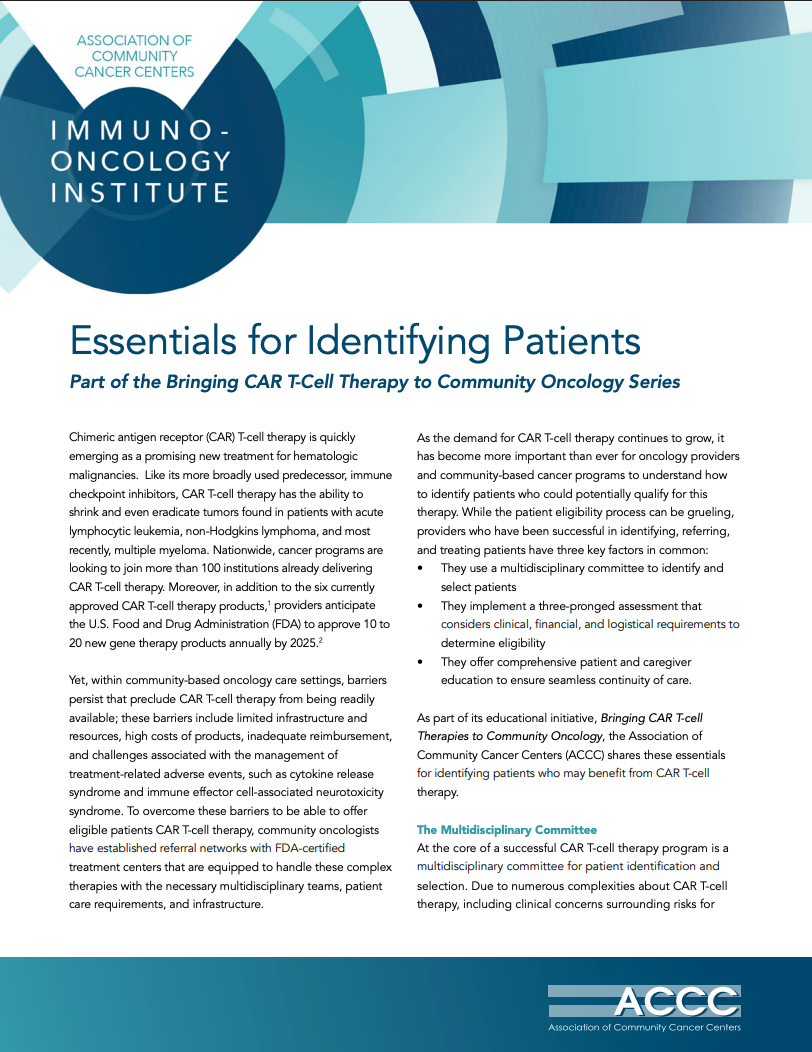
Essentials for Identifying Patients

As CAR T-cell therapy continues to show promise as an effective treatment for patients with acute lymphocytic leukemia, non-Hodgkins lymphoma, and multiple myeloma, it has become increasingly important for oncology providers and community-based cancer programs to be proactive in identifying patients who could benefit from this form of therapy. ACCC outlines essential steps for the identification, selection, and assessment of patients who may qualify for this life-saving treatment.
Read More
Essentials for Identifying Patients

From Oncology Issues

Issues: CAR T-Cell Therapy: A Significant Advance for Patients with Hematologic Malignancies

Issues: CAR T-Cell Therapy: A Significant Advance for Patients with Hematologic Malignancies

Nicole Tapay

CAR T-cell therapies have ushered in a new era of treatment options for patients with certain hematologic malignancies. Thus, it is important to make these therapies accessible and affordable.

Changing the Tune for CAR T-Cell Therapy

Changing the Tune for CAR T-Cell Therapy

Brittney M. Baer, BSN, RN, and Nancy C. Long, MSN, AGACNP-BC

Learn how Vanderbilt-Ingram Cancer Center in Nashville, Tenn. has been using monitoring devices for patients undergoing chimeric antigen receptor (CAR) T-cell therapy. Thanks to this technology, these high-risk patients can be remotely monitored 24/7.