In recognition of March as social work month, ACCCBuzz discusses the value of social workers as a member of the multidisciplinary cancer care team with Sarah Conning, MSW, LCSW, OSW-C, APHSW-C.

The origin of social work in the United States can be traced back to the late 19th century. The profession was established to ensure individuals, who belong to underrepresented groups, obtain the requisite tools to escape economic and social hardship. The 1970s saw the evolution of the oncology social worker, as physicians desired a member of the multidisciplinary cancer care team who understood and could assist with the psychosocial needs of patients with cancer.
Over the years, the Association of Cancer Care Centers (ACCC) has continually recognized the value oncology social workers bring to the cancer care team. Krista Nelson, MSW, LCSW, OSW-C, FAOSW, senior oncology social worker and program manager, Cancer Support Services & Compassion at Providence Health & Services, served as the 2021-2022 ACCC president—only the second social worker to hold the position. Her ACCC President’s Theme focused on driving oncology forward using lessons learned from the COVID-19 pandemic, and she believes social workers will be key in achieving this goal.
Preceding the ACCC 49th Annual Meeting & Cancer Business Summit (#AMCCBS), the association held the Call to Action: Delivery of Psychosocial Care in Oncology Summit—an invite-only event dedicated to addressing the mental health needs in oncology, whether they are the needs of patients, caregivers, or the cancer care team. Sarah Conning, MSW, LCSW, OSW-C, APHSW-C, oncology and palliative care social worker at UC Davis Medical Center, was in attendance. In recognition of March as social work month, ACCCBuzz spoke with Conning to discuss the importance of oncology social workers in delivering comprehensive and equitable cancer care to patients everywhere.

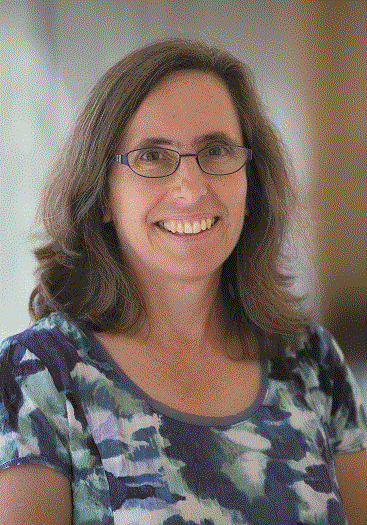
ACCCBuzz: Could you describe the role and responsibilities of an oncology social worker?
Conning: Social workers can fill different roles in a cancer program [or practice]. The prototypical oncology social worker is an integral member of the cancer care team—working side by side with physicians and nurses to provide direct care to patients. The social worker’s role within that team is addressing the mental health, social determinants of health, and practical needs that are common for patients during [anti-]cancer treatment. Oncology social workers also address barriers to care patients with cancer face, as well as the ways a cancer diagnosis can impact quality of life. Lastly, social workers make great contributions as managers, quality improvement specialists, and researchers.
ACCCBuzz: How important is psychosocial care to patients with cancer?
Conning: Psychosocial care is an integral component of comprehensive cancer care. When there are social determinants that affect a person’s ability to access healthcare, that has an impact on their health. [Additionally], psychosocial care allows the cancer care to take place and facilitates person-centered care. One of my physician colleagues said, “Social work is how we operationalize person-centered care,” and that rings so true to me.
ACCCBuzz: What kind of barriers do social workers face in caring for patients with cancer?
Conning: A lot of the barriers social workers face are related to the policies of healthcare systems. For example, one of the common issues we [social workers] deal with are transportation concerns—patients don’t have a way to get to their treatment [appointments]. Often, the social worker is asked to address those transportation concerns, but we have no resources to work with.
ACCCBuzz: What type of solutions can solve these issues you mention above?
Conning: Integrating Social Care into the Delivery of Health Care Moving Upstream to Improve the Nation's Healthwas a report published in 2019, and it provides a framework for how we can address these issues. The framework starts with awareness and ends with advocacy—giving us a way to orient our efforts for the most impact. This includes providing direct assistance, adjusting our services to make them more accessible to people, and the alignment of our social services and healthcare systems. This ultimately allows us to facilitate effective collaboration.
ACCCBuzz: Cancer programs and practices across the country have shared with ACCC how their oncology social workers are now providing much-neededpsychosocial supportto their colleagues because of the pandemic. Is this something you are experiencing? How are oncology social workers meeting this new demand for their services?
Conning: Most of us, oncology social workers, have experienced this over the years, even before COVID-19. We are attuned to the mental health concerns of our colleagues and are often a safe person on the team for other staff to turn to. I think social workers have done interesting and creative things to provide psychosocial support to our colleagues. This includes leading team debriefings, providing education for staff about grief, as well as supporting colleagues as they access help through employee assistance programs.
ACCCBuzz: Can you share some insights on any current efforts to transition more social workers into leadership roles? How can cancer programs and practices empower their oncology social workers to succeed in these roles?
Conning: There are many creative, smart, and hardworking social workers that have forged a path into leadership, and those people are an inspiration. Unfortunately, a lot of the time, they achieved this feat by swimming upstream and creating their own ladder. A lot of people experience a professional ceiling instead—they don’t find their way into these leadership roles.
I think cancer programs [and practices] can promote the skills that social workers bring to the healthcare system by investing in professional development and specialty certifications. We often see support…for nurses to achieve specialty certifications, get special training, and raise their skills. But unfortunately, because social work is a smaller…population within the oncology workforce, too often, there has not been the same kind of opportunity for social workers.
Cancer programs [and practices] should also be open to the idea of social workers in leadership. The more social workers we see in leadership, the more our unique perspective and skills will contribute to quality improvement in cancer care. Lastly, I think raising awareness about what is involved in a social work education would help oncology administrators understand why social workers are key professionals to include at a leadership level. The basic framework of a social work education is the study of human development in the social environment and is clearly applicable across the cancer care continuum.
ACCCBuzz: You recently attended the Call to Action: Delivery of Psychosocial Care in Oncology Summit at #AMCCBS. What were some of your key takeaways from this event?
Conning: During the mental health summit, we circled around the idea of promoting and disseminating the collaborative care model for mental health services in oncology. This is a model for behavioral health that has been implemented over recent years in a lot of primary settings and, according to research, it is also applicable in an oncology setting. We agreed at the summit that this model can improve the delivery of mental health services and will help us do more with a limited workforce.
Promoting a culture of care was also a key takeaway from the summit. This has to do with the building standards around the adequate support and wellness of the well-being of our workforce.
ACCCBuzz: What are you most proud of in your professional life?
Conning: I feel most fulfilled when I gain some insight or understanding from a patient or a family about what they are experiencing or how their illness is impacting them, and I can bring that to their oncology care team in a way that will inform and improve the care they receive.
Stay tuned for more from the ACCC Call to Action: Delivery of Psychosocial Care in Oncology Summit, which is supported by BeiGene.