ACCC association of cancer care centers
Join/Renew
Login
Join/Renew
Login
Education & Resources
ACCC eXchange LogInCorporate Member Sponsored ResourcesPresentations & AbstractsPresident's ThemeACCC Connect eLearning LogIn
Publications
Oncology IssuesPatient Assistance & Reimbursement GuideTrending Now in Cancer Care
Events
2026 ACCC Leadership SummitAnnual Meeting & Cancer Center Business SummitCapitol Hill DayNational Oncology ConferenceOncology Reimbursement MeetingsOncology State Society Meetings
Policy & Advocacy
2024 Policy Wrap-Up and ACCC 2025 Policy PrioritiesLetters & StatementsAccess, Payment & Reimbursement ReformWhite Bagging & Brown BaggingAdvocacy ResourcesCancer Moonshot
Membership
Join | RenewWho We AreMembership Types & BenefitsCorporate MembersACCC Member Portal FAQMember Directory
Partners
Oncology State SocietiesPartner OrganizationsCME
News
News ReleasesAdvocacy News ReleasesOncology News
About ACCC
Timeline / 50th Anniversary2025 Impact ReportACCC Innovator AwardsACCC FellowsACCC Senior Staff
Breast CancerMetastatic Breast Cancer
Gastrointestinal CancerBiliary Tract CancerColorectal CancerGastric CancerLiver Cancer
Genitourinary CancerBladder CancerProstate CancerRenal Cell Carcinoma
Gynecologic CancerOvarian Cancer
Head & Neck Cancer
Hematologic MalignanciesAcute Lymphocytic Leukemia (ALL)Acute Myeloid Leukemia (AML)Chronic Lymphocytic Leukemia (CLL)Mantle Cell Lymphoma (MCL)Multiple Myeloma (MM)Myelodysplastic Syndromes (MDS)
Lung CancerNon-Small Cell Lung Cancer (NSCLC)Small Cell Lung Cancer (SCLC)
Sarcoma
Skin CancerMelanomaNon-Melanoma Skin Cancers (NMSC)
Clinical Practice & TreatmentCancer DiagnosticsCare CoordinationEHR Integration for Biomarker TestingQuality Improvement Collaboration: Integration of Precision Medicine in Community OncologyTreatment
Financial NavigationFAN Boot CampFinancial Advocacy Network (FAN) Resource LibraryPatient Assistance & Reimbursement GuidePrior Authorization
Health Equity & Access3, 2, 1, Go! Practical Solutions for Addressing Cancer Care DisparitiesAppalachian Community Cancer AllianceOncology Advanced PractitionersPersonalizing Care for Patients of All BackgroundsSocial Drivers of Health
Patient-Centered CareAddressing Care Disparities for VeteransAdolescent and Young Adult (AYA)Care Action Plans for People with CancerDermatologic ToxicitiesEmpowering CaregiversGeriatric OncologyHealth LiteracyNutritionOncology PharmacyPatient NavigationPsychosocial Care in OncologyShared Decision-MakingSupportive CareSurvivorship Care
Practice Management & OperationsCancer Program FundamentalsLeadership Sustainment and Engagement VideosOncology Practice Transformation and Integration CenterOncology Team Resiliency
ResearchACCC Community Oncology Research Institute (ACORI)
Technology & InnovationTelehealth & Digital Medicine
ACCCBuzz Blog
CANCER BUZZ Podcast
Oncology Issues
Join/Renew
Login
Breast CancerMetastatic Breast Cancer
Gastrointestinal CancerBiliary Tract CancerColorectal CancerGastric CancerLiver Cancer
Genitourinary CancerBladder CancerProstate CancerRenal Cell Carcinoma
Gynecologic CancerOvarian Cancer
Head & Neck Cancer
Hematologic MalignanciesAcute Lymphocytic Leukemia (ALL)Acute Myeloid Leukemia (AML)Chronic Lymphocytic Leukemia (CLL)Mantle Cell Lymphoma (MCL)Multiple Myeloma (MM)Myelodysplastic Syndromes (MDS)
Lung CancerNon-Small Cell Lung Cancer (NSCLC)Small Cell Lung Cancer (SCLC)
Sarcoma
Skin CancerMelanomaNon-Melanoma Skin Cancers (NMSC)
Clinical Practice & TreatmentCancer DiagnosticsCare CoordinationEHR Integration for Biomarker TestingQuality Improvement Collaboration: Integration of Precision Medicine in Community OncologyTreatment
Financial NavigationFAN Boot CampFinancial Advocacy Network (FAN) Resource LibraryPatient Assistance & Reimbursement GuidePrior Authorization
Health Equity & Access3, 2, 1, Go! Practical Solutions for Addressing Cancer Care DisparitiesAppalachian Community Cancer AllianceOncology Advanced PractitionersPersonalizing Care for Patients of All BackgroundsSocial Drivers of Health
Patient-Centered CareAddressing Care Disparities for VeteransAdolescent and Young Adult (AYA)Care Action Plans for People with CancerDermatologic ToxicitiesEmpowering CaregiversGeriatric OncologyHealth LiteracyNutritionOncology PharmacyPatient NavigationPsychosocial Care in OncologyShared Decision-MakingSupportive CareSurvivorship Care
Practice Management & OperationsCancer Program FundamentalsLeadership Sustainment and Engagement VideosOncology Practice Transformation and Integration CenterOncology Team Resiliency
ResearchACCC Community Oncology Research Institute (ACORI)
Technology & InnovationTelehealth & Digital Medicine
ACCCBuzz Blog
CANCER BUZZ Podcast
Oncology Issues
    • Education & Resources
    • Publications
    • Events
    • Policy & Advocacy
    • Membership
    • Partners
    • News
    • About ACCC
ACCC association of cancer care centers
1801 Research Boulevard, Suite 400, Rockville, MD 20850
Tel: 301.984.9496 Fax: 301.770.1949 Email Us
Contact UsVolunteers
Advertise
Career Center
Terms and Conditions
Privacy Policy
ACCC Rebranding
Copyright © 2026 Association of Cancer Care Centers. All Rights Reserved.
Advertisement

Blog

Article

January 28, 2020

ACCC’s Landmark Cancer Community Survey Turns 10

ACCC’s Landmark Cancer Community Survey Turns 10

Now in its 10th year, ACCC’s Trending Now in Cancer Care survey continues to bring into focus the proactive and reactive responses of cancer programs to shifts in the business of cancer care delivery. As they have throughout the past decade, in 2019, survey respondents nationwide told ACCC how they are handling the intersecting levers of change that continue to buffet oncology care. As developments in science, business, industry, policy, and patient and provider concerns continue to evolve, ACCC’s Trending Now survey helps clarify the most relevant challenges and opportunities facing the cancer care community.

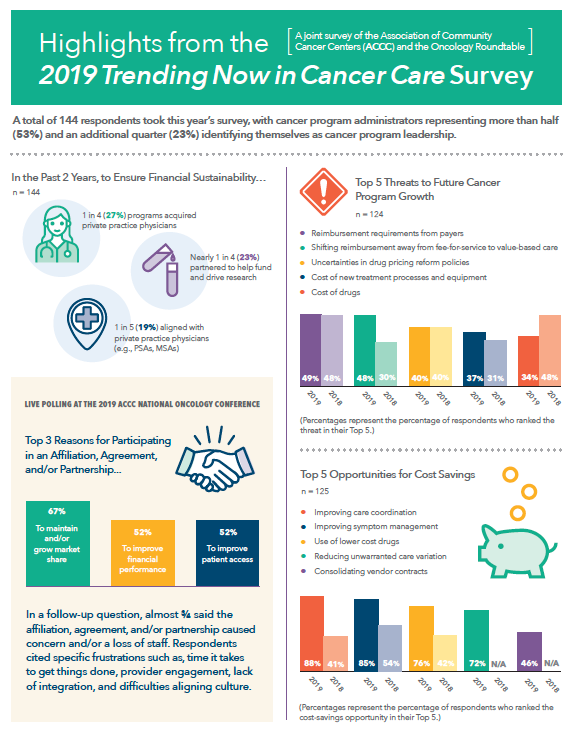
Conducted by ACCC in partnership with the Advisory Board’s Oncology Roundtable, the 2019 survey was distributed via email in fall 2019 and received 144 responses from individuals at 126 organizations. Despite a volatile reimbursement climate and the challenges that accompany value-based care models, cancer programs continue to find innovative ways to meet a rising demand for patient-centered care.

Cancer practices say the top three services or programs they plan to add or grow this year are survivorship visits or clinics, palliative care consults, and navigation. Additional plans to grow services in genetic counseling, oral chemotherapy adherence and support, and financial advocacy indicate an ongoing demand for comprehensive cancer care.

Top Challenges: Payer Reimbursement, Value-Based Care

When asked to identify the top threats to future cancer program growth, nearly half of respondents (49 percent) cited payer reimbursement requirements (slightly up from 48 percent in 2018). The shift of reimbursement from fee-for-service to value-based care ranked second (48 percent; up from 30 percent in 2018). Also of concern are uncertainties in drug pricing reform policies (40 percent) and the cost of new treatment processes and equipment (37 percent). Notably, the cost of drugs as a top concern was down from 48 percent in 2018 to 34 percent in 2019.

Top Cost-Saving Opportunities: Care Coordination, Symptom Management

For many cancer programs, expanding supportive care service lines is often paid for by cost-savings or cost-containment efforts. Asked to identify the top opportunities for cost savings, a significant majority of respondents (88 percent) named improving care coordination, up significantly from 41 percent in 2018. Eighty-five percent of respondents named improving symptom management as a cost-savings opportunity, compared to 54 percent in 2018. Seventy-six percent of respondents said using lower-cost drugs was a cost-savings prospect for them, up from 42 percent in 2018.

Survey highlights

  • Workplace concerns: With burnout prevalent among healthcare workers, survey respondents cited a number of workplace concerns:
    • Workflow inefficiencies (75 percent)
    • Heavy workloads (58 percent)
    • Staff complaints about workload and burnout (58 percent)
    • Lack of work/life balance (40 percent)
    • Decreasing focus on patient care (24 percent)
  • Telehealth: Survey results revealed limited adoption of telehealth in cancer care delivery. Asked to name the top four services they currently provide via telehealth, respondents cited tumor boards (45 percent), genetic counseling (32 percent), molecular tumor boards (24 percent), and second opinions (16 percent). A number of respondents say they plan to leverage telehealth for multiple services during the next two years, including:
    • Genetic counseling (35 percent)
    • Symptom management consults (28 percent)
    • Oral chemotherapy adherence and support (28 percent)
    • Symptom monitoring (28 percent)
    • Psychosocial counseling (24 percent)
    • Nutrition counseling (22 percent)
    • Financial navigation (21 percent)
    • Survivorship visits (21 percent)
    • Tumor boards (21 percent)
  • Staffing needs: Retaining adequate staff to ensure access to quality care for all patients is an ongoing challenge. The positions cancer programs report being most concerned about filling are medical oncologists (59 percent), oncology nurses (53 percent), financial advocacy staff (49 percent), navigators (44 percent), and palliative care specialists (43 percent).
  • Clinical trials: Survey results reveal a number of ongoing challenges to offering patients access to clinical trials. More than half (53 percent) cite inadequate staff resources and training, 50 percent cite inadequate program infrastructure, and 46 percent cite lack of patient understanding of the clinical trial process.

During the past decade, ACCC’s Trending Now in Cancer Care survey has provided an annual comprehensive picture of the evolution of cancer services and care delivery at programs and practices nationwide. While some concerns have resolved with time, others remain as intractable as ever. As oncology care enters the third decade of the new millennium, the Trending Now survey will continue to take the pulse of the provider community. ACCC President Ali McBride, PharmD, MS, BCOP, calls the annual survey, “a real-world reference point that cancer programs large and small can utilize as they navigate the multisector changes in healthcare.”